Horror Film Review: The Possession of Joel Delaney (dir by Waris Hussein)


joeldelaneyposter

The Possession of Joel Delaney is a film that I watched a few years ago and it totally freaked me out.  It’s a film about possession that has never gotten as much attention as The Exorcist but seriously, this is one frightening movie.

This 1972 film takes place in New York City.  Norah Benson (Shirley MacClaine) is a rich and spoiled socialite, a snob who might brag about how nice she is to her maid but who would never dream of being caught dead visiting the neighborhood where she lives.  On the other hand, her younger brother — Joel Delaney (Perry King) — is a self-styled bohemian.  He’s just as rich as his sister and, in many ways, he’s just as much of a snob.  However, he disguises that fact by living in the “bad” part of town and hanging out with (and both idealizing and condescending to) the poor.  (When people talk about the “bad” part of the town in this film, they’re euphemistically referring to any part of the city where the majority of the residents are not white.)  If The Possession of Joel Delaney were made today, Norah would be Sasha Stone and Joel would be Devin Faraci.

Norah is extremely protective of Joel.  In fact, the film suggests that there might be something more to their relationship than just a sibling bond.  Norah worries about Joel living in a bad neighborhood.  She worries about his friends.  She reacts jealously when she meets his girlfriend, Sherry (Barbara Trentham).

So, you can imagine that Norah is rather upset when Joel is suddenly arrested for trying to kill his landlord.  Judged to be insane, Joel is sent to Bellevue.  Joel claims that he has no memory of attacking anyone.  In order to get out of the mental hospital, Joel lies and says that he was on drugs.

Moving in with Norah and her two kids, Joel starts to act strangely.  He starts to quiz Norah about her sex life.  He plays too rough with the children.  He tries to set Sherry’s hair on fire.  And he starts to speak in Spanish!

Could it be that Joel has been possessed by the spirit of his friend, Tonio?  Tonio, it turns out, was the landlord’s son.  It also appears that Tonio was the main suspect in a series of decapitation murders.  Could Tonio have moved his spirit into Joel’s body?  That’s what Norah’s Puerto Rican maid, Veronica (Miriam Colon), thinks!  Veronica quits her job, rather than have to deal with possessed Joel.

Norah decides to go to Veronica’s home and ask what’s happening with Joel.  What follows is a mix of horror and social satire.  Despite being a total stranger in Veronica’s neighborhood, Norah seems to be shocked when Veronica doesn’t exactly act overjoyed to see Norah standing in front of her small apartment.  As Norah demands to know what’s happening with her brother and Veronica explains that Joel may be possessed, you can’t help but get the feeling that Norah is more upset by the fact that Joel has been possessed by someone poor than by anything else.  In these scenes, Norah becomes the ultimate symbol of wealthy white privilege.

Meanwhile, Joel is going more and more crazy.  It all leads to one of the most horrifying sequences that I’ve ever seen, in which a possessed Joel torments Norah’s two children.  It’s an amazingly disturbing scene, one that is all the more upsetting because, in the title role, Perry King had previously done such a good job portraying Joel as being irresponsible but likable.  I don’t want to give too much away, beyond saying that the scene gave me nightmares and if you’re triggered by scenes of child abuse, you should not watch The Possession of Joel Delaney.

As I said, The Possession of Joel Delaney has never really gotten the credit that it deserves.  It’s always overshadowed by The Exorcist.  But if you want to see a truly scary film and if you like a little social satire mixed in with your horror, The Possession of Joel Delaney is one to track down.
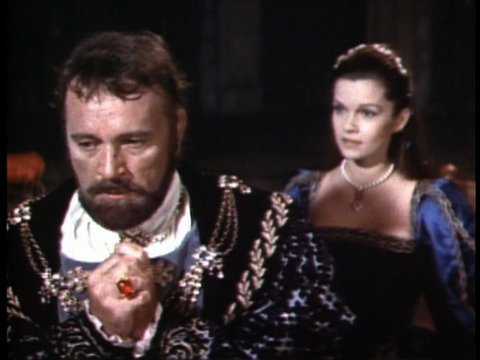
Cleaning Out The DVR, Again #8: Anne of the Thousand Days (dir by Charles Jarrott)


Anne

After I finished writing my review of Rolling Thunder, I continued the process of cleaning out my DVR by watching the 1969 film, Anne of the Thousand Days.  How does a film like Anne of the Thousand Days compare to a film like Rolling Thunder?

They might as well have been conceived, written, directed, and released on different planets.

I recorded Anne of The Thousand Days off of TCM on March 26th.  The main reason that I set the DVR to record it was because Anne was a best picture nominee.  It may seem strange to think that this rather conventional film was nominated the same year as Butch Cassidy and the Sundance Kid, Z, and Midnight Cowboy.  It gets even stranger when you consider what wasn’t nominated that year: Medium Cool, If…, Last Summer, They Shoot Horses, Don’t They?, Alice’s Restaurant, The Wild Bunch, Once Upon A Time In The West, and a long list of other films.  In fact, if I wanted to, I could probably spend this entire review listing all of the 1969 films that feel like a more appropriate best picture nominee than Anne of the Thousand Days.

And yet, Anne was nominated for best picture.  In fact, it received a total of 10 Oscar nominations, the most of any film that year.  Tellingly most of the nominations were in the technical categories and the only Oscar that it won was for its costumes.  Genevieve Bujold received a nomination for playing the title character and Richard Burton became the third actor to receive a nomination for playing King Henry VIII.

As for the film, Anne of the Thousand Days tells the oft-told story of King Henry VIII and his marriage to Anne Boleyn.  Told in flashback as both Henry and Anne wait for her to be executed on charges of adultery, the film shows us how middle-aged Henry VIII first met and fell in love with 18 year-old Anne Boleyn.  Standing in the way of Henry’s pursuit of Anne was the fact that 1) Anne intensely disliked him, 2) Anne was already engaged, 3) Anne’s sister was already Henry’s mistress, and 4) Henry was already married to Catherine of Aragon (Irene Papas).

Fortunately, Henry happens to be king and being king comes with its perks.

For instance, as king, he can order Anne and her fiancée to break up.  As king, he can casually dismiss his former mistress.  And, as king, Henry has the power that Anne finds to be the ultimate aphrodisiac.  At first, Anne merely loves the fact that Henry is obsessed with her.  But slowly, she comes to love Henry as a man as well…

The only problem is that Henry is still married and Catherine is still popular with the people.  Even after Henry divorces her and marries Anne, the common people refuse to accept Anne as their queen.  When Sir Thomas More (William Squire) refuses to recognize Anne as queen, Anne demands that More be executed.  When Henry initially shows reluctance, Anne announces that she will not sleep with him until More is dead.

Needless to say, Thomas More is quickly executed.

However, Henry’s attention has already moved on to Jane Seymour (Lesley Paterson) and, desperate to get Anne out of his life, he arranges for Cardinal Cromwell (John Colicos) to frame Anne on charges of adultery and incest.  With Anne facing a humiliating trial and the possibility of execution, Henry makes her an offer.  If she agrees to an annulment, he’ll free her.  However, their daughter — Elizabeth — will lose her claim to the throne…

It’s telling that Charles Jarrott did not receive an Oscar nomination for his work as Anne of the Thousand Day‘s director.  There are a lot of technically good things about Anne of the Thousand Days but, despite all of the melodrama and sex and historical detail to be found in Anne, it never comes to life as a movie.  The costumes are to die for, the sets are impressive, and the cast is full of talented British character actors but the whole movie just feels oddly flat.  Try as it may, it can never convince us that either Henry VIII or Anne Boleyn is worth all the trouble.

Anne of the Thousand Days was obviously a big production, which probably explains all the Oscar nominations.  But otherwise, it’s one of the more forgettable best picture nominees.

Lisa Watches An Oscar Nominee: Barry Lyndon (dir by Stanley Kubrick)


Barry_Lyndon_A

“It was in the reign of George III that the aforesaid personages lived and quarreled; good or bad, handsome or ugly, rich or poor, they are all equal now.”

— Barry Lyndon (1975)

As I may have mentioned yesterday on this site, Texas has finally caught up with the rest of this frozen country.  Starting on Sunday night, it has finally been cold and wintry down in my part of the world!  For two days straight, schools have been closed and the streets have been covered in ice.  And, even though the temperature got slightly above freezing today, I have been told that I can expect to wake up tomorrow morning to a snowy wonderland.

And I hope that’s the case because I would love to stay home on Wednesday!  Ever since the 31 Days of Oscar began, I have recorded so many movies off of TCM that I am running dangerously close to running out of space on the DVR.  The best thing about being snowed (or iced) in is that it gives me an opportunity to watch some of those films.

For instance, I spent this afternoon watching the 1975 best picture nominee Barry Lyndon.  And when I say that I spent an afternoon, I mean that literally.  Clocking in at a little over 3 hours, Barry Lyndon is a film that’s so long that it even provides an intermission so the you can stand up and stretch your legs.

Seriously, I was really thankful for that intermission.

Which not to say that Barry Lyndon is a bad film.  Far from it!  It’s actually one of the best films to be included in this year’s 31 Days of Oscars.  While I may have no first hand knowledge of what it was like to live in the 1700s, I can now say that I definitely have a clue on account of the fact that I’ve seen Barry Lyndon.

Directed by the great Stanley Kubrick and based on a novel by William Makepeace Thackery, Barry Lyndon tells the story of a penniless Irishman Redmond Barry (Ryan O’Neal) who, following a duel with a wealthy British captain, is forced to flee from his home.  After being robbed by a highwayman, Barry joins the British army but, upon being sent to fight in Germany, discovers that he has no love for combat.  As such, Barry deserts but is then captured by and forced to enlist in the Prussian Army.  Once the war ends, Barry is order to spy on a professional gambler who the Prussians suspect might, himself, be a spy.  Barry and the gambler soon become partners and travel around Europe together.  However, Barry has decided that he now wants to marry into wealth and he gets that chance when he meets the Countess of Lyndon (Marisa Berensen), whose husband is dying.

And that’s when the intermission kicks in.

http://www.youtube.com/watch?v=titZx8VA4DY

When we come back, Redmond Barry is now known as Barry Lyndon and appears to have everything that he’s ever wanted.  However, while Barry may have been naturally lucky when he was poor, the opposite is true once he’s rich.  Despite his new station in life, Barry is never truly accepted by his wife’s circle of friends.  Furthermore, his son, Bryan (David Morley) is injured while out riding a horse and Lady Lyndon has a nervous breakdown as a result.  Meanwhile, Barry’s stepson, Lord Bullington (Leon Vitali), hates him and spends most of his time plotting ways to get rid of his stepfather.

And, naturally enough, it all leads to one final duel in a barn, in which two men point guns while surrounded by the deafening sounds of hundreds of pigeons cooing.

I’m at something of a disadvantage when it comes to reviewing Barry Lyndon because I watched it on television and Barry Lyndon is one of those films that demands to be seen on a big screen.  For all of the dramatic moments and satirical asides (this film has a wonderfully snarky narrator), Barry Lyndon is ultimately most concerned with recreating the past as authentically as possible.  Watching this film, you really do feel as if you’ve traveled back to the 18th Century, where all of the rooms are lit by candle light and one’s station in life can be determined by the ornateness of his or her costume.

As I watched Barry Lyndon, I had to wonder — whatever happened to Ryan O’Neal?  I recently saw O’Neal in a film called The List and it was hard to believe that the terrible actor from that film was the same guy who starred in Barry Lyndon.  Kubrick may not have a reputation for being an actor’s director but Ryan O’Neal gives a great performance in Barry Lyndon.  (Compare O’Neal’s performance in the earlier Love Story to his performance here and you’ll see how good a job Kubrick did when it came to directing O’Neal.)  When we first meet Barry, he is an almost passive aggressive character, a cunning guy who has the patience necessary to wait for his opportunity to advance.  It’s only during the second half of the film that Barry becomes a truly sympathetic character, redeemed by both his love for his son and the fact that all of his enemies are even worse than him.  The strength of Ryan O’Neal’s performance can be found in the fact that Barry can be both amoral and sympathetic at the same time.

So, I’m glad that the streets were icy on Tuesday.  I’m thankful because it gave me a chance to watch Barry Lyndon.

And yes, I’m also very thankful for that intermission.