Cleaning Out The DVR: Anthony Adverse (dir by Mervyn LeRoy)


AnthonyAdverse

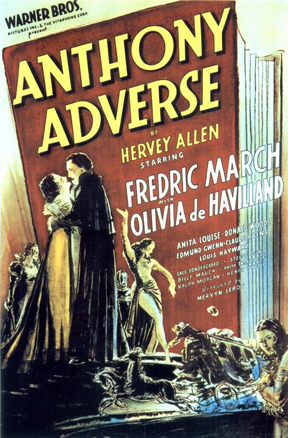
Late last night, I continued to clean out my DVR by watching the 1936 film, Anthony Adverse.

I recorded Anthony Adverse off of TCM, where it was being shown as a part of that channel’s 31 Days of Oscars.  Anthony Adverse was aired because it was nominated for Best Picture of 1936.  That’s significant because, if not for that nomination, I doubt that anyone would ever have a reason to watch Anthony Adverse.  It’s certainly one of the more obscure best picture nominees.  Despite a prestigious cast and being directed by the respectable Mervyn LeRoy, Anthony Adverse only has a handful of reviews over at the imdb.  And most of those reviews were written by Oscar fanatics like me.

Anthony Adverse is an epic historical film, one that tells the story of Anthony Adverse (Frederic March).  Anthony is the illegitimate son of Denis Moore (Louis Hayward) and Maria (Anita Louise), the wife of evil Spanish nobleman, Don Luis (Claude Rains, convincing as a nobleman but not as someone from Spain).  Luis murdered Denis and Maria died giving birth so Luis abandons the baby at an Italian convent.  Anthony is raised by nuns and priests and then, 10 years later, is apprenticed to an English merchant named John Bonnyfeather (Edmund Gwenn).  Bonnyfeather just happens to be Anthony’s grandfather!  Though Luis told him that Anthony died as soon as he was born, Bonnyfeather quickly figures out that Anthony is his grandson.  However, Bonnyfeather doesn’t share that information with Anthony and instead, he gives Anthony the surname “Adverse.”

Bonnyfeather raises Anthony as his own son.  Anthony grows up to be Frederic March and ends up falling in love with and marrying the beautiful Angela (Olivia De Havilland).  However, Anthony is suddenly called away on business to Havana, Cuba.  He doesn’t even have a chance to tell Angela that he’s leaving.  He does leave her a note but it blows away.  Assuming that she’s been abandoned, Angela goes to France, becomes an opera singer, and is soon the mistress of Napoleon.

Meanwhile, in Cuba, Anthony becomes convinced that Angela has intentionally abandoned him.  Consumed by grief, he ends up running a slave trading post in Africa.  He takes one of the slaves, Neleta (Steffi Duna), as his mistress and becomes known for his cruelty.  However, he eventually meets Brother Francois (Pedro de Cordoba) and starts to reconsider his ways.

(The film’s treatment of the slave trade is …. well, it’s awkward to watch.  The film is undoubtedly critical of slavery but, at the same time, it’s hard not to notice that the only slave with a prominent part in the film is played by a Hungarian actress.  Anthony may eventually reject cruelty but it’s left ambiguous as to whether or not he rejects the slave trade as a business.  If Anthony Adverse were made today, one imagines that this section of the film would be handled much differently.)

Meanwhile, back in Europe, Bonnyfeather is dying and his housekeeper, Faith (Gale Sondergaard, who won the first ever Oscar awarded for Best Supporting Actress for her performance here), plots to claim his fortune.

After I watched the movie but before I started this review, I did some research and I discovered that Anthony Adverse was based on a 1,222-page best seller that came out in 1933.  I’m going to guess that the film’s long and ponderous story may have worked better on the page than it does on the screen.  As a film, Anthony Adverse clocks in at 141 minute and it feels even longer.  Despite the impressive cast, the film just never clicks.  It’s never that interesting.

At the same time, I can understand why it was nominated for best picture.  It’s a big movie, full of characters and extravagant sets and ornate costumes.  You can tell it was an expensive movie to make and there’s enough philosophical dialogue that you can pretend there’s something going on underneath the surface.  In the 1936, Anthony Adverse may have been quite impressive but seen today, it’s forgettable.

Anthony Adverse lost best picture to another overproduced extravaganza, The Great Ziegfield.  Personally, I would have given the award to the unnominated My Man Godfrey.
Lisa Reviews An Oscar Nominee: Blossoms In The Dust (dir by Mervyn LeRoy)


Blossoms_dust_movieposterDid you know that up until the year 1936, if a child was born to unwed parents, it was common practice to actually put the word “illegitimate” on that child’s birth certificate?  As you all know, I am perhaps the biggest history nerd in the world and, while I knew that there was once a huge stigma associated with being born outside of marriage, I did not know just how institutionalized that stigma was.

I’m also proud to say that my home state of Texas — the state that all the yankees love to bitch about — was the first state to ban the use of the word “illegitimate” on birth certificates.  This was largely due to the efforts of Edna Gladney, an early advocate for the rights of children.  Along with starting a home for orphans and abandoned children in Ft. Worth, Edna also started one of the country’s first day care centers for the children of working mothers.

That’s right — there was a time when day care was itself a revolutionary concept.

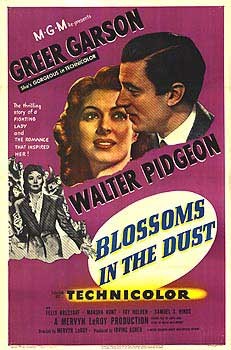
I have TCM to thank for my knowledge of Edna Gladney, largely because TCM broadcast a 1941 biopic called Blossoms in The Dust.  According to Wikipedia, the film was a highly fictionalized look at Edna’s life but, to be honest, I would have guessed that just from watching the movie.  While Blossoms In The Dust gets the important things right (and it deserves a lot of credit for sympathetically dealing with the cultural stigma of being born to unwed parents at a time when it was an even more controversial subject that it is today), it’s also full of scenes that are pure Hollywood.

In real life, Edna knew firsthand about the challenges faced by children of unwed parents because she was one herself.  Apparently, at the time, that was going too far for even a relatively progressive film like Blossoms In The Dust so, in Blossoms, Edna (played by Greer Garson) is given an adopted sister named Charlotte (Marsha Hunt).  When the parents of Charlotte’s fiancée discover that she was born outside of marriage, they refuse to allow Charlotte to marry their son.  In response, Charlotte commits suicide.

In real life, Edna was born in Wisconsin but, following the death of her stepfather, moved to Ft. Worth to stay with relatives.  Edna was 18 at the time and eventually met and married a local businessman named Sam Gladney.  In Blossoms in The Dust, Edna is already an adult when she first meets Sam (played by Walter Pidgeon, who played Greer Garson’s husband in a number of films) and they meet in Wisconsin.  It’s only after Charlotte dies that Edna marries Sam and it’s only after they’re married that Edna moves to Texas.  Whereas the real life Edna had relatives in Texas, the film’s Edna is literally a stranger in a strange land.

That said, the film is actually rather kind to my home state.  The film spend a lot of time contrasting the judgmental snobs up north with the more straight-forward people who Edna meets after she moves to Ft. Worth and it’s occasionally fun to watch.  (Of course, I would probably feel differently if I was from Wisconsin.)

Blossoms In The Dust was nominated for best picture but it lost to How Green Was My Valley.  Greer Garson was nominated for best actress but she lost to Joan Fontaine in Suspicion.  However, just one year later, Garson would win an Oscar for her performance in the 1942 best picture winner, Mrs. Miniver.  Incidentally, her husband in that film was played by none other than Walter Pidgeon.

Ultimately, Blossoms in the Dust is typical of the type of movies that you tend to come across while watching films that were nominated for best picture.  Some best picture nominees were great.  Some were terrible.  But the majority of them were like Blossoms in the Dust, well-made, respectable, and just a little bit bland.  Blossoms in the Dust is not bad but it’s also not particularly memorable.  If, like me,  you’re a student of history and social mores, Blossoms in the Dust has some historical interest but, when taken as a piece of cinema, it’s easy to understand why it’s one of the more forgotten best picture nominees.

Lisa Reviews An Oscar Nominee: Five Star Final (dir by Mervyn LeRoy)


Five_Star_Final_1931_poster

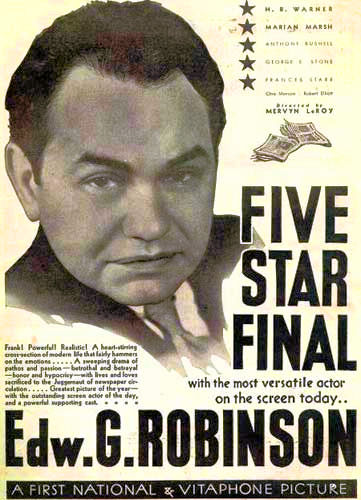
In 1911, a pregnant secretary named Nancy Voorhees (Frances Starr) shot and killed her boss and lover.  It was quite a scandal at the time but, twenty years later, it has largely been forgotten.  Nancy has married a successful businessman named Michael Townsend (H.B. Warner) and is a respected member of society.  Her daughter, Jenny (Marian Marsh), has no idea about Nancy’s past and believes Michael to be her father.  Jenny is now engaged to marry the handsome and rich Phillip Weeks (Anthony Bushnell).

Everything seems to be perfect but you know what they say about perfection.

Bernard Hincliffe (Oscar Apfel) is the publisher of a struggling tabloid newspaper.  He is frustrated by city editor Joseph Randall (Edward G. Robinson) and Randall’s refusal to do whatever it takes to boost circulation.  “Why, he won’t even print pictures of women in their underwear!” one of Hincliffe’s assistants exclaims.  Finally, Hincliffe orders Randall to publish a series of articles that will take a retrospective look at both the scandal and what has happened to those involved in the years since.  At first, the cynical Randall refuses but eventually, he gives in.

He assigns two reporters to crack the story.  One of them, Kitty Carmody (Ona Munson) is first introduced showing off her legs and bragging about how there’s no way that she won’t be hired to work at the newspaper.  (By the way, if anyone ever remakes Five Star Final and needs someone to play Kitty, I am ready and available.)  The other is the incredibly creepy T. Vernon Isopod (Boris Karloff).  Isopod was a divinity student until he was arrested on a “morals charge.”  Now, he pretends to be a minister as a way to fool people into revealing their deepest secrets to him.  Kitty and Isopod dig into the life of Nancy and Michael.  The stories appear on the front page.  Suicide and melodrama follow and Randall is forced to finally take a stand.

Released in 1931, Five Star Final was nominated for best picture but lost to Grand Hotel.  Seen today, Five Star Final is undeniably stagey (it was based on a play) but it’s still a compulsively watchable melodrama, featuring good performances and a lot of memorably snappy 30s dialogue. Five Star Final is one of several films about journalism to have been nominated for best picture.  Most of these films — like All The Presidents Men, The Front Page, and this year’s front-runner, Spotlight — have featured journalists as heroic seekers of the truth.  Five Star Final, on the other hand, plays more like a pre-Code version of Network set at a newspaper.  It’s a deeply angry film and, when Randall finally tells off Hincliffe, it feels like the 30s equivalent of Peter Finch shouting that he’s mad as hell and not going to take it anymore.

Finally, the best part of the film, for me, was Boris Karloff as the sleazy Isopod.  Karloff made Five Star Final right before he played the creature in Frankenstein and it’s interesting to see him play a totally different type of monster here.  If I had to choose which character is scarier, I’m going with T. Vernon Isopod.

Shattered Politics #2: They Won’t Forget (dir by Mervyn LeRoy)


they_won_t_forget-582401011-large

The title of the 1937 film They Won’t Forget works on many levels.

It describes the reaction of a small Southern town, following the brutal murder of teenager Mary Clay (played, in her film debut, by Lana Turner).  The town won’t forget Mary and they won’t forget the terror caused by her murder.  They also won’t forget that local teacher Robert Hale (Edward Norris) was accused of the crime.

The district attorney, Andrew Griffin (Claude Rains), hopes that the people of his state won’t forget his efforts to see Griffin convicted of that crime.  Griffin wants to be elected to the U.S. Senate and he knows that the high profile case could be just what his career needs.

The Governor (Paul Everton) knows that, if he steps into the case and acts on his suspicion that Hale is innocent, the voters of his state will never forget.  And they certainly won’t be willing to forgive.

And, on a larger level, the title lets us know that the South and the North will never forget the Civil War and the conflict between the two regions.  The film opens with three elderly veterans of the Confederate Army, preparing to march in the town’s annual Confederate Memorial Day parade and admitting to each other that, after all these years, it’s difficult to remember much about the war other than the fact that they’re proud that they fought in it.

It’s while the rest of the town is busy watching Griffin and the governor ride in the parade that Mary Clay is murdered.  It’s easy to assume that Hale was the murderer because Hale was one of the few townspeople not to go to the parade.  You see, Hale is originally from New York City.  When he’s accused of murder, it’s equally easy for Griffin and tabloid reporter William A. Brock (Allyn Joslyn) to convince the town people to blame this Northern intruder for both the murder of Mary Clay and, symbolically, for all of the post-Civil War struggles of the South itself.

Meanwhile, up North, Hale is seen as a victim of the South’s intolerance.  A high-profile lawyer (Otto Kruger) is sent down to defend Hale but, as quickly becomes clear, everyone involved in the case is more interested in refighting the Civil War than determining the guilt or innocence of Andrew Hale.

They Won’t Forget is a hard-hitting and fascinating look at politics, justice, and paranoia.  It’s all the more interesting because it’s based on a true story.  In 1913, a 13 year-old girl named Mary Phagan was murdered in Atlanta.  Leo Frank was accused and convicted of the murder.  (In Frank’s case, he was born in Texas but was also Jewish and had previously lived in New York before moving to Atlanta, all of which made him suspicious in the eyes of many.)  On the word of a night watchmen, who many believe was the actual murderer of Mary Phagan, Leo Frank was convicted and sentence to death.  After spending days reviewing all of the evidence and growing convinced that Frank had been wrongly convicted, Georgia’s governor committed an act of political suicide by commuting Frank’s sentence to life imprisonment.  Leo Frank was subsequently lynched and the man who had prosecuted the case against him was subsequently elected governor.

Well-acted and intelligently directed, They Won’t Forget is probably one of the best films of which few people have heard.  Fortunately, it shows up fairly regularly on TCM and, the next time that it does, be sure to watch.  It’s a great film that you won’t easily forget.


6 Reasons To Watch I Am A Fugitive From A Chain Gang


I am so thankful for TCM.  This wonderful network has allowed me to discover so many old films that I might otherwise have never seen.  Among those films, 1932’s I Am A Fugitive From A Chain Gang.

As you might guess from the title, I Am A Fugitive From A Chain Gang was something of a low-budget B-movie.  It’s also one of the few films that can legitimately claim to have changed society.  The fugitive of the title is James Allen (Paul Muni), a veteran of the First World War who, feeling uncomfortable in peace time and unable to find work, finds himself in Georgia where he unintentionally becomes involved in a robbery and then ends up being sentenced to 10 years on a chain gang.  After suffering months of inhumane treatment, Allen finally escapes.  He makes his way up north and, much like Jean Valjean, attempts to start a new life for himself.  However, even as he find success, he knows that he could be exposed and sent back to prison at any moment.

Here’s 6 reasons to watch I Am A Fugitive From A Chain Gang.

1) It’s based on a true story.  I Am A Fugitive From A Chain Gang was based on a book written by a man named Robert Ellis Burns.  Burns actually had served time on and escaped from a Georgia chain gang.  At the time the movie came out, Burns was still a fugitive.  The movie was such a success and was so effective that when Burns was later arrested in New Jersey, the governor refused to extradite him.  Burns was finally pardoned in 1945 and lived the rest of his days as a free man.

2) I Am A Fugitive From A Chain Gang got results.  Alone among the major studios in the 30s, Warner Bros. specialized in making films that dealt with social issues.  While other studios either celebrated wealth or invited audiences to escape the Great Depression through fantasy, Warner Bros. was unashamed to be on the side of the oppressed.  I Am A Fugitive From A Chain Gang is a perfect example of this.  Not only did the film lead to Burns receiving a pardon but it also helped to end the chain gang system.

3) Director Mervyn LeRoy directs the film as if it were a film noir.  By the end of the film, it’s impossible not to empathize with the main character’s growing sense of paranoia.

4) Do you know who Paul Muni is?  You will after watching I Am A Fugitive From A Chain Gang.  Paul Muni is largely forgotten today but, back in the 1930s, he was considered to be one of the best actors around.  Watching him in this film, you can see why.

5) The film’s final scene is a classic.  You can watch it below (and yes, this video does count as a spoiler).

6) I Am A Fugitive From A Chain Gang was nominated for best picture.  It lost to Cavalcade, a celebration of the British upper class.