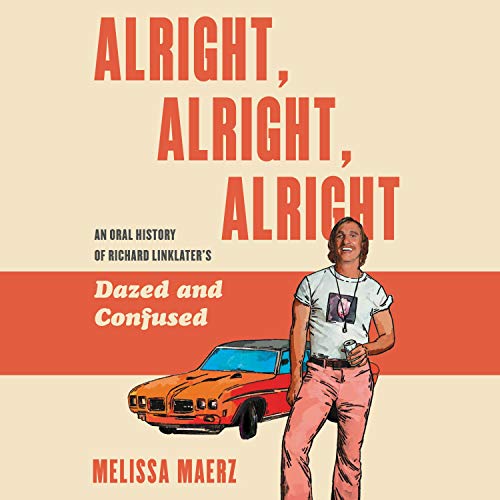
There are a lot of different ways that I could praise this 2020 book about the 1993 high school film, Dazed and Confused.
I could point out that it is the definitive history about the making of one of my favorite films, told by the people who were there.
I could point out that it’s a book that captures a very important time in the development of modern independent film.
I could point out that anyone who is a fan of Richard Linklater should read this book to discover the struggles that Linklater went through while directing his second feature film. Linklater learned a lot during the filming. He’s also an endlessly fascinating interview subject, a filmmaker who has figured out how to balance the needs of art with the needs of commerce.
If you’re a Texan, you definitely have to read this book because Dazed and Confused is a part of our culture.
I would also point out that this book is about more than just went on while the movie was being shot. It’s also about how the movie effected and continued to effect the lives of the people who were in it and who have seen it.. Some cast members, like Matthew McConaughey, Ben Affleck, Parker Posey, and Renee Zellweger (even though she’s only visible for a second and isn’t actually credited in the film), became big stars. Others, like Anthony Rapp and Adam Goldberg and Nick Katt, have emerged as strong characer actors, the type of people who you love to see in any movie. Others had a bit less success and most of them do not hold back on discussing why stardom did or did not come calling.
Featuring interviews with just about everyone who was involved in the film, Alright Alright Alright begins with Richard Linklater finding arthouse success with Slacker and then moving on to Dazed and Confused. As many people in the book point out, Linklater’s first few films helped to define both Austin and the entire Texas film scene. At a time when most Texas films were about cowboys and oilman, Linklater revealed that there was a lot more going on. And yet, when Linklater went on to find his own quirky brand of mainstream success, many of his former colleagues in Austin felt left behind. Linklater acknowledges their feelings while also making no apologies for not spending the rest of his life remaking Slacker.
The full production of Dazed and Confused, from casting to the film’s release, is covered. We learn about some of the people who tried out for the film but, ultimately, weren’t cast. (Linklater seems to feel almost guilty for not casting Vince Vaughn in a role.) We learn how Matthew McConaughey almost randomly found his way into the cast and then subsequently transformed Wooderson from being a minor character into being the heart of the film. We follow Wiley Wiggins as he comes of age on the film set. Just about everyone is interviewed and no one holds back. It was a frequently wild set, with a young cast who, to a certain extent, recreated high school while the film was being shot. I was sad to learn that Michelle Burke did not get along with Parker Posey and Joey Lauren Adams. I was happier to read that Jason London was apparently as cool off-camera as he was when he was playing Randall “Pink” Floyd. And, considering the way that his character just vanished from the film, I have to say that I wasn’t surprised to discover that no one seemed to get along with Shawn Andrews.
Shawn Andrews, of course, played Kevin Pickford. Pickford was originally meant to be an almost shamanistic character, though the concept of the character started to change once filming actually started. (“There’s a reason we called him Prickford,” Rory Cochrane says, at one point.) Two chapters are devoted to everyone in the cast taking about how much they disliked working with Shawn Andrews. No one really seems to hold back, which I have to admit almost made me feel sorry for the guy. Like many young actors, he went a bit too far trying to be method. Nick Katt compared him to Jared Leto at his worst. The otherwise easy-going Jason London talks about nearly getting into a fistfight with him. Linklater attempts to be diplomatic while discussing what happened but even he admits that Andrews didn’t gel with his vision for the film. Pickford was originally meant to be a major character. He was meant to be on the football field with Randall and Dawson. He was also originally meant to be the one heading out to get Aerosmith tickets. However, with more and more actors basically refusing to deal with the actor who was playing him, Pickford was replaced in scene after scene by Matthew McConaughey’s Wooderson. (Andrews, apparently, felt that Pickford should die in a dramatic car accident towards the end of the film.) Perhaps not surprisingly, Andrews was one of the few actors to decline to be interviewed for the book.
The final few chapters of the book are a bit sad, as some members of the cast discuss their careers after Dazed and Confused. We read about a cast reunion that occurred in Austin that turned a bit awkward when the actors who had become big stars reunited with the actors who hadn’t. Jason London, who dealt with a great personal tragedy shortly after the filming of Dazed and Confused, talks about the experience with a wistfulness sadness that is actually a bit heart-breaking. One gets the feeling that London’s mixed feeling weren’t so much about not becoming a Matthew McConaughey or Ben Affleck-style star as much as they were an acknowledgement that the past is the past. The unstated theme running through the book is that, as good a time as everyone had while making Dazed and Confused, everyone’s older now and that moment can never be recaptured.
(Kind of like high school!)
The book does end with some speculation about a Dazed and Confused sequel. Linklater seems to have given it some thought, though he also says that it will never happen. Personally, I think that’s the right decision. Dazed and Confused is perfect as it is. Alright, Alright, Alright is the book that helps us to understand why that is.
 Through the Shattered Lens