The Naked Gun 2 1/2: The Smell Fear (1991, directed by David Zucker)


Frank Drebin is back!

Now separated from Jane (Priscilla Presley) and working in Washington D.C., Frank (Leslie Nielsen) finds himself investigating a bombing at the offices of Dr. Albert S. Meinheimer (Richard Griffiths), an advocate of renewable energy who has just been put in charge of America’s energy policies by President George H.W. Bush (John Roarke, who was better-known for playing Ronald Reagan on Friday’s).  With the help of Captain Ed Hocken (George Kennedy) and Officer Nordberg (O.J. Simpson), Drebin’s investigation leads him to Quentin Haspburg (Robert Goulet), an oilman who is plotting on replacing Dr. Meinheimer with a double.  It also leads him back to Jane, who is now working as an assistant to Meinheimer and being wooed by Hapsburg.

The Naked Gun 2 1/2 is a worthy sequel to the first Naked Gun.  It’s more plot-heavy than the first film and some of the jokes feel a little bit too familiar but it’s still a very funny film.  That’s largely due to Neilsen, Kennedy, and Presley, all of whom really commit to playing their absurd characters.  (Robert Goulet gives a game performance but he really can’t match Ricardo Montalban’s villainous turn in the first movie.)  Nielsen was probably the only actor alive who could keep a straight face even while hitting Barbara Bush in the face while opening a door and then struggling to eat lobster at a state dinner.  As was often the case with the ZAZ films (even though Jim Abrahams and Jerry Zucker didn’t have anything to do with the screenplay of the sequel), the funniest moments are also the most random and the stupidest.  I laughed a lot harder than I should have at Leslie Neilsen struggling with a very small towel that had been thrown against his face.  And don’t worry, O.J. Simpson fans.  Nordberg gets injured in this movie too.

Leslie Nielsen was one of those actors who could make anything funny.  Whether he was delivering his hard-boiled dialogue or doing absurd physical comedy with an absolutely straight face, it was impossible not to laugh when Leslie Nielsen was onscreen.  He was a true cinematic treasure.
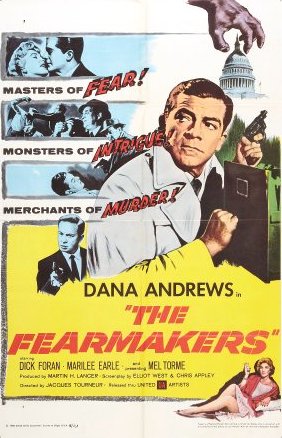
 

Shattered Politics #13: The Fearmakers (dir by Jacques Tourneur)


The_Fearmakers_film_poster

Did you know that 75% of people are sick of hearing the results of polls about what people think about other polls?  It’s true!

Me, I first got sick of polls back in 2012.  That was when, every day, everyone on twitter would be talking about the result of another political poll.  A poll would come out showing that Obama was ahead of Romney in the presidential election and all of my Republican friends would immediately start tweeting about why the poll could not be taken seriously.  Then 2014 came along and polls started to show that the majority of American citizens did not approve of the job Obama was doing.  And all of my Democrat friends would immediately start tweeting about why those polls could not be trusted.

As for me, I was always more concerned with what the polls said over on Rotten Tomatoes.  Really?I would think.  Only 35% of critics gave California Scheming a good review?  67% of moviegoers want to see the new Transformers film?

Oh my God, I thought, those numbers have to be so fake…

Because, let’s face it.  The only time that we believe a poll is when we agree with it.  Otherwise, we assume that they’re either the result of subtle manipulation, selective interpretation, or just completely and totally untrue.

Believe it or not, this suspicion is not a new phenomena.  I’ve always felt that you can learn a lot about history by watching the movies.  That doesn’t mean that movies are historically accurate.  One need only read my review of Magnificent Doll to see that.  However, movies do reflect the culture and concerns of the time in which they were made.

For instance, The Fearmakers was made in 1958 and it shows that not only has polling been around for a while but so has the fear of being manipulated by a fraudulent poll.

In The Fearmakers, Dana Andrews plays Alan Eaton.  Before the start of the Korean War, Alan owned one of the best and most respected polling firms in Washington D.C.  However, while serving in the army during the war, Alan was captured and held prisoner by the Chinese.  After years of being tortured and perhaps brainwashed, Alan is finally released.

He returns to an America that is far different from the country that he left.  For instance, while on a flight to Washington, D.C., he finds himself sitting next to a shifty scientist (Oliver Blake) who tries to convince Alan to support a group that believes in nuclear disarmament.  Even worse, once the plane lands, Alan discovers that he’s been forced out of his polling firm and that his partner has died under mysterious circumstances.

The firm’s new owner, the outwardly friendly, inwardly cold-hearted Jim McGinnis (Dick Foran), offers to hire Alan as a special consultant.  Alan is at first resistant but then he has a meeting with his old friend, Senator Walder (Roy Gordon).  Walder explains that he suspects that Alan’s old polling firm has been infiltrated by outside forces and that it might be using its polling to try to push communist propaganda on the American people.  Alan agrees to work for Jim and to help track down any and all subversives….

The Fearmakers is better than it sounds.  Beyond the fact that the story remains relevant in our poll-driven times, it was directed by Jacques Tourneur, who directed several atmospheric and intelligent horror films in the 30s and 40s.  He brings a similar atmosphere of doom to The Fearmakers.  Perhaps the film’s best scenes are the ones where Tourneur just focuses his camera on Andrews’s face while Alan struggles to understand the country to which he has returned.  As played by Andrews, Alan is troubled and hardly your typical hero.  You’re never quite sure how much of the film’s danger is real and how much of it is just the result of Alan’s own paranoia.

I first saw The Fearmakers on Netflix.  The next time you’ve got 84 minutes to kill, check it out.