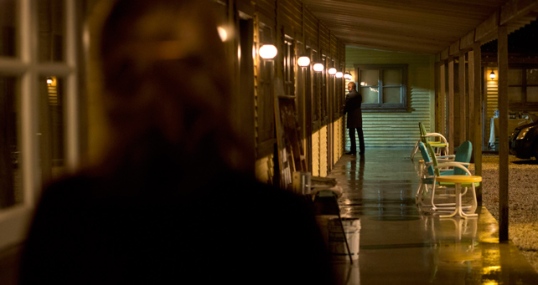
Review: Bates Motel 1.7 “The Man In Number 9”


Bates-episode7

Really, Bates Motel?

After all that build-up and all the dramatic cliffhangers, that’s how you resolve the Deputy Shelby subplot?

Last week’s episode of Bates Motel ended with the evil Deputy Shelby (Mike Vogel) getting shot by Dylan (Max Thieriot) and ending up lying dead at the feet of Norma (Vera Farmiga) and Norman (Freddie Highmore).  How, we wondered, would the Bates Family get out of this one?  How would they handle the suspicions of Sheriff Romero (Nestor Carbonell)?  How could they possibly get anyone to believe what had happened, especially since Shelby’s sex slave had disappeared into the woods?

Well, that was all resolved in the episode’s first five minutes.  Romero showed up, believed everything that Norma told him, and agreed to help cover up the truth.  Problem solved.

Oh, and the missing sex slave?

Well, who knows?

To be honest, nobody seems to be too concerned about her.

Despite the fact that the rest of the episode was actually pretty well-done, it was all overshadowed by the anti-climatic resolution of the whole Shelby subplot.  (Or, as it was referred to in this episode, “The Deputy Shelby scandal.”)  So far, Dylan, Norman, and Norma have — individually and together — murdered four people and they’ve managed to rather easily get away with it despite the fact that they live in a town where criminals are burned alive in the town square.

(Are we ever going to hear about that again?)

Anyway, once Romero let the Bates Family off the hook, Bates Motel got back to normal.  In preparation for the grand opening of the Bates Motel, Norma attempted to pass out some brochures at a few local businesses but was told that nobody wanted anything to do with the Bates Motel because of the “Deputy Shelby scandal.”  I have to say that I laughed out loud when I heard that phrase.  I just imagined people driving by the Bates Motel and saying, “Did you hear about the Deputy Shelby scandal?”

However, there is a glimmer of sordid hope on the horizon when a guy named Jake (played by Jere Burns) shows up at the motel.  As Jake explains, he had a standing reservation with the motel’s former owner for a block a rooms every few weeks.  It’s pretty obvious from the first minute Jake shows up that he’s evil and creepy but Norma needs the money…

Meanwhile, Norman has perhaps the worst week of his life.  He discovers a stray dog and starts feeding it.  He even names it Juno.  (At first, I assumed that he had named it after the Ellen Page movie but I doubt Norma would have allowed him to see that film.)   Then, Bradley (Nicola Paltz) rejects him, explaining that their sexual encounter was a one time thing.  An upset Norman walks back to the motel and arrives just in time to see Juno get run over by a passing car!

Picking up his dead dog, Norman announces that he’s going to see Emma’s father the taxidermist and that’s where this episode ends.

There was a lot to like in last night’s episode.  Jere Burns gave an appropriately creepy performance as Jake and Vera Farmiga continues to find the perfect balance between melodrama and camp.  However, the rather convenient resolution of the “Deputy Shelby scandal” overshadowed the entire episode.  Normally, I enjoy the melodramatic shifts on tone that have come to define Bates Motel but, during last night’s episode, it was all just a bit too much.

Random Observations:

  • Jere Burns certainly is a creepy looking guy, isn’t he?  He looks and occasionally sounds like he could be Christopher Walken’s younger brother.
  • I say this nearly every week but Olivia Cooke really does deserve her own show where she plays a high school student who solves crimes in her spare time.  Her scenes with Vera Farmiga were a lot of fun.
  • Norma’s sex talk with Norman was performed to squirm-inducing perfection by Farmiga and Freddie Highmore.
  • It looks like Bradley might like Dylan and who can blame her when Dylan’s played by Max Thieriot?
  • When Norman was imagining being in bed with Bradley early in this episode, I briefly thought the show was acknowledging what I initially suspected — that Norman and Bradley’s earlier encounter took place solely in Norman’s mind.  However, it turns out I was wrong on both counts.
  • I wanted to cry when Norman’s dog got run over.

Review: Bates Motel 1.6 “The Truth”


Bates Motel The Truth

(Warning: Spoilers Ahead)

Ever since Bates Motel began, one of the central questions has been just who was responsible for the death of Norman’s father.  The implication from the start was that Norma (Vera Farmiga) was responsible.  After all, the series began with Norman (Freddie Highmore) finding his father’s body and Norma responding rather calmly to the whole situation.  It was Norma who insisted on leaving town, buying a motel, and starting a new life.  For the past five episodes, it’s Norma who has been the dramatic and manipulative one while Norman has apparently been the one struggling to live a normal life while dealing with his overbearing mother.

In short, it was easy to assume that Norma was responsible.

That said, there has always been a number of viewers who have suspected that Norman would turn out to be the actual murderer.  When the show started, I was one of them.  However, I have to admit that, as Bates Motel progressed, I found myself so caught up in all the other subplots — like the return of Dylan (Max Thieriot) and the creepy Deputy Shelby (Mike Vogel) with his sex slave — that I forgot that there actually was any mystery about the death of Mr. Bates.  I figured it would be one of those plot points that would forever be left open to interpretation.

It turns out I was wrong because last night, the mystery was solved.  As Norma explained to Dylan, Mr. Bates was murdered by Norman.

And, with that explanation, Bates Motel suddenly made a lot more sense.

In the past, Bates Motel has often struggled to define itself.  Last night, however, Bates Motel finally had an identity.  Bates Motel is now a show about a mother trying to protect the world from her son and her son from himself.  With that one revelation, Norma went from villain to sympathetic character and Norman became a lot more creepier.

It’ll be interesting to see how this development will play out over the rest of the series.  Should we be worried about Emma (Olivia Cooke) or the oddly-named Bradley (Nicola Peltz)?

While last night’s episode was dominated by the truth about the death of Mr. Bates, it was also memorable for the fate of Deputy Shelby (Mike Vogel).  After discovering that his sex slave was at the motel, Shelby went on a rampage before finally being shot and killed by Dylan.  Last night’s episode ended with the Bates family staring down at Shelby’s dead body.

How much you want to bet that next week’s episode will feature Shelby being dumped in a nearby swamp?

Random Observations:

  • The Truth is the best episode of Bates Motel so far.  It was certainly the first episode to have a true and definite idea of what the show is trying to be.
  • I loved Norma’s awkward conversation with Emma (Olivia Cooke) at the beginning of the episode.  Emma desperately wants a mom and Norma is frightened of letting anyone get too close to her or Norman.  It created an interesting dynamic.
  • Judging from the previews, next week sees the return of Nestor Carbonell!  YAY!


Disconnected From Disconnect


Disconnect, the feature film directing debut of award-winning documentarian Henry-Alex Rubin, has been getting some fairly positive reviews.  According to Rotten Tomatoes, the film has a critical score of 71 while audiences have been even more impressed.  The last time I checked, it had an audience score of 83%.  If you’ve seen any of the commercials for this film then you’ve undoubtedly heard it referred to as being “the best film of the year.”

That’s high praise for a film that’s essentially Crash with better acting.

Much like Crash (which, incidentally, I consider to be the worst film to have ever won the Oscar for Best Picture), Disconnect is an ensemble film that tells several different stories.  For whatever reason, first-time directors seem to have a weakness for movies with ensemble casts and multiple-story lines.  When done well, an ensemble film can say something profound about the way that people in a society relate to one another.  When done poorly (like in Crash or Disconnect), they just feel trendy.  Watching Disconnect, I felt as if the filmmakers couldn’t come up with a way to tell one compelling story from beginning to end so, instead, they just tossed together fragments of three separate stories and then desperately tried to come up with a theme to connect them all.

That theme, by the way, is that our reliance of modern technology has created a society where people are Disconnected from one another.

Gee, you think?

Disconnect tells three separate, inter-connected stories.  In one story, Paula Patton and Alexander Skarsgard are a married couple who are struggling to deal with the recent death of their child.  Skarsgard deals with his grief by going on long business trips and getting addicted to online gambling.  Meanwhile, Patton joins an online support group and finds herself tempted to have affair another member (Michael Nyqvist).  Patton’s activities leads to identity theft and bankruptcy.  With the help of a sleazy private investigator (Frank Grillo), Patton and Skarsgard try to track down the man who stole their identity.  This story falls apart once Patton and Skarsgard find the man and both characters suddenly start acting in the most inconsistent ways conceivable.  It really should be impossible t0 make charismatic performers like Alexander Skarsgard and Paula Patton seem  bland and boring but somehow, Disconnect manages to do it.

In the film’s best storyline, Grillo’s teenage son (Colin Ford) catfishes and cyber-bullies an alienated classmate (Jonah Bobo).  When Bobo hangs himself as a result, Ford is wracked with both guilt and fear.  Ford’s attempts to cover-up his involvement leads to him meeting and briefly befriending Bobo’s father (Jason Bateman), who has no idea what led to his son attempting suicide.  In this story, Bateman proves that he’s as good with drama as he is with comedy and Ford’s complex and multi-layered performance is more than award-worthy.  This was probably the most powerful part of the film and, if the filmmakers had simply concentrated on this story (as opposed to diluting it by making only one part of a multi-part film), Disconnect would fully deserve the high-praise that it’s currently receiving.

In the film’s third (and most flamboyant) storyline, Andrea Riseborough is a cynical and opportunistic reporter who does a story about a cocky teenager (Max Thieriot) who performs on an adults-only site and who recruits other teenagers for a manipulative pimp (played by none other than Marc Jacobs).  Riseborough finds herself charmed by the teenager (and who can blame her because, after all, he’s played by Max Thieriot) and soon she’s having an affair with him.  However, her news story captures the attention of the F.B.I. and soon both Thieriot and Riseborough find themselves in danger.

At first, I thought I was going to enjoy this storyline because I love Max Thieriot.  He’s ideally cast here and he gives a good, sympathetic performance. For that matter, so does Andrea Riseborough and even Marc Jacobs brings a certain reptilian charm to his role.  However, this story falls apart as it quickly becomes obvious that the filmmakers, having set up a potentially interesting situation, have no idea what to do with it.  Instead, much as with the characters played by Skarsgard and Patton, Riseborough ceases to behave with anything resembling logic or consistency.  Both she and Thieriot go from being interesting, well-rounded characters to being mere plot devices.

That, ultimately, is the main reason why Disconnect fails.  With the exception of the characters played by Bateman and Ford, nobody in this film feels real and, again with the notable exception of Bateman and Ford’s storyline, very little that happens feels genuine.  The film is watchable because of the talented cast but, otherwise, it’s a melodramatic and predictable mess that seems to think that it’s a lot smarter than it actually is.

Perhaps that’s why so many people over on the imdb have been praising this film as “the best of the year.”

Some people will always enjoy feeling like they’re thinking without actually having to do it.

Review: Bates Motel 1.2 “Nice Town You Picked, Norma.”


-bates-motel--episod

Norman Bates has a brother?

Wow, who would have guessed?

That was the main addition that last night’s episode of Bates Motel provided to the Psycho mythology.  Played by Max Thierot (who was so good in last year’s underrated The House At The End of the Street), Dylan is Norman’s half-brother.  He was born when Norma was 17 years old and, as this episode quickly establishes, he’s a little bitter that Norma abandoned him and his father so that she could marry Sam Bates.

Actually, he’s more than a little bitter.  Bitterness appears to be Dylan’s only emotion.  From the minute that Dylan shows up at the Bates Motel, he’s angry.  Though he greets Norma with “Hello, mother,” (presumably so the slower members of the audience won’t be confused as to who he is), he spends the rest of the episode loudly refusing to call her anything other than “Norma” or “the whore.”

Dylan’s relationship with his half-brother isn’t much better.  About halfway through the episode, Norman reacts to Dylan’s taunting by attacking him with a meat cleaver and gets beaten up for his trouble.  “I told you not to do that!” Dylan shouts after he tosses Norman down to the kitchen floor.

To be honest, Dylan would pretty much be insufferable if not for the fact that he’s played by Max Thierot.  Much as he did in The House At The End Of The Street, Thierot is able to generate sympathy for a fairly unsympathetic character.  It helps, of course, that when compared to Norman and Norma, Dylan almost seems to be sensible.

Norma, meanwhile, has bigger problems than just her oldest son deciding to move back in with her.  She’s still trying to cover up the fact that she killed the previous owner of the motel.  It doesn’t help that Sheriff Romero (Nestor Carbonell) has discovered the dead man’s pickup truck parked near the motel.

Norma handles the situation by flirting with Deputy Shelby (Mike Vogel).  While Norman and Dylan are busy fighting in the kitchen, Norma and Shelby are at the town’s logging festival.  Judging from some of the feedback on twitter, I may be in a minority on this but I actually enjoyed the scenes between Shelby and Norma.  Vogel and Vera Farmiga had a very likable chemistry and I thought the scenes did a good job of establishing the town itself as a character.  Much as Lost had to leave the island, Bates Motel has to be able to tell stories outside of the motel and I think that tonight’s episode showed that it can.

Speaking of things happening outside of the motel, that’s probably where Norman (Freddie Highmore) should try to spend as much time as possible.  When he’s inside the motel, he spends all of his time looking at his little BDSM sketchbook and watching his mother while she undresses in front of him.  However, outside of the motel, he’s got a rather sweet relationship with a girl named Emma (Olivia Cooke).  Together, he and Emma research the origins of the sketchbook (“Don’t worry,” Emma says, “I’ve read lots of manga.”) and they even stumble across a local marijuana farm.

Norman ends up spending a lot of time with Emma because his other female friend, the oddly named Bradley (Nicola Peltz), spends most of the episode at the hospital.  Apparently, somebody set her father on fire.  However, as Deputy Shelby explains to Norma, the town has a way of taking care of trouble makers. That’s made pretty obvious at the end of tonight’s episode when Norma drives by another man who, in an apparent act of retribution, has been set on fire in the middle of the town square.

I enjoyed the second episode of Bates Motel.  It was full of atmosphere and Vera Farmiga’s performance continues to maintain the perfect balance between reality and camp.  Narratively, the story is still unfolding at a very deliberate pace but this episode provided enough intriguing clues to make me excited about seeing what happens next Monday.

That said, I still can’t help but feel that this show’s main weakness is the fact that , as opposed to being a stand alone series, it has to exist as part of the mythology of Psycho.  In many ways, Bates Motel reminds me of The Carrie Diaries, a prequel to Sex In The City that airs on CW.  It’s a well-acted show that’s full of a nicely observed moments but it’s still impossible for me to watch without thinking, “It doesn’t matter what happens because we already know Carrie’s going to eventually end up meeting and marrying Mr. Big.”

By the same token, I still find it next to impossible to watch Bates Motel without thinking to myself, “Eventually, regardless of what happens wit Dylan, Emma, or the pot farmers, Norman’s going to end up wearing Norma’s clothes, peeping on women in the shower, and killing them.”

Divorced from the Psycho mythology, Bates Motel is an entertaining and intriguing little show.  However, without the Psycho mythology, would a show called Bates Motel have ever made it to the air in the first place?

Random Observations:

  • The best scene, by far, was Norma’s alternatively friendly and creepy conversation with Emma.  “And what’s your life expectancy?”
  • How much do you want to bet that Dylan’s going to end up working with the pot farmers?
  • Speaking of the pot farm, am I the only one who was reminded of that episode of Lost where John Locke’s flashback dealt with the period of time he spent living on a commune?
  • I know I said this last week but seriously, how can you not love Nestor Carbonell?

Horror Film Review: House At The End of the Street (dir. by Mark Tonderai)


Hi there!  I’m back!  For the past two weeks, I’ve been “on the road,” traveling from my home in Texas to Baltimore, Maryland and then back to Texas again.  It was a great two weeks and a much-needed vacation and now, I am back at my office here at the Shattered Lens Bunker, and I am refreshed and I am ready to get caught up on what really matters: reviewing movies.

This is October, perhaps the third greatest month of the year.  Traditionally, October is horror month here at the Shattered Lens and, for my first post-vacation film review, I want to take a look at an underappreciated horror film that came out right before I left for Maryland.  It was released to theaters on September 21st, was the number one film in the country for a week, and got next to no love from either mainstream critics or my fellow film bloggers.  It’s still playing at a theater near you and, believe it or not, it’s not that bad.  The name of the film?  The House At The End of the Street.

(Or, as my BFF Evelyn and I called it, “The House at the End of the Cleavage” because seriously…)

In The House At The End of Street, recently divorced Sarah (Elisabeth Shue) and her daughter Elissa (Jennifer Lawrence) move to a small country home.  Sarah has managed to buy a house that she really shouldn’t be able to afford and the new neighbors quickly explain to them that this is because, many years ago, a crazy girl named Carrie-Ann was living at the house at the end of the street and she murdered her parents before then disappearing into the woods.  Apparently, this has caused all of the property values in town to plummet and I really have to wonder why.  I’m not a real estate expert (for instance, I have no idea what a mortgage is and I have no desire to learn) but, personally, I would love to live next to a murder house.  Seriously, imagine the interesting conversations that could be started by saying, “So, my neighbor buried a salesman in his basement…”

But anyway, it turns out that Elissa has a perfect view of the house at the end of the street from her bedroom window and she quickly discovers that the house is not deserted.  It turns out that Carrie-Anne’s brother Ryan (Max Thieriot) is living in the house and, despite being shunned by the entire community, he seems to be a nice, sensitive guy.  Despite her mother’s misgiving, Elissa befriends Ryan and defends him against everyone who claims that he’s crazy.

Of course, what Elissa doesn’t know is that there’s another girl in Ryan’s life and she’s locked up in his basement…

When I look over the negative reviews of House at the End of the Street (especially the ones written by male film bloggers), I frequently come across the phrase “lifetime movie.”  Their argument seems to be that House At The End of the Street, with its emphasis on a single mom raising her daughter, was essentially just a PG-13 rated Lifetime movie.

Well, they’re right.

But so what?

Seriously, Lifetime movies are a lot of fun to watch when you’re in the right mood for them and that’s a perfect way to describe House At The End Of The Street.  It’s a lot of fun, the type of silly horror film that’s fun to watch with a group of friends.  Max Thieriot plays the type of cute but damaged (and potentially dangerous) outsider that every girl has had a crush on and, for the boys in the audience, there’s plenty of cleavage and visible bra straps.

Finally, I think the main reason that House At The End of the Street stayed with me is because both Elisabeth Shue and Jennifer Lawrence really invested themselves in their roles.  They were totally believable as mother and daughter and their loving but occasionally contentious relationship felt totally true-to-life (or, at the very least, it was true to my life).  Lawrence and Shue both give performances that bring some unexpected depth to this underrated film.