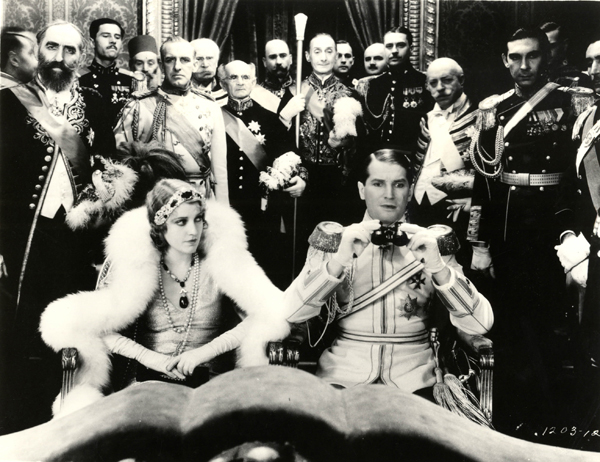
Recently, as a part of TCM’s 31 Days of Oscar, I watched the 1929 musical The Love Parade.
Now, I have to admit that this was one of those movies that I started watching with a lot of pre-conceived notions. While I happen to enjoy movies from all eras, I sometimes have a hard time adjusting to the style of the films that were made in the early days of the sound era. Often times, it’s obvious that these films were made by directors and actors who were still struggling to make the transition from silent to sound cinema. As a result, it’s not uncommon for films of this era to come across as being stiff and stagey.
But I needn’t have worried. While The Love Parade does have its occasionally stagey moments, it actually holds up remarkably well. For a film that was made 89 years ago, The Love Parade is still a lot of fun and surprisingly entertaining. It helps, of course, that The Love Parade was made before the adoption of the infamous Production Code and, as such, it’s allowed to show off a racy sense of humor that keeps the film from feeling too dated.
As for the film itself, it deals with Queen Louise (Jeanette MacDonald), the young ruler of the European kingdom of Sylvania. Despite the fact that Louise is a capable ruler, her subjects worry that she has yet to get married. When her advisors inform her that she is running the risk of never marrying, Louise dismisses their concerns in a very Pre-Code way. She lifts up her skirt, shows off her left leg, and says that there’s only one other leg as perfect as her left leg. She then extends her right leg. Since I basically do the same thing every single day, that was the moment when I realized that she might be the Queen and I might just be an outspoken redhead but I could still totally relate to Louise.
After showing off her legs, Louise deals with the issue of Count Alfred (Maurice Chevalier), a diplomat at Sylvania’s Paris embassy. Apparently, Alfred ended up having an affair with every woman at the embassy (including the ambassador’s wife) and he has been recalled to Sylvania. After reading the details of his sexual exploits, Louise decided that she has to meet Alfred for herself.
(And again, we’re reminded that this is a Pre-Code film.)
Alfred and Louise meet, fall in love, and marry. However, Alfred has a hard time dealing with the fact that, as Queen, Louise has all the power in their marriage. Even his attempts to draw up an economic plan are dismissed by the Queen’s advisors. Feeling emasculated, Alfred sings a song called Nobody’s Using It Now.
Three guess what “it” is.
Can this marriage be saved? Louise’s maid (Lillian Roth) and Alfred’s servant (Lupino Lane) are determined to make sure that it can be!
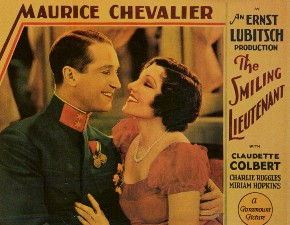
If the plot description and my review of The Love Parade sounds in any way similar to my review of The Smiling Lieutenant, that’s because both films were directed by Ernst Lubitsch. In fact, The Love Parade was Lubitsch’s first sound film and, in many ways, his assured direction here played a huge role in helping Hollywood make the transition from the silents to the talkies. Both Jeanette MacDonald and Maurice Chevalier give assured (and sexy) performances that hold up well today and the film’s opulent sets and costumes remain a visual delight. The end result feels like a wonderfully entertaining fairy tale.
The Love Parade was nominated for best picture but it lost to the far more grim All Quiet On The Western Front. But, regardless of what awards it won or did not win, The Love Parade is a delightful little film that works both as a historical document and a terrifically entertaining musical comedy.
 Through the Shattered Lens