Though the Academy of Motion Picture Arts and Sciences claim that the Oscars honor the best of the year, we all know that there are always worthy films and performances that end up getting overlooked. Sometimes, it’s because the competition too fierce. Sometimes, it’s because the film itself was too controversial. Often, it’s just a case of a film’s quality not being fully recognized until years after its initial released. This series of reviews takes a look at the films and performances that should have been nominated but were, for whatever reason, overlooked. These are the Unnominated.
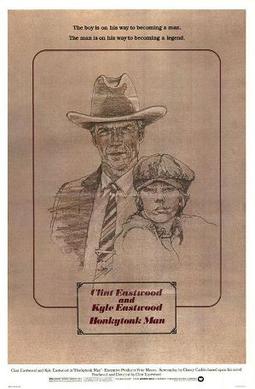
1982’s Honkytonk Man was a Clint Eastwood film that I had never heard of, until I came across it on Prime. I decided to take a chance and I rented it. I’m glad that I did because it turned out to be one of Eastwood’s best films.
Clint stars as Red Stovall, a country singer turned farmer during the Great Depression. Kyle Eastwood stars as Red’s nephew, 14 year-old Whit “Hoss” Wagoneer. When Red gets an opportunity to perform at the Grand Old Opry, he decides to head for Tennessee. Since Red is dying of tuberculosis and barely knows how to drive a car, he is accompanied by Grandpa Wagoneer (John McIntire) and Whit. Whit may be young but he knows how to drive and soon, he’s driving Red and Grandpa across the country. When a highway patrolman (Tim Thomerson) stops them, he says that Whit is too young to drive. After watching a speeding Red struggle to keep the car in the right lane, the patrolman pulls up beside them and says, “Let the kid drive.”
Honkytonk Man features an unexpected performance from Eastwood. Typically, we think of Eastwood’s characters as being the epitome of cool. Red is definitely not that. Red is a screw-up, someone who gets arrested while trying to steal chickens and who frequently gets conned by those that he meets during his journey. When the car breaks down in Arkansas, Red is too busy drinking to remember to catch the bus to Tennessee. He spends the night with a hitchhiker named Marlene (Alexa Kernin). The next morning, Whit wakes Red up and informs him that he only has a few minutes before the next bus leaves. Marlene announces that she’s pregnant. “HOLD THE BUS!” Red yells as he hastily puts on his clothes.
That said, Whit loves his uncle and the two Eastwoods, Clint and Kyle, both give excellent performances in Honkytonk Man. In fact, his performance here is probably the best that Clint Eastwood has ever given. Clint plays with his own image here. Initially, the film almost feels like a satire of Clint’s hypermasculine persona. (There is one scene where Eastwood handles a gun but it doesn’t play out the way that you might expect it to.) But, as the film progresses and Red’s illness grows worse, we start to understand Red and his way of looking at the world. Red is flawed but he loves his nephew and he loves music and, in the end, what’s important is not whether or not his song were recorded but instead that he spent his final days with Whit. The film may start out as a comedy but it ultimately becomes a meditation on aging and how one faces the inevitability of death.
As a director, Eastwood takes his time. He lets the movie play out slowly, with the casual pace of country story. It’s a film full of wonderful performance and beautiful visuals and it more than earns our patience. Wisely, Eastwood the director realizes that this story really isn’t about Red. The story is about Whit (or Hoss, as he asks to be known) and his experiences with his uncle. Whit worships his uncle but he also comes to learn that the most important thing is to be able to respect yourself. In this film, Clint Eastwood knows the story that he’s telling and he knows exactly how to tell it.
Honkytonk Man went unnominated as far as the Oscars are concerned. In the year when the well-intentioned but dramatically inert Gandhi dominated the awards and the nominations, Honkytonk Man was forgotten. That’s a shame.
Previous Entries In The Unnominated:
 Through the Shattered Lens