Lisa Cleans Out Her DVR: Dreamer (dir by Noel Nosseck)


(I am currently trying to clean out my DVR!  I recorded this 1979 sports film off of FXM on February 1st!)

In Dreamer, Tim Matheson plays a character named Harold Nuttingham.  His nickname is Dreamer.  Do you think it’s possible that Harold has a dream!?  Well, it would probably be a really cruel nickname if he didn’t!

Dreamer lives in small town Illinois.  He loves to bowl.  He spends all of his time down at the local bowling alley, where everyone knows him and they all love him and his dreams of becoming a professional bowler.  His mentor is named Harry White (Jack Warden) and runs the pro shop.  Harry dreamed of being a famous, champion bowler but his dreams didn’t come true.  But now he can help Dreamer’s dreams work out.  Everyone loves the fact that Harry is helping Dreamer.  Dreamer’s girlfriend is named Karen Lee (Susan Blakely).  She loves that Dreamer loves bowling but she is frustrated because everyone keeps telling Dreamer that it would be a mistake to take her to his games.  Karen might bring bad luck.

Everyone in his hometown loves Dreamer but the Professional Bowling Association (which apparently is an actual thing) doesn’t love Dreamer.  They don’t want to let Dreamer compete on a professional level.  Or, at least, they don’t until Dreamer meets with them personally and shows off his amazing bowling skills.  Then they love Dreamer.

Even though Dreamer is the new guy on the professional circuit, the audiences love him.  And all the other professional bowlers love him, even when they lose to him.  Everyone loves Dreamer, perhaps because everyone loves a dreamer…

Are you getting the impression that Dreamer might be one of the most positive movies ever made?  Well, it is.  Hardly anyone says a bad word about anyone in Dreamer.  Nobody tells Dreamer to give up.  Dreamer never really suffers from any self-doubt, though he does injure his thumb at one point.  There is a moment of tragedy towards the end of the movie but it’s one of those tragedies that leads to better things.  You can’t have light without a little darkness, though Dreamer seems to suggest that you can come awfully close.

Normally, films get on my nerves when they’re overwhelmingly positive but I can’t really complain about a movie like Dreamer.  It’s just so earnest and sincere.  There’s no real conflict and there’s no real drama but everyone in the movie is just so damn likable that you almost feel guilty for wishing something unexpected would happen.  Dreamer struggles and fails to make bowling cinematic but Dreamer’s a nice guy so you wish him the best.

Perhaps the most interesting thing about Dreamer is that it was directed by Noel Nosseck, who also directed an incredibly odd little grindhouse film called Best Friends.  Best Friends, which I recommend tracking down, is almost the anti-Dreamer.  Watch Best Friends to have your faith in humanity destroyed and then follow it up with Dreamer so your faith can be restored.

Or don’t.  It’s really up to you.

Film Review: Thank God, It’s Friday (dir by Robert Klane)


529thank_god_its_friday

So, I just finished watching Thank God, It’s Friday, a movie from 1978.  It’s an episodic comedy, one that follows a group of genuinely unlikable characters as they all gather in one genuinely unlikable location and proceed to have some fairly generic experiences.

For example, there’s the married couple and the husband needs to loosen up.  There’s the DJ who is going to lose his job if he can’t deliver the big stars that he’s promised.  There’s the short, violent guy who is upset because he’s been set up on a date with a tall woman.  There’s the dental hygienist who comes across like she’s desperately trying to convince everyone that she’s eccentric when she’s really just boring.  (We all know the type.)  There’s the teenager girls who try to sneak into the club, despite being underage.  There’s the two dorky guys who are looking for love.  There’s the two dorky girls who are looking for love.

In fact, everyone in the movie is looking for love!  Except for Jeff Goldblum!  He just wants to get laid.  He manages the club where everyone has gathered on this particular Friday.  He’s a womanizer.  We can tell because he wears a red jacket and his shirt is half-buttoned.  Goldblum decides that he wants to break up the married couple.  Boo!  Hiss!  But wait a minute — neither the husband nor the wife are likable or interesting.  Go, Jeff, go!  BREAK UP THAT BORINGASS MARRIAGE!

Oh!  And Nicole (Donna Summer) is wandering around the club too.  She wants a chance to perform but the DJ refuses to let her.  So, eventually, she just grabs a microphone and she starts to sing.  Luckily, the song she sings is Last Dance and, by singing it, she gives everyone an excuse to go home.  If you’ve ever been to a karaoke night, you know that, as soon as a drunk sings Last Dance, it’s time to pay the bill and get the Hell out of there.

Last Dance was apparently written specifically for Thank God, It’s Friday.  Or maybe Thank God, It’s Friday was written specifically for Last Dance, who knows?  What we do know is that Last Dance won the Oscar for Best Original Song.  That’s right — Thank God, It’s Friday is an Oscar winner and therefore, will always be enshrined with fellow Oscar winners like Crash, Titanic, and SPECTRE.

(Which songs did Thank God, It’s Friday beat?  It defeated a song from Grease, which is a good thing because Grease is even more annoying than Thank God, It’s Friday.  That’s right, I said it.  And you know it’s true.)

Anyway, Thank God, It’s Friday is a really bad movie, one that is full of bad writing, bad jokes, bad performances, and indifferent direction.  It’s tempting to say that the music was really good but actually, we don’t hear much of the music.  The movie is often more concerned about what’s happening in the club’s parking lot than in what is happening (and being heard) on the inside.  We may not hear much music but we do get to see some pretty icky racial stereotyping and who would guess that a movie about disco would be so homophobic?

(We don’t see any cocaine, though I’m sure you could probably hear the key grip and the gaffer snorting a line off-camera if you listened closely enough.  A lot of the cast looked pretty wired.)

ANYWAY — here’s the important thing about Thank God, It’s Friday.  Occasionally, I’ll watch a movie like Dazed and Confused or Boogie Nights or Saturday Night Fever and I’ll get jealous because I know that I’ll never get a chance to experience the 70s first hand.  Fortunately, something like Thank God, It’s Friday will always be around to reassure me, “No, Lisa.  The 70s sucked!”

Thank God, it’s Friday?

No, thank God the movie’s over.

"Is it Friday yet!?"

“Is it Friday yet!?”

Actually, you know what?  I can’t end this review without sharing this film’s trailer:

Doesn’t Skatetown, USA look better?

Oh well!  Sing us out of here, Donna!


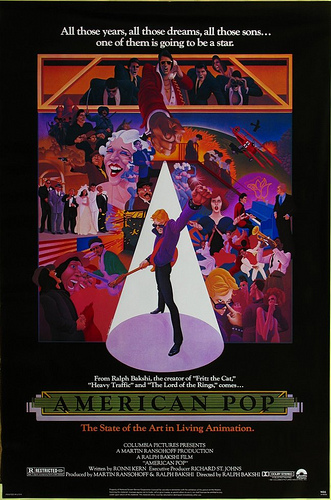
Film Review: American Pop (1981, directed by Ralph Bakshi)


American PopLong before South Park, The Simpsons, and Pixar, there was Ralph Bakshi.  At a time when animation was considered to only be good for children, Bakshi shocked audiences and critics with animated films that dealt with mature themes and were definitely meant for adults.  His first two films, Fritz the Cat (1972) and Heavy Traffic (1973), was the also the first two animated films to receive an X-rating.  Bakshi satirized racism in the controversial Coonskin (1975) and Bakshi’s adaptation of The Lord Of Rings (1978) beat Peter Jackson’s by 23 years.  It was after the critical and commercial disappointment of the heavily flawed but interesting Lord of the Rings that Bakshi decided it was time to make a film that would be more personal to him.  The end result was American Pop.

American Pop tells the story of four generations of a family of Jewish immigrants and how music affects their lives.  In typical Bakshi fasion, this animated film deals with issues of violence, sexuality, drug abuse, and poverty.  American Pop may be animated but it is definitely a film meant for adults.

In the 1890s, Zalmie (Jeffrey Lippa) and his mother escape from Russia after Zalmie’s father, a rabbi, is killed by the Cossacks.  Zalmie grows up in New York and after his mother is killed in the Triangle Shirtwaist Factory fire, he is raised by a vaudeville comedian named Louie (Jerry Holland).  Zalmie wants to be a singer but is shot in the throat during World War I.  His voice ruined, Zalmie marries a stripper named Bella (Lisa Jane Persky) and manages her career.  His partnership with the mobster Nicky Palumbo (Ben Frommer) leads to Bella dying and Zalmie going to prison.

Zalmie’s son, Benny (Richard Singer), is a jazz pianist who, as a favor to his father, marries Nicky’s daughter.  Benny has a son named Tony and tries to pursue his career without using his father’s influence.  Then World War II breaks out.

Benny enlists in the army, seeking redemption from the crimes of his father and father-in-law.  Serving in Europe, he misses his piano and, when he finds one in a bombed-out house in Nazi Germany, he plays a few bars of As Time Goes By.  When a Nazi walks in on Benny, Benny plays Lili Marleen.  For a few seconds, Benny and the Nazi share the common bond of music.  “Danke,” the Nazi says before shooting Benny dead.

Growing up without his father, Tony (Ron Thompson) becomes a beatnik and eventually runs away from home.  He ends up in Kansas, where he has a one-night stand with a waitress and becomes a songwriter for Frankie Hart (Marya Small), a stand in for Janis Joplin.  Both Tony and Frankie start using heroin and Frankie dies of an overdose right before she is supposed to open for Jimi Hendrix.  Abandoned by Frankie’s band, Tony ends up as an addict and dealer in New York.  Accompanying him is his son, Pete, the result of his hookup with the waitress.

After being abandoned by his father, Pete (also played by Ron Thompson), follows in his footsteps and becomes a successful drug dealer.  He is dealing cocaine to all of the big rock bands but, after discovering punk rock, he realizes that he wants something more out of his life.

After announcing that he will no longer sell anyone cocaine unless he is given a chance to record a demo, Pete is given a band and a recording studio.  With the drug-craving record company execs watching, this tough and cocky punk grabs the microphone and sings…

…BOB SEGER’S NIGHT MOVES!?

The use of Night Moves, which is one of the least punk songs ever written, is one of the few false notes in American Pop.  Otherwise, this is one of Ralph Bakshi’s best films.  The majority of the film’s animation was done through rotoscoping, a technique in which animation is traced over live action footage.  (For the gang war scenes, scenes from The Public Enemy were rotoscoped, as was footage of the Nicholas Brothers used in the Sing Sing Sing With A Swing montage.)  Seen today, the technique is crude but effective at showing the contrast between the fantasy of music and the grim reality of life.  Though it has its flaws (*cough* Night Moves *cough*), American Pop is an engaging look at the history and development of American music.

American_Pop