May Noir: The Big Sleep (dir by Michael Winner)


Raymond Chandler’s detective classic, The Big Sleep, has twice been adapted for film.

The first version came out in 1946, just seven years after the book’s publication.  That version starred Humphrey Bogart as detective Philip Marlowe and Lauren Bacall as Vivian, the daughter of a man who has hired Marlowe to discover who is trying to blackmail him.  Directed by Howard Hawks and co-written by William Faulkner, this version of The Big Sleep is considered to be a classic noir, one that was cited as being a major influence on director Akira Kurosawa.

The 1978 version was directed by Michael Winner, takes place in London in the 1970s, and features Robert Mitchum as Marlowe.  Despite a strong ensemble cast and an excellent lead performance from Mitchum, this version of The Big Sleep still features one of the worst performances ever put on film.

Sarah Miles plays the role of Charlotte Sternwood Regan, the eldest daughter of General Sternwood (James Stewart).  Miles is playing the role that Lauren Bacall played in the first film and, despite the fact that they both earlier co-starred to a certain amount of acclaim in Ryan’s Daughter, Miles and Mitchum do not have a hint of chemistry in this film.  Actually, Miles doesn’t have chemistry with anyone in this film.  She seems detached from the action and her frequent half-smiles come across as being not mysterious but instead somewhat flakey, as if she doesn’t quite understand that she’s in a noir.  Sarah Miles is not a bad actress (as anyone who has seen Hope and Glory can tell you) but her performance here is incredibly dull.  That said, she is not the one who gives the worst performance in the film.

Instead, that honor goes to Candy Clark, playing General Sternwood’s youngest daughter, Camilla.  Camilla is meant to be mentally unstable and potentially dangerous.  Clark plays the role like a giggly teenager, constantly fidgeting and literally hissing in more than a few scenes, as if she’s been possessed by a cat.  Clark overacts to such an extent that you’ll be more likely to laugh at than be disturbed by her antics.  It doesn’t help that she shares nearly all of her scenes with Robert Mitchum, a man who was a master when it came to underacting.  If you’re going to give a bad performance, you don’t want to do it opposite someone who will make you look even worse by comparison.

The mystery of who is blackmailing General Sternwood is twisty and full of disreputable people.  At times, the film feels like a a parade of character actors.  Edward Fox, Joan Collins, Richard Boone, Oliver Reed, Harry Andrews, Richard Todd, and John Mills all show up throughout the film and, as a viewer, I was happy to see most of them.  They all brought their own sense of style to the film, especially the menacing Oliver Reed.  That said, director Michael Winner was never known for being a particularly subtle director and the film gets so mired in its own sordidness that it becomes be a bit of a slog to sit through.  As a filmmaker, Winner was a shameless.  That sometimes worked to a film’s advantage, as with the original Death Wish.  That film needed a director who would dive into its Hellish portrayal of New York City without a moment’s hesitation and that’s what it got with Michael Winner.  With Winner’s adaptation of The Big Sleep, however, the film gets so caught up in trying to shock and titillate that it’s hard not to miss the wit that made the first adaptation so special.

That said, The Big Sleep does feature the truly special opportunity to see Robert Mitchum and James Stewart acting opposite each other.  Both give good and heartfelt performances, with Mitchum plays Marlowe as a cynic with a heart and Stewart capturing the pain of knowing that your children don’t deserve all that you do for them.  Stewart and Mitchum bring a lot of emotion and sincerity to their scenes and, for at least a few minutes, The Big Sleep becomes about something more than just bloody murders and revealing photographs.  It becomes about two aging men trying to find their place in a changing world.  The Big Sleep was one of Stewart’s final feature films and he shows that, even late into his career, he was always one of the best.

 

Lisa Reviews The Oscar Nominees: Nicholas and Alexandra (dir by Franklin J. Schaffner)


Nicholas_and_Alexandra-831476012-large

(Depending on how much you know about world history, the review below may contain spoilers.)

It was nearly four years ago that I decided that my goal in life was to watch and review every single film — no matter how obscure or potentially disappointing — that had ever been nominated for best picture.  Of course, that’s not my only goal.  If anything, I may have too many, often contradictory goals in my life.  But seeing all of the best picture nominees was definitely one of them and, all these years later, it’s a goal that I’m still trying to achieve.  With the help of TCM and their nonstop schedule of movies made long before I was born, it’s also a goal on which I am slowly but surely making progress.

Last night, as I scrolled through the guide, I noticed that TCM would be showing Nicholas and Alexandra, a three and a half hour film from 1971.  Now normally, I would be hesitant about watching a film that long, if just because I have ADHD and I doubt I’d be able to concentrate on it.  In a theater, watching the action unfold on a big screen, it wouldn’t be a big deal.  However, it’s totally different when you’re talking watching a movie on TV in a house that is full of potential distractions.  Add to that, Wednesday night is when I usually watch shows like Survivor, Hell’s Kitchen, and South Park.

But, here’s the thing.  The title Nicholas and Alexandra sounded familiar to me and not just because I’m an obsessive history nerd.  I did some checking and I discovered that, regardless of how obscure the film may be today, Nicholas and Alexandra was nominated for best picture.  It lost to The French Connection but it was nominated.

So, of course, I had to watch it.

And you know what?

NA

It’s not a terrible movie.  It’s certainly not great.  It has multiple flaws and it’s hard to imagine this film being nominated alongside films like The French Connection, Last Picture Show, and A Clockwork Orange.  Watching the movie, I got the feeling it was probably nominated because it was a big, expensive epic and not because it was one of the best of the year.  But, if you stick with the film (which, if we’re going to be honest here, is much easier said than done), it’s not quite as disappointing as you might expect it to be.

Nicholas and Alexandra tells the story of the last monarch of Russia, Tsar Nicholas II (Michael Jayston).  Struggling to escape the shadow of his father and incapable of understanding what life is like for those not born into royalty, Nicholas is portrayed as being well-meaning but autocratic and blind to the fact that the days of royalty are rapidly coming to an end.  His wife, Alexandra (Janet Susman) is also unpopular with both the Russian citizenry and the royal court on account of being German.

Alexandra spends most her time doting on her youngest son, Alexei, who suffers from hemophilia.  When a flamboyant Serbian monk named Rasputin (Tom Baker) claims that he has the power to heal Alexei, Alexandra immediately brings him into the court.  Soon, rumors are flying across Russia about Rasputin’s relationship with Alexandra.

Meanwhile, men with names like Lenin (Michael Bryant), Trotsky (Brian Cox), and Stalin (James Hazeldine) are plotting to lead a “worker’s revolution…”

If you know anything about history, it’s not really a spoiler to reveal what happens in the second half of Nicholas and Alexandra.  (And if you’re not into history, you probably would not have any interest in watching the movie in the first place.)   Archduke Franz Ferdinand is assassinated, plunging the entire world into war.  Russia declares war on Germany and the German-born Alexandra becomes even more unpopular than before.  The rest of the royal court, jealous over the mad monk’s influence, plots against Rasputin.  The Tsar is forced from the throne and Nicholas and his family spend their last days as captives of the people they once ruled.  Now a powerless prisoner, Nicholas finally starts to understand the world beyond his palace walls.  However, in the end, Nicholas, Alexandra, their children, and their loyal servants are taken into a small room and violently executed.  End of movie.

NA2

So, there are a lot of things wrong with Nicholas and Alexandra.  Not the least of the film’s problem is an unwieldy length and generally slow pace.  (The film was directed by Franklin J. Schaffner, who also directed the still-fun original Planet of the Apes.  Little of the flair he brought to Planet of the Apes is present here.)  This is one of those films that is full of incident with various characters popping up and discussing the intricacies of international politics with little concern as to whether or not any of this is the least bit cinematic or even compelling on a narrative level.  The film has a huge cast but very few memorable characters.

Even worse is that neither Nicholas nor Alexandra never come across as being all that interesting.  The film makes the case that Nicholas’s downfall was largely a result of him being unlucky enough to rule at a time when people across Europe and Asia were rejecting the old ways for the new ways of revolution and industrialization.  Nicholas is continually portrayed as being well-meaning but isolated and that has the potential to be interesting but, at times, the film feels almost as emotionally detached as its characters.

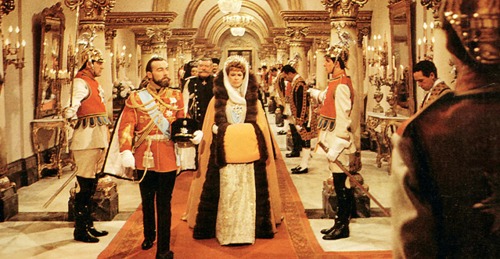
That said, Nicholas and Alexandra does work as a spectacle, as a showcase for beautiful clothing and ornate scenery.  As a character study, Nicholas and Alexandra largely fails but, as a fashion show, it’s actually a lot of fun.    Early on in the film, there’s a lengthy sequence in which Nicholas and Alexandra walk down the red-carpeted hallways of their palace.  It’s shot through Nicholas’s eyes and we see a collection of guards and noblemen and women standing to the side and bowing their heads as the Tsar and his wife walk past.  It’s a good scene and one that perfectly shows not only the life that Nicholas is used to but also why Nicholas doesn’t want to change that life.

baktna03

Perhaps not surprisingly, the first two hours of Nicholas and Alexandra work best when they focus on the flamboyant character of Rasputin.  Baker does a really go job as Rasputin, delivering all of his lines with a ferocious intensity while staring with obviously unhinged eyes.  When he’s with Alexandra, Rasputin is calculating and coldly conniving, providing just enough comfort to keep her under his control.  When he’s with Nicholas or any of the other male members of the court, he reveals himself to be an arrogant libertine, making profane jokes and bragging about his conquests.  It’s a really good performance but, as with so many other good performances in this film, it occasionally gets lost in the film’s dense production.

The best moments of Nicholas and Alexandra come towards the end, with the humbled Nicholas finally revealing his humanity and the Tsar’s family struggling to maintain their dignity even as their inevitable fate approaches.  At this point, the performers came to life.  The film suddenly had an emotional resonance.  It finally became about something!  For those final 20 or so minutes, Nicholas and Alexandra suddenly seemed worthy of being awarded.

In fact, based on those final 20 minutes, I would even be willing to see a sequel called Nicholas and Alexandra and Rasputin Makes Three.  

(Though I’m not sure how that sequel could ever be made.  As @Kev1Media pointed out when I suggested it on twitter, Adam Sandler would have to be somehow involved.)

As for Nicholas and Alexandra, it’s not a great film but if you’re into history or you’re an Oscar completist like me, the film has its occasional charms.  You just have to be willing to look for them.

Nicholas and Alexandra