VGM Entry 25: Meanwhile in Europe…


VGM Entry 25: Meanwhile in Europe…
(Thanks to Tish at FFShrine for the banner)

It can be pretty easy to get boxed into a NES perspective and forget that, while Nintendo may have controlled the majority of the gaming market, they weren’t a total monopoly. The Commodore 64 in particular was still a close rival in the area of gaming music.

The same small handful of names seem to pop up everywhere I turn for C64 music. I don’t know if there were in fact fewer musicians, if their works drastically outshines the competition, or if most C64 composers have been unfairly forgotten, but I can tell you this much. Between 1985 and 1987 Rob Hubbard composed the music for over 60 video games. That is completely unheard of for any other time and any other system. Monty on the Run, the first Hubbard work to catch my attention, also happened to be one of his earliest. He would carry on the innovative tradition for many years to come, with such original (to the best of my knowledge) compositions as Nemesis the Warlock (Martech, 1987) rivaling his more famous 1985 works.

The tendency towards covers continued as well. Rob Hubbard visited Larry Fast and his Synergy project again on Zoids (Martech, 1986), this time arranging “Ancestors” from Audion, the same album that featured “Shibolet”. This time around, a version of the original music is conveniently available.

Which Hubbard music I post from here is really quite arbitrary, because the quality of his works is consistently high. Delta (Thalamus, 1987) is among my favorites. Delta is an interesting example of just how low-key video game development used to be. The sequel to Sanxion (Thalamus, 1986), both Delta and its predecessor were programmed by Stavros Fasoulas and composed by Rob Hubbard. To the best of my knowledge, that’s it. Perhaps this is why Hubbard was not composing ending credits themes.

I’ve read that the music to Delta was inspired by Koyaanisqatsi by Phillip Glass, but I have no reliable source to confirm this, and I have not heard the song myself.

Ben Daglish is another prolific C64 composer with dozens upon dozens of titles to his name. It’s pretty easy to miss soundtracks like Mountie Mick’s Death Ride (Ariolasoft, 1987) in the sea of material out there, especially with Daglish not getting quite the excessive attention of Hubbard and Galway. A great stand-alone song, Mountie Mick’s Death Ride also achieves a much higher level of game relativity than the average C64 composition. Unless this video is misleading, the game doesn’t seem to have had a seperate sound effects track at all; Daglish’s composition incorporated the chug of the train into the basic beat of the music.

http://www.youtube.com/watch?v=n8jI_BUvUGI

(This video must have been removed in the past day or two, and I could not find a replacement nor did I have time to overhaul my article to adjust for it. I do hope this was deleted by the poster’s choice and not another victim to the most recent string of copyright threats by these media conglomerates who seem to be buying up massive quantities of obscure, out of print material and erasing all record of their existence. A whole ton of similarly innocent videos from different users seem to have vanished in the past few days.)

A Commodore 64 composer I drew attention to in an early post was Martin Galway, for his work in Yie Ar Kung-Fu and Roland’s Rat Race. I didn’t quite realize how significant the guy was at the time, but the more C64 soundtracks I look at (at least up through 1987), the more he comes across as the guy who scored every soundtrack that Hubbard didn’t. The two both put out ridiculous numbers. To Hubbard’s 60+, Galway can add another 30. Just how many games were released in this three year span?

By 1987, Galway seems to have gotten pretty experimental. A lot of his works don’t feel quite as “safe” as Hubbard’s. Game Over (Imagine, 1987) is a case in point. Weird as it may be, the first 1:50 still constitute a functional game soundtrack. But as the melody all drops out and nothing but Galway’s bizarre experimental drumming is left behind, well… whatever your take on the composition, I think you’ll be hard pressed to conceive of a relevant gaming context.

http://www.youtube.com/watch?v=jZcB_WOuPhQ

Maybe it’s just Game Over‘s cool box art that makes me think a relevant gaming context matters in the first place. I mean, if you tried to musically capture the title screen of The Baby of Can Guru (Rainbow Arts, 1987) you would probably be fired. So just as he did with The Great Giana Sisters that same year, Chris Hülsbeck said “to hell with this” and wrote whatever pleased him.

I mean, if the significance of what you’re now hearing hasn’t sunk in yet, let me try to clarify:
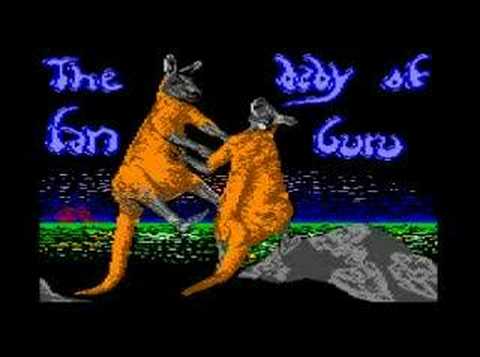
THIS GAME has a wicked soundtrack.

Anyway, this about wraps up my thoughts on SID music up through 1987. I will leave you with another Martin Galway piece: the Commodore 64 port of Arkanoid (Imagine, 1987), which is really just as absurd as Hülsbeck’s music for The Baby of Can Guru when you consider that the game is nothing more than a Breakout copycat.

http://www.youtube.com/watch?v=1stW0J7Myew

Rob Hubbard and Martin Galway were not the only two people writing music for the Commodore 64–I still know next to nothing about David Whittaker, for instance–but it is consistently their works which strike me as noteworthy in the mid-1980s. Chris Hülsbeck, or Huelsbeck if you prefer, seems to really start to make his presence known in 1987, and the works of Jeroen Tel would soon follow. Tim Follin, the mastermind behind the Bionic Commando port arrangement, would also start to really expand his impact beyond the ZX Spectrum in the late ’80s. ’85-’87 might for many people constitute the real glory days of Commodore 64 music, but there was much greatness still to come.

———————-

Notice: Square Enix have apparently deemed one of my soundtrack reviews a copyright infringement and demanded I remove the offending content (brief audio samples from an out of print ost). I have complied, and I kindly encourage you to boycott all Square Enix products in the future. Since their games are terrible these days anyway I am probably doing you a favor.

VGM Entry 09: Nintendo’s turn


VGM Entry 09: Nintendo’s turn
(Thanks to Tish at FFShrine for the banner)

If a bit humbled by less apparent contemporaries, Koji Kondo’s work in Super Mario Bros. (Nintendo, 1985) nevertheless stands as the most recognized video game music in the world. Your average Joe on the street is more likely to identify it than a Beatles or Dylan song. A lot of this has to do with successful marketing. Super Mario Bros. is not the most distributed game of all time. In fact, it barely sneaks into the top 10, at roughly 40 million copies sold. A lot of this has to do with dirt cheap mobile phone distribution. (Apparently that Angry Birds game has broken 1 billion. I still have no interest in checking it out, and anyway it’s pretty easy to exploit a free download to your heart’s content to get into the world record book. Does one seventh of the world’s population even own smartphones?) Of games that actually require you spend a little, the 2006 title Wii Sports is leading the records at 79 million. It must be that economic depression…

But really, if you asked people what they thought was the all-time best seller I’m pretty sure most would mention Nintendo’s 1985 classic, and that is an indication of the company’s groundbreaking marketing strategy. If you owned a Nintendo, you knew Mario and his music. And if you played video games in the late 80s, you probably owned a Nintendo. The company has moreover been persistently re-releasing the game ever since its conception, not to mention incorporating features of its classic soundtrack and iconic characters into newer games. The only prior game that really offered this sort of bundle–very catchy music, memorable characters, massive distribution–was Pac-Man.

But a 5 second song that doesn’t even loop and a big yellow dot just aren’t all that satisfying. Oh the ghosts had names, and I’m sure if I was born a few years earlier I’d have gotten a kick out of pretending they were somehow relevant and imagining some sort of weird plot to it all. (Preferably a better one than the Hanna-Barbera 1982 Pac-Man tv series.) But all of the important features, while present, were just too simplistic to stand the test of time. And it wasn’t a game design you could make good sequels to.

What Super Mario Bros. really offered was a full package. The “best” music of its day? No. The most memorable characters? Not in isolation. But all of the features came together to make a game that really had no flaws. Nintendo knew it, and they ran with it.

If I tried to compare Koji Kondo’s music to other game musicians of the day, I might sound a little unfair. He certainly wasn’t revolutionary in style; his music was if anything retro, harking back to earlier carnival- esque soundtracks, whereas electronic experimentation was the cutting edge. Compared to the likes of Monty on the Run (which by the way, despite being only one song, was longer than the Super Mario Bros. soundtrack in its entirety), the game sounds a little childish. But that was, after all, the target audience, and let’s not split hairs here. Koji Kondo is brilliant. He wrote a soundtrack that was simultaneously extraordinarily catchy and quite aesthetically pleasing. It never clashes with the game. It never speaks out louder than the game. It just merges harmoniously, and keeps on playing in your head when you power off.

Maybe that should be remembered as one of his greater contributions to video game music. A lot of the Commodore 64 tracks I’ve been listening to, while feeling more progressive than Super Mario Bros., seem to disregard their games entirely. A good case in point is Roland’s Rat Race.

Another 1985 title, composed by Martin Galway, Roland’s Rat Race (Ocean Software) is a sleazy little bop, perfect for an inner-city street fighter, or perhaps, in consideration of the peculiar opening sequence, something to do with extraterrestrial pimps. It’s great stuff, way better than the vast majority of soundtracks that would ever appear on the Nintendo Entertainment System. But the problem here should become pretty obvious when you take another look at the game’s cover art.

You will find irrelevant soundtracks up to this day, and plenty of carefully coordinated ones prior to Koji Kondo, but I do have to wonder if perhaps Super Mario Bros.‘ success lead to developers demanding a little more attention to audio relativity.

VGM Entry 08: Ports complicate the picture


VGM Entry 08: Ports complicate the picture
(Thanks to Tish at FFShrine for the banner)

While I have noted that composers remained within regional spheres, games certainly did not. Ports reigned supreme, and it was not uncommon for a game to appear around the world in a half dozen different formats. Each of these required a group of programmers familiar with the given system, and it was certainly not always the case that the original arcade version remained the best at the end of the day.

Take Commando (Capcom, 1985) for instance. The original main theme was composed by Tamayo Kawamoto, an obscure name which will persistently resurface throughout this series of articles. It’s certainly a commanding little march (utilizing the YM2203, if my previous article has peaked anyone’s interest in this regard), and I’d have fed in my quarter in the hopes of hearing more. But quite a number of Kawamoto’s soundtracks are better known for what other artists made of them in the port process than in their original form, and Commando is no exception.

Put it in the hands of Rob Hubbard and, well, did you expect anything less? This wild ride might be his most famous 1985 work after Monty on the Run, and it’s all the more enhanced when you realize how distinct it was from the original. Again Hubbard shines best when he is expanding and improvising upon the music of others. The potentially performable original work is completely lost here, transformed into a uniquely SID sound and style, and with all due respect to Tamayo Kawamoto, its certainly not worse off in consequence. The problem, which would go on to haunt countless composers down the line, is that most fans of Commando have no idea Kawamoto had any part in writing it.

The composition was actually a single day project, and the entire port was pushed through by Elite Systems in a mere two months. Hubbard briefly discussed it in an interview by Jason ‘Kenz’ Mackenzie’s Commodore Zone magazine. (Issue 10 as best I can tell, probably released in 1997): “There is an interesting story behind Commando. I went down to their office and started working on it late at night, and worked on it through the night. I took one listen to the original arcade version and started working on the c64 version. I think they wanted some resemblance to the arcade version, but I just did what I wanted to do. By the time everyone arrived at 8.00am in the morning, I had loaded the main tune on every C64 in the building! I got my cheque and was on a train home by 10.00 am…

Yie Ar Kung-Fu (Konami, 1985) is an especially odd game to consider, because its ports varied so drastically. I couldn’t find a stand-alone sound sample of the original arcade version, but you can hear it well enough beneath the sound effects of this gameplay video. The upbeat, distinctly Asian sound is a refreshing change of pace from the usual video game song styles, and in consideration of what Rob Hubbard did with Commando, you can imagine the potential for new arrangements this presents. Arguably the most famous version of the game’s music, however, is a completely bizarre departure.

The only rational explanation I can think of for Martin Galway having replaced the traditional Asian music theme with a completely irrelevant cover of “Magnetic Fields” by Jean Michel Jarre is that the title screen music is, in fact, completely irrelevant. I think perhaps Galway, either by request or on his own initiative, submitted the song as an all-purpose Commodore 64 option for Imagine Software, who produced the European computer ports of the game, and that it found its way into Yie Ar Kung-Fu simply because it happened to be available at the time. It is not one of Galway’s finer works, but I suppose you can do what you want to the loader screen. It was the combat music that really defined the game.

http://www.youtube.com/watch?v=rC2SBO_-NX4

Even so, the actual gameplay music to the Commodore 64 port of Yie Ar Kung-Fu is as unexpectedly similar to the arcade as the title screen is unexpectedly divergent. The arrangement makes no effort whatsoever to expand upon or even properly convert the original arcade gameplay music to suit the SID sound. Instead we’re met by an unimaginative attempt to emulate the original as closely as possible, marred by SID distortion which could have so easily emphasized the music’s finest features but instead just drowned them out. I mean, this is far more appropriate than Galway’s load screen, but so much for a middle ground between total disregard for the original and a carbon copy.

http://www.youtube.com/watch?v=5OOm4CyFutQ

And then you have the Famicom/NES version, released in April 1985. (That’s five months before Super Mario Bros., to put things in context.) Without altering the style of the arcade version in the slightest, it offers an almost entirely original song. It’s really the best version of Yie Ar Kung-Fu out there–you’d be hard-pressed to argue otherwise–and its existence is a bit puzzling. Who composed it?

The notes I’ve found on Yie Ar Kung-Fu credit Miki Higashino, but they fail to distinguish between the arcade and NES versions, as if these weren’t completely different songs. Now, I am inclined to think Higashino wrote both, which is quite remarkable considering she was only 17 years old at the time. (The only other really famous game musician I can think of to get this early of a career start is Tim Follin.) The other titles credited to Higashino in the mid-80s don’t exhibit this kind of quality, but in consideration of the fact that ten years later she would compose one of the greatest game soundtracks of all time (Suikoden), I know she had it in her. The Suikoden soundtrack is predominantly folk and traditional music (like Yie Ar), and the consistency of style between the arcade and Famicom songs favors a single composer.

The other thing Higashino-authorship has going for it is that she worked for Konami, who made both the arcade and Famicom versions. She would have been involved in the sound team of both, so it’s reasonable to believe she would have had the liberty to create an entirely new song when it came time to program the port. Her hands would have been tied for the European versions, which were produced by Imagine Software. On a final interesting note, the MSX version ports the Famicom soundtrack, not the original arcade music.

It’s all just speculation though. Anyone at Konami could have potentially been responsible for the changes. I’ll leave you with one final version that was most certainly not arranged by Miki Higashino. … Ok, I’m really going to try to avoid video game covers where they aren’t historically relevant, but you have to admit this Markdoom Shehand cover is one of the most awesome things ever.