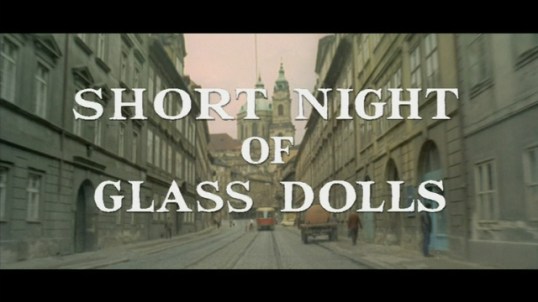
Short Night of Glass Dolls, an Italian thriller from 1971, opens with the discovery of a body in Prague. American journalist Gregory Moore (Jean Sorel) is found lying in a plaza, his blank eyes staring up at the sky. When he is examined by a doctor, we can hear a heartbeat pounding faintly on the soundtrack but Gregory is still declared dead. At the hospital, he is taken down to morgue and left on a slab until a coroner can get around to opening him up….
The only problem is that, as the heartbeat indicated, Gregory Moore is not dead! Instead, he’s paralyzed. He can’t move or speak but he is alive and he can think. As he waits to be dissected, Moore tries to figure out how he came to be in the situation. He searches through his mind and we search with him. He remembers his lover, Mira (Barbara Bach), who begged him to help her defect. He remembers how she mysteriously vanished and how he worked with Jessica (Ingrid Thulin) and Jacques (Mario Adorf) to investigate her disappearance. Moore’s mind is full of disturbing and surreal images but, as he remembers, it slowly starts to make sense. And yet, even if Moore does eventually figure out what happened to Mira and how he came to be paralyzed, the coroner is still making his way over to Moore’s body….
Because it’s an Italian thriller from the 70s, Short Night of Glass Dolls is often mistakenly referred to as being a giallo. Actually, it’s not. Though the film does have the type of convoluted plot and the stylish imagery that is typically associated with the giallo genre, the film also lacks a black-gloved killer and really, it can’t be a giallo unless you have the unknown killer wearing black gloves. Instead, Short Night of Glass Dolls is a deliberately paced paranoia thriller, one in which Moore uncovers not just a single crazed killer but instead a shadowy conspiracy. It’s also an effective horror film, one that makes good use of Prague’s gothic atmosphere and which is full of haunting imagery. Whether it’s the leering gargoyles that seem to be present on every building or the mysterious chandelier that continually shows up randomly in Moore’s mind, Short Night of Glass Dolls plays out like a cinematic dream. Moore finds himself trapped, both physically and mentally. His body is trapped in the morgue while his mind is trapped in the past.
Director Aldo Lado was always one of the more political of the Italian thriller directors and, not surprisingly, there’s a heavy political subtext to Short Night of Glass Dolls. It’s probably not a coincidence that the journalist, who starts out as being cocky just to eventually discover that he doesn’t understand the world as much as he thinks he does, is an American. It’s also not a coincidence that the film takes place in Prague, which was, at that time, a Communist-ruled city. Prague is portrayed as being a city that is controlled by secret police and secret societies, where no one is allowed to fly free. In the end, Short Night of Glass Dolls is full of secrets.
The name inspires a lot of reactions. Some people will tell you that Dario Argento is one of the greatest directors of all time. Some people regularly cite him as being a prime example of an artist who hit his peak too early and who has spent the latter part of his career imitating his previous successes. Some people will tell you that his films are dangerous. He’s one of those directors whose films always seem to end up getting banned in certain communities. Other cineastes will always praise him as a superior stylist whose influence is still felt to this very day. Argento’s films have inspired thousands of horror filmmakers. His films have also inspired a countless number of viewers to fall in love with horror. Without the influence of Argento the horror genre would be not only less interesting but less profitable as well.
Myself, I’m a huge Argento fan. Yes, I do love Suspiria but then again, everyone love Suspiria. I have also made it a point to track down and watch the forgotten and/or critically reviled Argento films, like Trauma and The Phantom of the Opera. My love of Argento is so strong that I usually even find myself enjoying his less acclaimed work as much as his acknowledged triumphs. He is one of the masters of horror, a true maestro of Italian art. For the longest time, I’ve been meaning to watch and review all 21 of Argento’s cinematic thrillers. (Sadly, his one non-thriller, The Four Days, is notoriously difficult to see.) With this being October, I figured why not now?
Dario Argento made his directorial debut in 1970 with The Bird With The Crystal Plumage. Before directing his first movie, Argento had been a film critic and a screenwriter. (Among other credits, he is listed as being one of the writers of Sergio Leone’s Once Upon A Time In The West. Interestingly enough, his co-writer was another future director, Bernardo Bertolucci.) With his very first film as a director, Argento established himself as a master of both suspense and horror.
I have seen some reviews that have identified The Bird With The Crystal Plumage as being the first giallo film. That’s not at all true. If anything, the credit for directing the first giallo should probably go to Mario Bava (who directed The Girl Who Knew Too Much in 1964) and some students of Italian cinema would even disagree with that. However, The Bird With The Crystal Plumage undoubtedly did a lot to popularize the genre outside of Italy.
The film tells the story of Sam (Tony Musante) and his girlfriend, Julia (Suzy Kendall). Sam is a writer and he’s living in Rome. Argento is not traditionally known as an actor’s director but Musante and Kendall are both remarkably sympathetic in their roles and they seem to have a very real chemistry when they’re both on-screen together. You actually do care about them as a couple and you find yourself hoping that nothing bad happens to them. One thing that I liked was that their tiny apartment looked like it was someplace where a couple actually would live, love, and try to solve a murder. Looking at Sam and Julia in that apartment (which is decorated with a picture of Albert Einstein and a poster reading “Black Power!”), you get the feeling that they have an existence outside of what you’re seeing during the film’s 94 minute running time. They feel real.
Reportedly, Tony Musante and Argento did not have a great working relationship. (Mustante was a character actor who wanted to talk about motivation. Argento was more concerned with the technical aspects of shooting the film.) Mustante may have been miserable but that actually works for his character. When we first meet Sam, he’s frustrated because he’s suffering from writer’s block. He’s so frustrated that he’s on the verge of moving back to the United States. Sam’s frustration feels real and if that’s because Musante happened to be frustrated while shooting the film, so be it. Whatever works.
One night, Sam goes for a walk and witnesses a stabbing in an art gallery. Monica Ranieri (Eva Renzi) survives but it appears that her assailant has managed to escape. The police suspect that Sam might be more than just a witness so they confiscate his passport. Until the attacker is caught, Sam is stuck in Rome.
There’s a serial killer terrorizing Rome and both Sam and the police suspect that Monica nearly became the killer’s latest victim. Some of the film’s most unnerving sequences are shot from the point-of-view of the killer, a technique that both leaves the killer’s identity a secret and also makes the audience complicit in the murders. It’s as if Argento the film critic is daring the audience to consider why they’re watching what Argento the director is doing.
(And the murders in The Bird With The Crystal Plumage are brutal, even by the standards of Italian cinema. The first murder that we actually witness — which is usually referred to as being “the panty murder,” for reasons that I’m not going to freak myself out by describing — is pure and total nightmare fuel.)
Everything that you might expect to find in a giallo is present in The Bird With The Crystal Plumage. It may not have been the first but it’s definitely one of the prototypes for what the genre is usually considered to be. Graphic violence, sexual perversion, point-of-view shots, a constantly roaming camera, a dramatic musical score, a killer who wears black gloves and carries a razor, a witness who has to prove his innocence, and a solution that’s revealed only when Sam reexamines what he thinks he saw; it’s all here.
What distinguishes The Bird With The Crystal Plumage is the style with which Argento tells his story. Dario was 30 years old when he directed The Bird With The Crystal Plumage and there’s an infectious enthusiasm to the way he frames the mayhem. Like many film critics directing their first film, Argento fills his debut with homages to earlier films. You can tell he’s having a lot of fun while discovering just how far he can go without losing his audience.
46 years after it was first released, The Bird With The Crystal Plumage holds up surprisingly well. It’s a nightmarish but compulsively watchable thrill ride and it remains one of Argento’s best.
 Through the Shattered Lens