Yoko Shimomura was a rising star when she composed the Super Mario RPG soundtrack in 1996, fresh out of Capcom and ready to embark on a higher profile career with Square. The whole soundtrack was exceptional, but one track in particular was so catchy that it’s been stuck in my head ever since, and it’s most certainly appropriate for a fall theme.
Within the game, the song plays to a forest maze–one of those looping maps that can have you wondering around forever if you don’t pay attention. ‘Forest music’ has always been among the best tracks in RPG scores, but I don’t know that anyone’s pulled one off as effectively as Yoko Shimomura. It’s not quite as dark and haunting as say, Koji Kondo’s “Forest” from A Link to the Past or Yasuaki ‘Bun Bun’ Fujita’s “Deep Forest” from Breath of Fire, nor as calm as Yasunori Mitsuda’s “Secret of the Forest” from Chrono Trigger, to name some contemporaries. It’s far more friendly and inviting, which really makes it all the more dangerous, because at the end of the day you’re still getting lost in a deep forest maze filled with monsters out to kill you. It draws you in, makes you want to keep on wandering, like a good proper evil enchanted forest ought to.
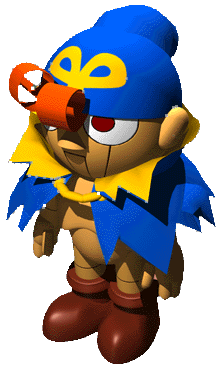
It’s also the theme song to Geno, a doll possessed by the spirit of one of the stars you’re out to rescue, who really creeped me out as a kid because I thought that orange thing on his hat was his nose for some reason.
VGM Entry 55: Honorable mentions of ’92
(Thanks to Tish at FFShrine for the banner)
No ‘best of’ compilation can ever satisfy everybody, and the difficulty of coming to agreement increases with the number of options available. With the average game soundtrack’s quality always on the rise, the task of singling out anything but the obvious best becomes sort of arbitrary after a while. I present these last few titles with the recognition that I have probably missed quite a number of arguably better works:
Super Mario Kart (Nintendo, 1992) would be the last major title passed off to Soyo Oka at Nintendo. Having scored Pilotwings in 1990 and Sim City in 1991, her distinct style briefly became a major voice of the Super Nintendo, but whether she should be counted among the best is very debatable. I will stand by the claim that Sim City was an outstanding and underrated work, but in general Soyo Oka was no Koji Kondo. Her inclusion isn’t obvious.
I played Super Mario Kart as much as any kid, and not a single song from it stuck in my memory over the years. The nostalgia here isn’t old familiar tunes. It’s an old familiar style. Soyo Oka had an extraordinarily distinct sound, and it’s her style of music, not any of the melodies, which lends such consistency down the line from Pilotwings to Super Mario Kart. I count this game among the best of 1992 because it does an excellent job of sounding like a Nintendo game for the SNES. It’s quite possible that Soyo Oka’s Nintendo career quickly diminished afterwards simply because they stopped producing this type of game. Her all-purpose sound worked great for simulations and racing, but after 1992 Nintendo came to focus much more heavily on character/plot-centric action and RPG titles. Star Fox, Super Metroid, Donkey Kong Country, these sort of games focused on franchise characters who required distinct theme songs.
Nintendo did not produce any more high-profile, well marketed games that could have actually fit Oka’s style until 1996, with Ken Griffey, Jr.’s Winning Run and Tetris Attack, but by then she had left the company.
I have only found two titles crediting Taro Kudo as composer, and that’s quite a shame, because both have found their way into my vgm series. Masanori Adachi’s partner on Super Castlevania IV, Kudo took on the task again the following year with Axelay (Konami, 1992). His mostly chill, relaxing tunes must have made a fairly substantial impact on the gameplay. Nothing frantic or unnerving here; the music carries a sense of confidence, and makes the game look a lot easier than it probably was.
Devilish (Hot-B, developed by Genki Co, 1992), known as Dark Omen in Japan, begins like some sort of Home Alone soundtrack, but before long it breaks out into more recognizable Genesis beats that will characterize a large portion of the game. Hitoshi Sakimoto managed to produce a very consistent and haunting selection of songs here that accurately reflect the settings of the game. These settings are themselves something of an anomaly. The game is basically an enhanced version of Breakout, but it’s set in an RPG world. You bounce into those rectangles in forests, deserts, airships, castles, the works.
About the only thing this bizarre mashup has against it is a plot. The main villain “turned the prince and princess into two stone paddles”? Really? … Really?
When I was a kid I for some reason always thought Kirby was an old, classic Nintendo character, perhaps because Kirby’s Adventure (Nintendo, 1993) was released for the NES despite the Super Nintendo having been around for three years. What inspired Nintendo to market a major franchise character on outdated and secondary systems is beyond me, but the little pink cream puff wouldn’t make his Super Nintendo debut until Kirby Super Star at the absurdly late date of March 1996. This may have been due in part to HAL Laboratory, not Nintendo, actually developing the games. But HAL Laboratory had released multiple Super Nintendo games by the end of 1991, so your guess is as good as mine. Kirby’s Dream Land (Nintendo, 1992) for the Game Boy was in fact the first game of the franchise, and it established a lot of the series’ iconic songs.
The other thing that caught me off guard is Jun Ishikawa composed it. I had been lead to believe it was the work of Hirokazu Ando. Ando did make an appearance on Kirby’s Adventure and many future installments, but the earliest original compositions appear to belong to Ishikawa. Ando and Ishikawa appear to have been HAL Laboratory’s main composers, collaborating together in many HAL titles both within the Kirby franchise and without, and perhaps this has created some of the confusion. Or perhaps Wikipedia is simply wrong. The bold claim in the Kirby’s Dream Land article that Jun Ishikawa was “the only composer for this game” (rather than just listing him as the composer and leaving it at that) is sourced to another game wiki site (Moby Games) which lists the credits in more or less the same unsourced manner that Wikipedia does, and makes no such explicit claim. Maybe Ishikawa wrote it all, or maybe he and Ando were in collaboration from the get-go, but either way Kirby’s Dream Land initiated a major Nintendo franchise series with catchy, highly regarded songs that ought not go unmentioned.
The last song I’d like to point out is the title theme to Agony (Psygnosis, 1992), composed by Tim Wright. Agony was a peculiar little shmup for the Amiga 500, fantasy themed to the extent of featuring a laser-blasting owl as the main hero. There is little room in your standard video game for a classical piano piece of this sort; it’s certainly not the type of thing you might associate with active gameplay. With the Commodore 64’s long history of loader music completely disassociated from the game however, and the Amiga’s much improved audio, this was the most probable platform for a work like Tim Wright’s to take shape.
VGM Entry 42: SNES
(Thanks to Tish at FFShrine for the banner)
Are we really there? I had naively intended to start this whole project off with a simple one to two post summary of video game music prior to 1990, then jump right away into the Super Nintendo. I suppose it didn’t quite work out that way.
I don’t know much about technological specifications. I have no idea what made the SNES tick the way it did. But there had to be something inspirational to musicians in its design. The Super Famicom was launched in Japan on November 21, 1990. By the end of the year it had nine titles, and as far as I’m concerned only two of them lacked noteworthy soundtracks. That’s better than the Genesis/Mega Drive managed in its first two years. And of the two that fail to impress me, Final Fight (Capcom) was a port arrangement of the arcade original and Super Ultra Baseball (Culture Brain, Super Baseball Simulator 1.000 in the U.S.) was precisely what it sounds like–the sort of game only a Tim Follin would put serious energy into.
F-Zero (Nintendo)’s soundtrack, composed by Yumiko Kanki (Naoto Ishida also wrote two tracks for it), is not one of the best on the SNES. Top 50? Eh, probably. But it sounds unbelievably better than nearly anything before it. The system brought nearly arcade-quality music to the mass consumer market, but also to musicians accustomed to having to compensate for lack of quality with highly creative song-writing.
So you got both. And you would continue to get both for the better part of a decade. Bombuzal (Image Works) was originally released for the Commodore 64, Amiga, and Atari ST in 1988. Its original version, composed by Ross Goodley as best I can tell, was pretty catchy in its own right. But the clarity of each tone on the Super Nintendo version (later released in North America as Kablooey), arranged, I believe, by Hiroyuki Masuno, gives the song a degree of fullness it could have never possessed before, even on the Amiga. And much like the Commodore 64/Amiga musicians of old, Hiroyuki Masuno was not afraid to improvise, incorporating his own melodies into the song and altering the rhythm and general vibe to suit his own whims. Hiroyuki Masuno’s revised Bombuzal theme is downright addicting.
SD The Great Battle (Banpresto) is a fun soundtrack to point out, both because you’ve almost certainly never heard it and because I think it really shows off how much better fairly generic scores could sound now. I mean, there is absolutely nothing special about what Norihiko Togashi did here. When the melodies are not a bit too overly repetative for their catchiness to be a virtue, they’re not particularly memorable at all. The only thing really to distinguish it from a standard to slightly above average NES soundtrack is the sound quality. But Norihiko Togashi makes excellent use of this. The accompaniment often pans and fades. The slap bass effectively fills in the percussion while still sounding like a real bass, and these never tastelessly overpower the melody as they’re so inclined to do on the Genesis/Mega Drive. It’s a completely forgettable little work which nevertheless surpasses a lot of the competition of its day.
Super Mario World by Koji Kondo obviously deserves mention, though I am not as fond of it as I perhaps ought to be. As a kid, I honestly found it kind of annoying, and I can understand why. Koji Kondo’s weird mix of Caribbean, Latin American, and African rhythms and instrumentation sound more like the sort of “world music” sampler cd you find at Starbucks than authentic ethnic music. (I find it funny that the PHD-waving ethnomusicologists I met in college placed the highest value in that sort of crap.) But this is Mario, not bad scholarship, so what he was borrowing for his compositions is really quite irrelevant. The end result is what matters, and the end result of most of these songs is pretty cheesy, whether you like it or not. It’s not until the ending credits (8:14) that Koji Kondo returns to the classic sound that so delights me in Super Mario Bros. 2. (That being said, Super Mario World‘s credits is one of my favorite Kondo songs ever.) This might have been the first game I ever personally owned–no more pretending the neighbor kid was my friend!–but it doesn’t hold much nostalgic value for me, and I think the music is somewhat to blame.
But enough with the negative criticism. Let’s not overlook the shear quantity of unique tracks in this game (well over 30 if we include some of the variations and shorter jingles). The “world music” gig is only a dominant fraction of a much larger collection. Such noteworthy tracks as “Forest of Illusion” (6:12), “Sub Castle”, “Koopa Junior”, “The Evil King Koopa”, and “Athletic” possess none of these nusences (as long as you stay away from Yoshi, which I never did, hence perhaps my youthful distaste). And had there ever been a game even remotely approaching Super Mario World‘s extent of gameplay relativity? Kondo’s own work on Super Mario Bros. 3 might come the closest, and it’s a long ways off. Super Mario World offered a ridiculous degree of diversity, with each zone and situation possessing a distinct and entirely appropriate sound. This might come to be the future norm for RPGs and adventure games, but we’re dealing with a simple side-scroller here.
Super Mario World was a grand showcase of the endless new possibilities made available by the Super Nintendo. It may lack some of the timeless classics of Super Mario Bros and Super Mario Bros 2, but only in proportion to its length. Its place in the history books of video game music is well deserved.
VGM Entry 29: Mario’s many sequels
(Thanks to Tish at FFShrine for the banner)
While the Genesis was just getting started, Nintendo developers were pumping out sequels. Super Mario Bros. 2, Final Fantasy II, Mega Man 2, Dragon Quest III, Super Mario Bros. 3… They were coming out right and left in 1988, and most of them were improvements over the originals.
The first thing you might ask is how Super Mario Bros. 2 and Super Mario Bros. 3 ended up being released in the same year. Well, they actually came out a mere two months apart. There is a bit more to this story though, and since Super Mario Bros. 2 has by far the best music among NES installments of the series, there should be time enough to tell it.
The first game to be titled “Super Mario Bros. 2” was released in Japan in March 1986. It seems to be readily downloadable today, but if you’re like me and don’t play games much these days you probably only ever encountered it on Super Mario All-Stars (1993) for the SNES, where it was titled The Lost Levels. As you might recall, it wasn’t particularly interesting; it was pretty much identical to the original, music and all, just with new level designs. This was not originally intended to be the case. A much more unique and creative game had been in development, but for whatever reason Nintendo’s market research lead them to believe that an expansion of the original would have greater commercial success. The project in development was passed off to Fuji Television Network and released as Yume Kōjō: Doki Doki Panic in July 1987. Koji Kondo’s original work went along with the package, and much of what you are hearing now first appeared in Doki Doki Panic.
Nintendo sensed a different interest in the American consumer and went ahead with the original project. You may have heard at some point years back–I know I had–that the American Super Mario Bros. 2 was just some cheaply refurbished port of a non-series Japanese title, but this is not entirely correct. The projects were one and the same for much of the game’s development. In a very peculiar turn of events by early gaming standards, North America (and Europe) got the real Super Mario Bros. 2, and Japan got the ripoff. It took so long for the game to be released in its intended form, however, that it ended up launching in North America at pretty much the exact same time that Super Mario Bros. 3 came out in Japan.
Musically, Super Mario Bros. 2 improved on Yume Kōjō: Doki Doki Panic by integrating peppier renditions of themes from the original Super Mario Bros. The music is also a lot more crisp, though that might be the consequence of differences between the Famicom and the NES. At any rate, it is probably my favorite early Koji Kondo soundtrack. The main theme remains, arguably unlike the original Mario Bros. theme, unconditionally pleasant. The limitations of the NES are a total non-factor here. I wish I could pinpoint what sort of style it is–I get some distant vibe of jazz and ragtime–but it either falls beyond my knowledge base or proceeds from nothing more than Koji Kondo’s incredible talent for writing instant classics. I mean, I never played Super Mario Bros. 2 back in the NES days, but it feels more nostalgic to me than the original Mario theme.
Super Mario Bros. 3 is a little less interesting in my opinion, if only because its generally laid back pace and Latin/Caribbean beats just don’t feel quite in harmony with what was probably the fastest-moving of the NES Mario games. But Super Mario Bros. 3 was also the most diverse of these soundtracks, switching up its style as needed to suit a greater variety of level designs. In some instances, most notably “Level 2 Theme” (1:09), Konjo employs sounds more akin to his work in the prequel. “Hammer Brothers” (4:28) seems to be inspired by rock and roll, and the beat-laden revision of the original underworld theme, here amusingly titled “Super Mario Rap” (2:30), is undeniably cool.
I suppose Super Mario Bros. 3 can be justly regarded as the “best” NES-era Mario soundtrack, if nothing else for the shear variety of styles Konjo successfully employed. But it lacks any particular really stand-out tracks–the sort of incredibly catchy anthems for which he is best known.
VGM Entry 20: The Great Giana Sisters
(Thanks to Tish at FFShrine for the banner)
A number of video games released in 1987 would go on to become major generation-spanning series. The Great Giana Sisters was not one of them. In fact, if was probably one of the worst ideas in gaming history. It was apparently developed for release on the Amiga, Amstrad CPC, Atari ST, Commodore 64, and MSX2 all at the same time, with a ZX Spectrum version to shortly follow. It was intended to be Rainbow Arts’ major commercial rival to the smash hit Super Mario Bros. But what was it exactly?
Well, one version of the box art depicts an attractive, perky-breasted woman in a miniskirt flying through a bizarre montage of giant lobsters, magical mushrooms, UFOs, and deadly dragons guarding foreboding castles on grim, icy mountain peaks.
Another depicts two trailer trash meth addicts sporting peace signs and an “I’m Cool” nametag, along with the suggestive comment that “The brothers are history!” A bit contradictory? Well, look right here! Zzap!64 says it’s “the greatest platform game of all time”, so it must be true!
The music, too, might lead you to believe this. It was also one of the first soundtracks composed by the now legendary Chris Huelsbeck (more often spelled Hülsbeck, though the artist himself uses Anglicized adaptation. For the sake of consistency I’ll stick to the latter in the future). The game’s title screen theme is pretty intriguing, bearing a sense of foreboding that aptly reflects the degree of strife and diversity which at least some versions of the cover art promise to bring.
Are you excited? Or at least curious? Good or bad, all signs point to a game that will in the very least be extraordinarily unique. Well, let’s take a look at the gameplay. Brace yourselves.
…
Needless to say, they got their pants sued off and pulled every version of the game from the shelves within weeks of its release, never again to see the light of day until Nintendo, perhaps for pure comedy value, allowed publisher Destineer to release it on the DS last year.
Rainbow Arts was a German publisher, and perhaps copyright laws are different there, but one has to imagine that a good many staff members were flipping burgers after this brilliant idea. Chris Hülsbeck would not be among them. He would go on to compose for many Rainbow Arts games to come, including the highly acclaimed Turrican series for which he is best known.
But before we brush The Great Giana Sisters off, really, what is going on with the music here? The main gameplay song is quite catchy and appropriate, but the title screen and underground theme (see Stage 4 in the video, 3:24) have about as much in common with the game as the box art. It would be interesting to find out why he chose these songs in particular. Perhaps they were some unaffiliated demos he had lying around in a dusty desk drawer, or perhaps he took advantage of a terrible game to write what he wanted to with no concern for relativity.
Whatever the case, the staff at Rainbow Arts heard his work even if no consumers did, and his future game assignments seem to reflect his personal style, not the reverse. The title theme and Stage 4 of The Great Giana Sisters examplify precisely the sound he would become famous for.
VGM Entry 09: Nintendo’s turn
(Thanks to Tish at FFShrine for the banner)
If a bit humbled by less apparent contemporaries, Koji Kondo’s work in Super Mario Bros. (Nintendo, 1985) nevertheless stands as the most recognized video game music in the world. Your average Joe on the street is more likely to identify it than a Beatles or Dylan song. A lot of this has to do with successful marketing. Super Mario Bros. is not the most distributed game of all time. In fact, it barely sneaks into the top 10, at roughly 40 million copies sold. A lot of this has to do with dirt cheap mobile phone distribution. (Apparently that Angry Birds game has broken 1 billion. I still have no interest in checking it out, and anyway it’s pretty easy to exploit a free download to your heart’s content to get into the world record book. Does one seventh of the world’s population even own smartphones?) Of games that actually require you spend a little, the 2006 title Wii Sports is leading the records at 79 million. It must be that economic depression…
But really, if you asked people what they thought was the all-time best seller I’m pretty sure most would mention Nintendo’s 1985 classic, and that is an indication of the company’s groundbreaking marketing strategy. If you owned a Nintendo, you knew Mario and his music. And if you played video games in the late 80s, you probably owned a Nintendo. The company has moreover been persistently re-releasing the game ever since its conception, not to mention incorporating features of its classic soundtrack and iconic characters into newer games. The only prior game that really offered this sort of bundle–very catchy music, memorable characters, massive distribution–was Pac-Man.
But a 5 second song that doesn’t even loop and a big yellow dot just aren’t all that satisfying. Oh the ghosts had names, and I’m sure if I was born a few years earlier I’d have gotten a kick out of pretending they were somehow relevant and imagining some sort of weird plot to it all. (Preferably a better one than the Hanna-Barbera 1982 Pac-Man tv series.) But all of the important features, while present, were just too simplistic to stand the test of time. And it wasn’t a game design you could make good sequels to.
What Super Mario Bros. really offered was a full package. The “best” music of its day? No. The most memorable characters? Not in isolation. But all of the features came together to make a game that really had no flaws. Nintendo knew it, and they ran with it.
If I tried to compare Koji Kondo’s music to other game musicians of the day, I might sound a little unfair. He certainly wasn’t revolutionary in style; his music was if anything retro, harking back to earlier carnival- esque soundtracks, whereas electronic experimentation was the cutting edge. Compared to the likes of Monty on the Run (which by the way, despite being only one song, was longer than the Super Mario Bros. soundtrack in its entirety), the game sounds a little childish. But that was, after all, the target audience, and let’s not split hairs here. Koji Kondo is brilliant. He wrote a soundtrack that was simultaneously extraordinarily catchy and quite aesthetically pleasing. It never clashes with the game. It never speaks out louder than the game. It just merges harmoniously, and keeps on playing in your head when you power off.
Maybe that should be remembered as one of his greater contributions to video game music. A lot of the Commodore 64 tracks I’ve been listening to, while feeling more progressive than Super Mario Bros., seem to disregard their games entirely. A good case in point is Roland’s Rat Race.
Another 1985 title, composed by Martin Galway, Roland’s Rat Race (Ocean Software) is a sleazy little bop, perfect for an inner-city street fighter, or perhaps, in consideration of the peculiar opening sequence, something to do with extraterrestrial pimps. It’s great stuff, way better than the vast majority of soundtracks that would ever appear on the Nintendo Entertainment System. But the problem here should become pretty obvious when you take another look at the game’s cover art.
You will find irrelevant soundtracks up to this day, and plenty of carefully coordinated ones prior to Koji Kondo, but I do have to wonder if perhaps Super Mario Bros.‘ success lead to developers demanding a little more attention to audio relativity.


 Through the Shattered Lens