30 Days of Noir #2: Whispering Footsteps (dir by Howard Bretherton)


The 1943 film Whispering Footsteps opens with Mark Borne (John Hubbard) getting ready for his day.  In his bedroom, at the boarding house where he lives, Mark turns on his radio and hears a news report of a double murder in a nearby town.  Two girls have been strangled.

As the news report says that the killer has brown hair, Mark brushes his brown hair.

As the news report says that the killer has brown eyes, Mark looks at his brown eyes in the mirror.

As the news report says that the killer has a “lean, intelligent” face, the camera focuses on Mark’s lean, intelligent face.

Finally, as the news report says that the killer was wearing a gray, double-breasted suit, Mark puts on gray, double-breasted suit.

Yes, Mark looks just like the murderer and that quickly becomes a problem for him as he attempts to go about his day.  When he walks to his job at the local bank, he notices that he’s being followed by a detective (Cy Kendall).  When Mark later tries to take his lunch break, he again finds himself being followed.  Desperate to escape from the detective, Mark steps into a bookstore and buys a random book.  It’s only once he steps outside that Mark discovers that the title of the book is Psychology of the Homicidal.

Mark is a respectable member of the community but, because he looks like a serial killer, everyone in town soon starts to gossip about him.  Why does he go for so many walks?  Why does he sometimes seem to be in a bad mood?  Could he be a murderer?  Even the other residents of the boarding house start to view him with suspicion.  Every time that she sees him, Rose Murphy (Juanita Quigley) screams.

Of course, Rose screams whenever anything happens.  For instance, when she is shown a newspaper story about a local murder, Rose screams.  Whenever anyone walks up behind her, Rose screams.  Whenever anyone says hi to her, Rose screams.  When a woman is found strangled in the basement, Rose screams again.  Admittedly, it’s easy to get annoyed with Rose’s constant screaming but, in that last case, she’s probably justified.

Anyway, Mark only has one person on his side and that’s Brook (Rita Quigley), the daughter of his boss.  And yet, at one point, Brook finds herself being chased through the night by a man in a double-breasted suit.  Is Mark guilty or does he just have the worst luck in the world?

If nothing else, Whispering Footsteps will keep you guessing.  Up until the last minute of the film, you’re never sure whether Mark is innocent or guilty.  Who is the monster, the film asks.  Is it Mark or is it the gossips who have decided to judge him?  As convincingly played by John Hubbard, Mark starts out as upbeat and just a little bit shallow but, by the end of the movie, he’s become a haunted and paranoid man, embittered by the town’s refusal to believe in him.  Charles Halton, as Mark’s self-righteous boss, and Rita Quigley provide good support.  Less successful are some awkward attempts at humor.  It won’t take you long to get tired of Rose screaming.

Clocking in at 52 minutes, Whispering Footsteps was obviously meant to be the second part of a double feature.  It’s a well-done examination of guilt, innocence, and gossip.  See it on a double bill with In A Lonely Place.
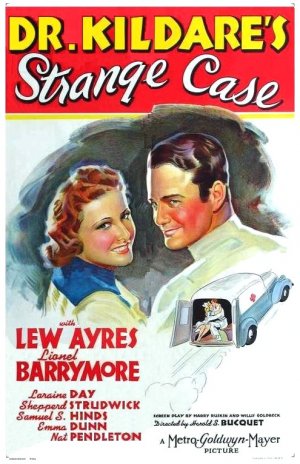
The Fabulous Forties #16: Dr. Kildare’s Strange Case (dir by Harold S. Bucquet)


Dr._Kildare's_Strange_Case_FilmPoster

The 16th film in Mill Creek’s Fabulous Forties box set was 1940’s Dr. Kildare’s Strange Case.  It’s about a doctor who investigates a medical case and wow, is it ever a strange case.

Apparently, there was a whole series of Dr. Kildare films that were released in the 30s and 40s.  I guess the films were the cinematic equivalent of a TV show like Grey’s Anatomy or ER or Children’s Hospital or… well, every medical show that’s ever shown up on TV since the beginning of time.  Dr. James Kildare (Lew Ayres) is a passionate young doctor who may break the rules but he gets results!  His mentor is Dr. Gillipsie.  Gillipsie is played by Lionel Barrymore and since the character is cranky and confined to a wheelchair, it was impossible for me to watch him without thinking about Mr. Potter from It’s A Wonderful Life.  Whenever Kildare went to him for advise, I kept expecting Gillipsie to glare at him and say, “You once called me a warped old man…”

Anyway, Dr. Kildare works in a hospital and, when he’s not silently judging everyone else that he works with, he’s busy silently judging the wealthy Dr. Lane (Sheppard Strudwick), a brain surgeon whose patients keep dying.  Kildare and Lane are also both in love with the same nurse, Mary Lamont (Laraine Day).  Mary wants to marry Kildare but Kildare would rather be poor and single than compromise his medical principles.  Lane, on the other hand, sends her a box full of silk stockings.  Plus, he’s rich!

Seriously, how is this even a competition?  Forget Kildare and marry Lane!

Except, as I mentioned earlier, all of Lane’s patients keep dying.  Is Lane incompetent or, as Kildare suggests, is it possible that brain surgery is just really, really hard?  I imagine it was even harder in 1940, when this movie was being made.  While Kildare and Lane are operating on brains, Dr. Gillipsie is still using leeches to suck sickness out of the poorer patients.

(You don’t actually see it happen in the movie but Gillipsie comes across as being a leech man.)

Anyway, eventually, Kildare has to cure a schizophrenic and it turns out that he can do this by putting the man into an insulin coma.  As is explained in great detail, forcibly putting a patient in a coma will cause that patient’s mind to go back to a reset point.  It’s kind of like how Windows sets up a restore point before doing a major update.

And that therapy sounds so crazy that you just know it had to be based in an actual practice.  I checked with Wikipedia and I was not shocked to discover that apparently Insulin Shock Therapy used to be a thing!

Anyway, Kildare’s gets into a lot of trouble for putting his patient into a coma and attempting to erase a huge part of his mind.  Will Kildare’s results vindicate his methods or will Gillipsie have to use leeches to suck the crazy out of the patient’s brain?

Watch the film to find out!  Or don’t.  Dr. Kildare’s Strange Case was directed by Harold S. Bucquet, who did a pretty good job with The Adventures of Tartu.  His direction here is flat and uninspired, which only serves to make this entire film feel like an old TV show.  I’m tempted to recommend the movie just because of the scene where it’s explained that insulin shock therapy causes patients to devolve so that they can re-evolve but otherwise, Dr. Kildare’s Strange Case is forgettable.

If you want to see it, you can watch it below!

http://www.youtube.com/watch?v=8UPFyrlNiGM

Or you can just watch this classic episode of Children’s Hospital!

http://www.youtube.com/watch?v=dpBjqgVaEbk