Late Night Retro Television Review: Highway to Heaven 4.15 “Time In A Bottle”


Welcome to Late Night Retro Television Reviews, a feature where we review some of our favorite and least favorite shows of the past!  On Thursdays, I will be reviewing Highway to Heaven, which aired on NBC from 1984 to 1989.  The entire show is currently streaming on Tubi and several other services!
This week, it’s another courtroom drama on Highway to Heaven.

Episode 4.15 “Time In A Bottle”

(Dir by Michael Landon, originally aired on January 20th, 1988)

A homeless man who goes by the name of Humphrey Bogart (Henry Bal) is arrested for trying to steal a bottle of cheap wine from a liquor store.  The hard-nosed assistant D.A. (Robin Strasser) charges him with a felony.  Jonathan and Mark recruit Humphrey’s friend, Matthew (John Rubinstein), to defend him in court.  Matthew may be homeless but he’s also a lawyer!

It turns out that a corrupt city councilman (Alan Fudge) wants to crack down on the homeless because he wants to turn the homeless district into a commercial area.  If you already guessed that this episode ends with Matthew leading a march of homeless people into a city council meeting while they chant “We will be heard,” then you’ve obviously seen quite a few episodes of Highway to Heaven.

Highway to Heaven frequently did stories about the homeless and I really can’t criticize the show for that.  This was an issue that Michael Landon obviously cared a lot about and the show was usually so earnest and sincere that you could overlook just how heavy-handed it often was.  The homeless people on Highway to Heaven are always a lot more clean-cut and polite than the ones that I used to yell at me when I worked in downtown Dallas.  On Highway to Heaven, the homeless are always funny and philosophical and they have wonderful lessons to teach everyone.  In Dallas, they come up to your car window while you’re stuck in traffic.  In order to visit my aunt when she was dying at Medical City last month, I had to endure being shouted at and occasionally threatened by all sorts of people.  By the end of it, I was running red lights because paying a fine was less annoying than having that guy whole lived at the Forest/Central intersection calling me the C-word while I was waiting for the light to change.

(That’s not say that the homeless should not be treated with compassion or helped because they certainly should.  I’m just saying that this habit that some people have of idealizing and infantilizing anyone living on the streets is, in many ways, as destructive as just ignoring the problem.)

As for this episode, it was a bit too preachy for its own good.  And I know what you’re going to say.  “It’s Highway to Heaven, it’s always preachy.”  That’s true to an extent but the first three seasons were also a bit less self-righteous than the fourth season has been.  The first three seasons featured characters who were often misguided but who were also capable of being redeemed.  In the past, this episode would have been about the city councilman seeing the error of his ways.  This season, though, the city councilman is just evil because he is.  It’s a far more heavy-handed approach to take and, as a result, far less effective.

This is another episode where one impassioned speech manages to change everyone’s mind.  If only things were as simple in the real world.
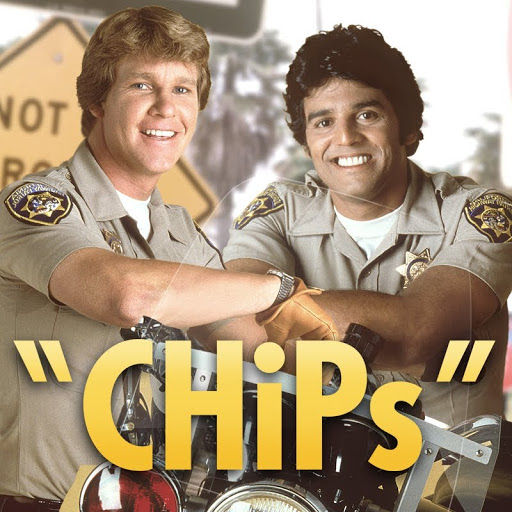
Late Night Retro Television Review: CHiPs 2.21 “CHP BMX”


Welcome to Late Night Retro Television Reviews, a feature where we review some of our favorite and least favorite shows of the past!  On Mondays, I will be reviewing CHiPs, which ran on NBC from 1977 to 1983.  The entire show is currently streaming on Freevee!

This week, Ponch saves us all.

Episode 2.21 “CHP BMX”

(Dir by John Florea, originally aired on March 3rd, 1979)

The California Highway Patrol is sponsoring a BMX racing team!  Sindy and Baker are the coaches while Ponch is …. well, Ponch is mostly just hanging out.  He does find time to flirt with Ms. Ramirez (Mina Vasquez), a teacher who hopes that joining the team could help out an at-risk student named Danny (Kirk Calloway).  Danny likes to vandalize things.  He’s on his way to juvie if Ponch can’t reach him …. hey, you know the drill.  By this point, we all know how this show works.  Of course, Ponch is going to reach the kid.  With that dazzling smile, Ponch can do anything.

It’s Getraer who has the most to deal with during this episode.  After his son is struck by a car, Getraer becomes so distracted on the job that he messes up the arrest of a drug dealer (Henry Olek).  Told by his superiors to take a week off while his son recovers, Getraer instead starts to tail the dealer on his own.  Getraer is determined to put the man in jail.  Fortunately, Ponch is there to help catch him.  Is there nothing that Ponch can’t do?

Seriously, when I watch an episode like this, I can understand why Larry Wilcox apparently did not enjoy working with Erik Estrada on this show.  While Baker humbly does his job without asking for any special recognition, Ponch is portrayed as being so perfect that you half-expect him to start walking on water.  The theme of this episode — and really, the theme of much of the second season — has been that Ponch can ultimately do no wrong.  Even when it looks like Ponch has screwed up, he ultimately turns out to be infallible.  He’s more than just a member of the California Highway Patrol.  He’s St. Ponch of Los Angeles, saving souls while riding his motorcycle amongst the heathens.

It probably sounds like I’m being critical of this episode but I actually enjoyed it, for much the same reason that I enjoy most episodes of CHiPs.  The car and motorcycle stunts were spectacularly filmed and the scenery was nice to look at.  Even though it rains through a good deal of this episode and Getraer, Baker, and Ponch aren’t exactly hanging out in the most glamorous sections of Los Angeles, this episode still manages to make L.A. look like the loveliest city in the world.

And really, even Erik Estrada is entertaining.  It’s easy to laugh at his big smile and his less-than-subtle acting technique but that’s just Estrada being Estrada and, in the world of CHiPs, it works.

The important thing is that everything works out.  Danny wins his race.  Getraer’s son gets out of the hospital.  And maybe Baker will get to do something more than smile at Ponch next week.  We’ll see!

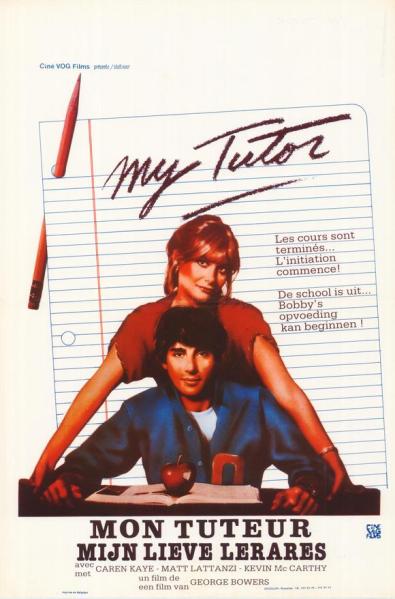
Back to School #30: My Tutor (dir by George Bowers)


my-tutor

It’s the house.

I was recently trying to figure out what it was exactly that I enjoyed about the 1983 teen comedy My Tutor and I finally realized that it all came down to the house.  Like almost every other teen film released in the 1980s, My Tutor is about rich people.  The main character, recent high school graduate and frustrated virgin Bobby Chrystal (Matt Lattanzi), lives in an absolutely gorgeous house.  There’s a huge pool in back and even the guest house appears to be bigger than any place that I’ve ever lived.  Bobby lives in the type of mansion that I’ve always wanted to live in.  For me, the best parts of My Tutor are the scenes that simply follow Bobby as he walks around the grounds of his home.

I just like seeing where people live.

I first came across My Tutor about two years ago when I got the Too Cool For School DVD box set from Mill Creek Entertainment.  My Tutor was one of the 12 movies included in the box set and it was one of the first that I watched, just because the title seemed to promise all sorts of sordid fun.  Looking back on the first time that I ever watched the film, my main impressions were that the film’s central plot — the affair between Bobby and his French tutor, Terry (Caren Kaye) — was actually handled with a surprising amount of sensitivity, that the great Kevin McCarthy was ideally cast as Bobby’s wealthy but sleazy father, and that the house was really nice.

Is that really proper teacher attire?

Is that really proper teacher attire?

When I rewatched the film for this review, I quickly discovered that I had either forgotten or managed to block from my mind about 5o% of the movie.  Because, before Bobby and Terry take the fateful midnight swim that leads to their affair, the movie largely focuses on the efforts of Bobby and his friend Jack (the reliably weird and nerdy Crispin Glover) to each lose his virginity.  The first half of the film is pretty much dominated by cartoonish scenes of Bobby passing out drunk at a brothel and Jack and his brother Billy (Clark Brandon) trying to pick up two female mud wrestlers.  (If you have bondage fantasies about Crispin Glover, I guess this is the film to see.)  At one point, all of the film’s action stops so that Bobby can have an elaborate fantasy about having sex with a girl that we’ve barely seen before and will never see again.

Bobby has problems beyond just his virginity.  A recent high school graduate, he still has to retake and pass a French exam if he’s going to have any hope of getting into Yale.  (Yale was where his father went to college.  Bobby says he wants to go to UCLA and study the skies, even though he doesn’t ever say anything about astronomy beyond that he wants to major in it.)  Bobby’s father hires him a tutor.  Terry is only ten years older than Bobby and has just recently broken up with her boyfriend.  She enjoys nude midnight swims, riding on motor scooters, and aerobic exercise.  Before you know it, Terry and Bobby are having an affair, Bobby’s father is hitting on Terry, and Terry’s ex-boyfriend keeps coming up to the house searching for her.

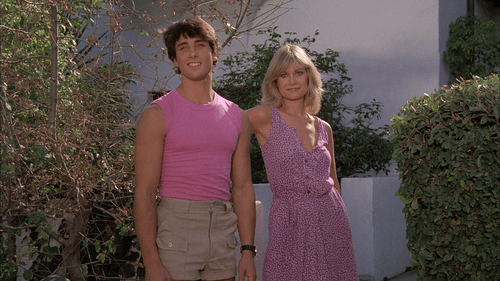
The perfect couple

The perfect couple

And what’s surprising is that, once Bobby and Terry become lovers, the film changes.  Well, it changes a little.  Don’t get me wrong — it doesn’t suddenly turn into a great (or even a good) movie or anything like that.  But the film really does make an attempt to realistically deal with the relationship between Bobby and Terry.  Terry doesn’t suddenly abandon her dreams or her plans just because she’s now secretly sleeping with Bobby.  Instead, Terry remains just as independent as before and, unlike a lot of films of the period, the film doesn’t condemn her for wanting a life of her own.  If anything, the film chastises Bobby whenever he gets overly possessive of her.  In the end, the movie suggests that the most important lessons Bobby learned weren’t about sex but instead, were about Terry’s right to live her own life.

Oddly enough, hiding within this typical teen comedy, there’s a surprisingly bittersweet film.  Perhaps less surprisingly, this film — like The Young Graduates, The Teacher, Trip With The Teacher, Coach, and Malibu High — was yet another teacher-student-sex film produced by Crown International Pictures.  Nobody handled potentially icky exploitation with quite the wit and grace of  Crown International.

CIP_Logo