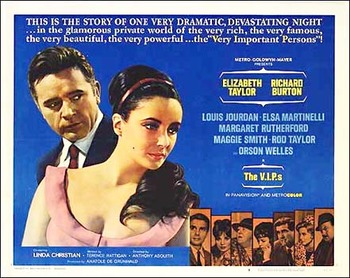
The 1963 film, The V.I.P.s, is about a group of very important people who have all shown at Heathrow Airport at the same time, all in an effort to get the Hell out of England. They’ve all got their own individual reasons for wanting to leave the country but the important thing is that they all want to leave. Unfortunately, a fog has rolled onto the runway and the plane can’t take off. Because this film was made in 1963, all the passengers are allowed to leave the plane and wait, overnight, in a hotel.
Among the Very Important People:
Flamboyant film producer Max Buda (Orson Welles, playing a version of himself) needs to leave London before he receives a gigantic tax bill. Accompanying him is his latest discovery, Gloria Gritti (Elsa Martinelli). Max is the type who does things like barging into the plane’s cockpit and demanding to know why the pilots aren’t willing to risk crashing the plane. That may sound self-centered on Max’s part but Welles is such a charmer that you forgive him. Add to that, he’s trying to avoid paying taxes and that’s something that I can definitely get behind.
The Duchess of Brighton (Margaret Rutherford) is an eccentric but impoverished noblewoman who is going to lose her home if she doesn’t fly to Florida and take on a somewhat demeaning job. The Duchess is the type who struggles to find room in the overhead compartment for her ludicrous oversized hatbox. She’s never really been out in the real world before. Margaret Rutherford won an Oscar for her performance, which is occasionally amusing but never particularly subtle. (Have you seen Airport? Rutherford has the Helen Hayes role, basically.)
Lee Mangrum (Rod Taylor) is a businessman who is on the verge of losing his business. Miss Mead (Maggie Smith) is his secretary. Miss Mead is secretly in love with Lee, who somehow hasn’t noticed. We’re supposed to sympathize with Lee but he’s so incredibly clueless that it’s hard not to feel that Miss Mead could do better.
Finally, we have Frances Andros (Elizabeth Taylor). Frances is one of the most popular film stars in the world. She’s married to Paul Andros (Richard Burton), who is very wealthy and who, like most Burton characters, is also very moody. Frances has decided to leave Paul and go to America with her lover, Marc Champselle (Louis Jourdan). However, the fog gives Paul a chance to come to the airport and try to talk Frances out of leaving him.
Make no mistake about it, Liz Taylor and Burton are the main attraction here. Welles, Rod Taylor, Rutherford, and Smith all get plenty of scenes but it’s obvious that the people behind The V.I.P.s understood that most of the audience would be there to watch Liz and Burton acting opposite each other. This was, I think, the first film that they made together after falling in love on the set of Cleopatra. Due to Cleopatra’s legendarily difficult production, it was released around the same time as The V.I.P.s, despite going into production years before the latter film. Audiences could go watch Liz and Dick fall in love in Cleopatra and then head over to a different theater and watch the two of them fight in The V.I.Ps. Elizabeth Taylor may be playing Frances Andros and Richard Burton may be playing Paul Andros but they really might as well be playing themselves.
The V.I.P.s is a big and glossy film, the type of movie that the Hollywood studios used to make as their way of saying, “See! You won’t get this on TV!” It’s frequently silly but it’s also undeniably watchable. While Burton and Taylor’s later films tended to feature the two of them at their worst, they’re both actually really good in The V.I.P.s and the scenes where they argue have an emotional heft to them that, with the exception of Who’s Afraid of Virginia Woof?, wasn’t found in their other films. For once, you watch the film and you really do hope that Liz and Dick will work things out and stay together. The V.I.P.s may be dated (just try to chase someone through an airport or get off a delayed flight now) but it’s still entertaining.
 Through the Shattered Lens