Film Review: La Dolce Vita (dir by Federico Fellini)


The great director Federico Fellini was born, on this day, 125 years ago.

He was born in Rimini.  That’s in Northern Italy.  (The Italian side of my family comes from Southern Italy and yes, there is a difference.)  Fellini was 19 years old when he enrolled in law school but records, which were admittedly spotty at the time, seem to indicate that he never attended a single class.  Instead, Fellini found work as a writer, working first as a journalist and then a screenwriter.  (He was one of the many credited for writing the screenplay for Rome, Open City.)  He began his directing career as a neorealist in the 50s but soon crafted his own unique style, one which openly mixed humor with drama and fantasy with earthiness.  Fellini established himself as one of the world’s best directors, a filmmaker who made art films that not only entertained but also provoked thought.  Fellini was a director who embraced life’s contradictions as well as being a strong anti-authoritarian who rarely commented on politics but did make known his distaste for communism.  He was also one of Mario Bava’s best friends.

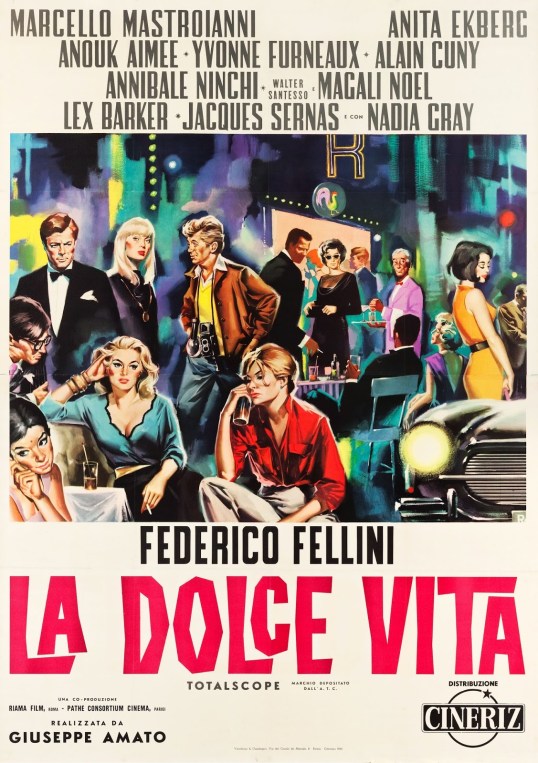
My favorite Fellini film is 1960’s La Dolce Vita.

Ah, to be rich, decadent, and jaded in Rome in the early 60s!  Or maybe not.  Sometimes, being jaded is not as much fun as it seems.

La Dolce Vita is largely remembered for the scene in which actress Sylvia (Anita Ekberg) and journalist Marcello (Marcello Mastroianni) wade into Rome’s Trevi Fountain.  While that it is a great and sensual scene and justifiably famous (and, in fact, the film’s poster was originally a shot of Ekberg in the fountain despite the fact that the scene is only a small part of a 3-hour movie), it’s often overlooked that the scene itself does not have a happy ending.  When Marcello and Sylvia return to Sylvia’s hotel, Sylvia is slapped by her loutish boyfriend (played by Lex Barker).  Marcello, meanwhile, has a fiancée named Emma (Yvonne Furneaux) who is recovering from a recent overdose.  Even though Marcello swears that he loves Emma and that he would do anything for her, he is still compulsively unfaithful.

When we first meet Marcello, he’s in a news helicopter, watching as a statue of Jesus is flown over Rome.  However, Marcello is distracted by the sight of a group of women sunbathing on a nearby rooftop and he tries to get their phone numbers before returning to following the statue.  That pretty much sets the tone for most of what we see of Marcello over the course of La Dolce Vita.  He’s searching for the profound and transcendent but he frequently gets distracted by his own more earthy desires.

The film follows Marcello as he encounters different people in Rome and the surrounding area.  Some of them are rich and some of them are poor.  All of them are looking for something but none of them seem to be quite sure what it is.  A possible sighting of the Madonna brings a crowd of people to the outskirts of Rome, where everyone asks for something but the end result is only chaos.  A meeting with an intellectual friend of Marcello seems to offer a solution to Marcello’s ennui until a tragedy reveals that his friend was even more lost than Marcello.  (The film’s sudden tragic turn took me very much by surprise when I first saw it, despite the fact that countless filmmakers have imitated the moment since.)  A possibly important conversation on a beach is made unintelligible by the crashing waves and, instead of providing enlightenment, it ends with a shrugs and an enigmatic smile.  There’s a definite strain melancholy running through the film though there’s also a certain joi de vivre to many of Marcello’s adventures.  Marcello is torn between seeking transcendence and seeking pleasure.  Fellini shows us that both are equally important.  It’s left to use to decide whether the pleasure is worth the heartache and vice versa.

La Dolce Vita is visually stunning portrait of life in Rome at a very particular cultural moment.  Marcello Mastroianni is the epitome of decadent cool in the lead role but he’s also a good enough actor to let us see that Marcello is never quite as proud of himself or as happt with his life as everyone assumes he is.  La Dolce Vita may be about a specific cultural moment but, as a film, it is timeless.
Scenes That I Love: The Final Scene of Federico Fellini’s La Dolce Vita


100 years ago today, the great Federico Fellini was born in Rimini, Italy.  It seems appropriate that today’s scene of the day should come from my favorite Fellini film, 1960’s La Dolce Vita.

In this scene, which occurs at the end of the film, jaded journalist Marcello Rubini (Marcello Mastroianni) finds himself hung over on the beach, watching as a group of people pulls a dead sea serpent out of the ocean.  The serpent appears to be a giant squid of some sort.  Myself, I’ve always felt that it was the equivalent of the Biblical Leviathan and maybe the fish that swallowed Jonah.  Regardless of the fish’s history, it’s now dead but, as Marcello points out, its eyes continue to stare.  The people on the beach are less interested in what the fish is and instead more concerned with what they can do with the carcass.

Marcello looks away from them and sees a young woman named Paola (Valeria Ciangottini) standing at the other end of the beach, calling out and motioning to him.  Marcello attempts to hear what Paola is saying but he cannot hear her words over the sounds of the ocean.  For once, Marcello, the journalist and the high society insider, does not know what is being said.  Finally, Marcello walks away with another woman, leaving Paola’s message a mystery.

What was Paola saying?  Perhaps, in the end, that’s not as important as what we think she may have been saying.  (Sofia Coppola later played a sort of homage to this ending with the final scene of Lost In Translation.)  Marcello missed the message but the good life — La Dolce Vita — continues.

https://www.youtube.com/watch?v=pIkFea5aO1g

Sci-Fi Film Review: The 10th Victim (dir by Elio Petri)


10th Victim

Before The Hunger Games…

Before The Purge

There was The 10th Victim!

This Italian film from 1965 takes place in a future that is a lot like our present.  After years of war and senseless violence, the world is finally at “peace.”  Wars are avoided by allowing people to take part in the Big Hunt.  When you join the Hunt, you’re agreeing to take part in 10 rounds of competition.  For five rounds, you’re the hunter.  For the other five rounds, you’re the hunted.  Survive all 10 rounds and your reward will be money and retirement.  So far, only 15 contestants have managed to survive.

If you’re being hunted, you get a letter informing you that you are now being hunted.  The only way to win is to kill the person who has been assigned to hunt you.  Unfortunately, you’re not told who is hunting you and, if you accidentally kill someone who is not hunting you, you’ll be sent to prison for 30 years.  And, of course, the whole time you’re trying to avoid getting killed, others are being hunted around you.  World peace means that there are constant gun battles in the streets, all of which are calmly observed by a rather apathetic populace.  It’s a violent world but it’s legal violence so it doesn’t really concern anyone beyond the people that are getting killed.

(At one point, an announcement is heard while a hunter guns down his target: “Live dangerously but obey the law…live dangerously but obey the law…”)

Coverage of the Big Hunt is the world’s most popular television show and, as a result, legalized murder has become big business.  Companies regularly sponsor hunters and turn their kills into elaborate commercials for their products.

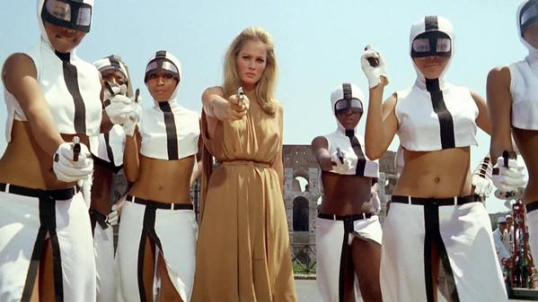
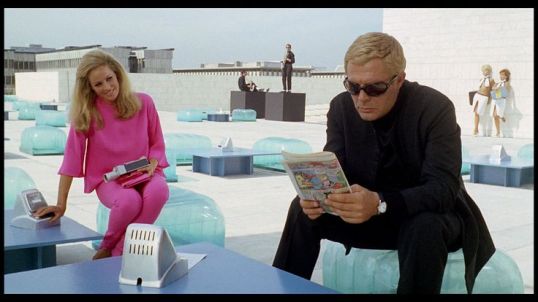
When we first meet Caroline Meredith (Ursula Andress), she is using a literal bullet bra to shoot a man dead.  Caroline is sponsored by Ming Tea and, when she is assigned to hunt Marcello Pollitti (Marcello Mastroianni), the company flies her out to Italy.  In order to make Marcello’s death as cinematic and commercial as possible, Ming Tea and Caroline decide to lure him to Rome’s Temple of Venus.  The Ming Tea dancers are flown in, a choreographer starts working on their routine, and Caroline tracks down Marcello.

Tenth Victim

Marcello has just found out that he’s being hunted and he’s more than a little depressed.  He’s also paranoid and when Caroline first approaches him, Marcello suspects that she’s his hunter and not, as she claims, a journalist.  However, because of the legal penalty for killing a non-hunter, Marcello cannot kill Caroline until he’s sure that she wants to kill him.  Meanwhile, Caroline cannot kill Marcello until they’re at the Temple of Venus, in front of the cameras and the dancers.

And, of course, there’s also the fact that, as they get to know each other, Caroline and Marcello start to fall in love.  When Caroline observes Marcello conducting a bizarre religious ceremony (he’s the head of a cult of sun worshippers), she is so touched that she starts to cry.  Or does she?  Are her tears just a ploy to keep Marcello from suspecting that she wants to kill him?  We’re never quite sure.

If you didn’t already know that The 10th Victim was made in 1965, you would guess it after just a few minutes.  This is one of those hyperstylized works of pop art that, for many people, define 60s cinema.  How you react to the film will depend on how much tolerance you have for its nonstop style.  Speaking as someone who happens to love over-the-top pop art, I enjoyed it but I could imagine other viewers ripping out their hair at the sound of the film’s peppy theme song.

But, if you’re patient, you will eventually discover that, underneath the film’s excesses, it’s actually a rather clever satire of media, politics, culture, religion, and just about everything else that deserves to be satirized.  Marcello Mastroianni and Ursula Andress are both a lot of fun and, in the end, the whole thing works as both a surprisingly accurate prophecy of today’s world and as a time capsule of the 1960s.

Plus, I loved the bullet bra.  I need to get one of those.

It’s a dangerous world, after all.

http://www.youtube.com/watch?v=uiJ6oghRqKY

Scenes That I Love: Anita Ekberg and Marcello Mastroianni In The Trevi Fountain


La_Dolce_Vita_(1960_film)_coverart

Anita Ekberg, RIP

This famous and iconic scene is taken from Federico Fellini’s 1960 film, La Dolce Vita.  The film follows tabloid journalist Marcello (Marcello Mastroianni) over the course of 7 days and 7 nights.  He spends the 2nd day pursuing a famous actress named Sylvia (Anita Ekberg).  As the day comes to an end, he finds Anita wading into the Trevi Fountain.

As famous and celebrated as this scene is, it’s often forgotten that it ultimately ends with Sylvia being slapped by her loutish boyfriend, Robert (Lex Barker).  That slap is not included in the video below but that’s okay.  For today, at least, let’s allow Sylvia her happiness.

http://www.youtube.com/watch?v=T4kZjU7zGbU