Maximum Regression: DotP 2015


magic2015announcement610

Let me ask you, dear readers, a question.

What happens when you fundamentally misunderstand your audience? When you think you know what people want… and you’re… just wrong? Or is it not a lack of understanding, but a lack of interest? Is it just that you know one way you can make some money, and you don’t really care what quality your product turns out to be?

Magic: Duels of the Planeswalkers 2015 answers pretty much all of these questions, by being one of the fundamentally worst games published yet this year. While I might have spent some energy making fun of Diablo, I didn’t understand how cynical, how shitty, and how worthless a moneygrab could be…. apparently… until I played Magic DotP 2015.

This is ten steps backward – in virtually every way – compared to even DotP 2014, a game which I did not have as much fun with as I would have hoped.

Duels of the Planeswalkers was touted for years as a beginners’ introduction to Magic. Obviously, Wizards would prefer for serious players of its CCG to get invested in Magic The Gathering: Online, instead… if they’re not going to play paper Magic. Speaking from experience, I can say that MTG:O has its own ups and downs. Its interface is shockingly primitive. At the time I last played a Draft tournament on MTG:O (admittedly, at least a year and a half ago), it was more primitive than free, user-generated programs to play cards on the internet. Not exactly a glowing endorsement. I preferred (greatly) to simply log into Xbox Live and fire up a game of Duels of the Planeswalkers 2013.

Nowadays, I’d rather play neither. Regardless of how MTGO might have improved itself, this isn’t an economic climate in which I want to spend money to stay competitive in Standard format Magic; nor is it a format where I would like to regularly pay for draft cards. This makes it all the more egregious, then, when my annual bill of roughly $10 US for Duels of the Planeswalkers is compromised by a ridiculous new microtransaction element. Most of the rare cards available in the game’s card pool are now, quite literally, unavailable unless you’re willing to shell out cash for additional “booster packs” full of rare cards.

Are you serious, Wizards?

Can I get my initial $10 back?

And none of this even addresses the fundamental problems in gameplay. Instead of the (already incredibly grind-y) card unlocking process from previous games, you now must take a limited starter – one you are locked in to! – against fully comprised enemy decks in order to unlock random boosters of around 3 cards – sans the aforementioned rares – which may or may not even improve your deck in any functional way. Hooray?

Beyond that, where are all of the modes? Multiplayer boasts 1v1… and that’s it? Where is 2HG? Where is … anything else? Remember how people complained that 2014 didn’t have cool mutliplayer modes? One of my most favourite things about DotP is the ease of running some low-maintenance 2HG with my friends. Now that’s gone, too? Why did I buy this game? It’s pretty much horse shit. I know that they already have my money, but hopefully I can save you from spending yours.

As far as I’m concerned, there’s basically nothing to like here. This game is a waste of your money, and you should exercise your power as a consumer by not spending it. Don’t fall into the same trap that I did.

Review: Hearthstone: Heroes of Warcraft


Like most of my b.net friends (that is: auction house junkies and achievement whores), I downloaded Hearthstone: Heroes of Warcraft for a free mount. What I got was an addicting breath of fresh air laced with all the appeal of nostalgia. In Blizzard Entertainment I’ve trusted since I first picked up my copy of Starcraft back in 1998, but it would be hard to argue that the company has not grown a little washed out of late. Starcraft 2, for all its glory, faces too much competition to match the popularity of its legendary predecessor; Diablo 3 was a bore to all but the most devoted series fans; and World of Warcraft is gagging on the fumes that keep it running. I thought BlizzCon 2013 was the nail in the coffin (and I still do), but Hearthstone definitely breaks from the current trend. It is the first Blizzard release since StarCraft II: Wings of Liberty (2010) that felt fresh to me.

Hearthstone is an electronic card game reminiscent of Magic: The Gathering. Unlike M:tG, you’re not going to find yourself at a loss for players when your friends grow up and get “lives”. (sigh…) I’m sure plenty of online M:tG-style card games have existed in the past, but what’s significant here is that I have never played them. Hearthstone had a few things going for it pre-launch that genre competitors lack: it is free, it is Blizzard, and its launch coupled with a long over-due Battle.net meta program that makes it highly visible to current Blizzard customers. The minute you click play, you’ll find a few other perks. Peter McConnell’s soundtrack is nothing short of brilliant, the game is conceptually very simple to grasp, and the graphics strike that balance between clarity and imagination that is non-existent in modern gaming. (If you don’t know what I mean by this, consider a modern game with severely limited character development–say Mists of Pandaria–to an old-school NPC overload like Suikoden, and ask yourself which game you remember more characters in.)

Once you’ve been at it a while–I’ve been playing for all three weeks the game has been public–some obvious cons will emerge. The game is highly dependent on card acquisition, and the availability of new decks is unnecessarily limited. Playing strictly for free, a casual Hearthstone fan will accumulate roughly two card packs every three days. A pack consists of five cards, with at least one guaranteed to be rare or higher (rarities roughly parallel WoW’s system of common, uncommon, rare, epic, and legendary). Because the game is new, the total amount of cards out there is relatively low, leaving little room for creative builds that can succeed in the absence of numerous epics and legendaries. Unfortunately, Blizzard offers no easy progress through pay. Booster packs (5 cards) can be purchased at a rate of 2 for $3, 7 for $10, 15 for $20, and 40 for $50. At the outset, nothing short of the all-in $50 deal is going to guarantee you much of an upper hand, and by the time you’ve accumulated 20 or so free decks through casual play the $20 and lower options seem like too much of a gamble. So if you want to roll your way up into the higher ranks, you’re stuck paying the full retail price of a major release or else sticking it out for free over an extended period of time. There is no financial happy medium. You will likely find yourself wavering between ranks 17 and 19 for a long, long time until you’ve gotten lucky enough to build a competitive deck. I would happily pay $20 for 40 booster packs at least once, but $50 is unreasonable.

Blizzard does not currently allow cards to be traded or sold, and that makes some practical sense. (I would just roll fake accounts and trade free boosters to my main until I had the full collection in a matter of days.) What they offer instead is a “disenchant” feature, where you can permanently destroy cards and use the byproducts to craft others of your choosing. The problem with this system is that it leaves collectors in the dust early on. Until you’ve accumulated enough duplicates, you’ll be faced with the unpleasant choice between remaining in the lower ranks and abandoning rare cards.

On the plus side, extensive losing streaks are pretty uncommon. The game seems to be very well balanced to match you against players of similar skill/decks. Skill development will cap out before deck improvement, unfortunately, but the monotony can be broken by a system that allows you to play 9 different classes loosely based around their World of Warcraft parallels. My Warlock deck might cap out at rank 17, but I haven’t even touched a Druid yet. Boosters are not class-specific, so what I earn on an alt class is of equal worth to me. Whether alternate class play too will dull before higher-level decks can be built is still too soon to tell. I can say that three weeks into the public launch, Hearthstone is still sufficiently captivating to chew up an hour of my evening daily.

I love this game not only for its innate appeal, but for its status as proof that Blizzard can break from their self-imposed molds and release a game that is not dependent on a franchise model. My dreams of a World of Starcraft are still far-fetched, but I really, really hope that Hearthstone succeeds. It serves as a reminder that, before Blizzard found themselves inextricably bound to decade-old gameplay models, they were the most innovative corporation in the world of PC gaming.

Did I mention that Peter McConnell’s soundtrack is godly? Russell Bower might be at the peek of his career with Mists of Pandaria, but this is what I want to hear in a game. Two thumbs up for Hearthstone all around.

Shad#1129 on battle.net if you want to hit me up for a round or two. 🙂

Ten Years #36: The Mountain Goats


Decade of last.fm scrobbling countdown:
36. The Mountain Goats (846 plays)
Top track (37 plays): Home Again Garden Grove, from We Shall All Be Healed (2004)
Featured track: Fault Lines, from All Hail West Texas (2002)

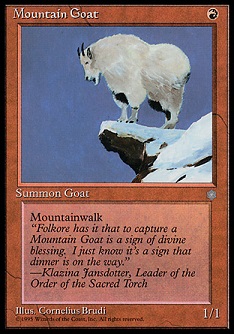
Back in my later high school days, when my early obsession with metal music coexisted with an active participation in games like Magic: The Gathering and Dungeons & Dragons, I remember stumbling across a 1/1 beast in Ice Age that I became bound and determined to name a pseudo-grim heavy metal band after:

I was very briefly disappointed to find that a band had already beaten me to the punch on that one. One of the things that makes John Darnielle an awesome person, though, is the very real possibility that this is no coincidence and he took his band name from M:tG too. (Probably not, given that his first album came out in 1994, but you never know.) This guy has made a guest appearance on an Aesop Rock hip-hop album and written an acoustic love song set to a Marduk black metal concert in the same year; his appreciation for the awkward and out-of-place couples with an above-average awareness of other musical scenes to conjure a constantly befuddling self-image. The first time I saw him live, before I was very aware of his works, I wasn’t sure if I ought to take the dialogue between each track as stand-up comedy or legitimate commentary by someone who was hopelessly socially inept. In retrospect, it was more the former, but the heart-felt sincerity Darnielle packs into everything he says or writes is both a quintessential part of the act and a reflection of who he really is–someone both incredibly aware and controlling of his public image and just a little bit legitimately weird. He has made his claim to fame writing sentimental solo acoustic songs with over-the-top lyrics and awkward subject matters that are simultaneously heart-felt and tongue-in-cheek. He has cultivated his awkwardness into some of the best solo acoustic albums recorded since Bob Dylan.

Lately, The Mountain Goats have evolved from a solo project to more of a full band. Last time I went to their show the audience had expanded from about a hundred to a few thousand, and Darnielle was hamming up the rock-star image with a shit-eating grin on his face the whole time. I absolutely love this guy and his works, and while I can’t say that I’ve kept up with him consistently over the years (his discography is massive), I’ve certainly listened to him enough to rank in my top 50 most played artists of the past decade. Here are the lines to Fault Lines, to give you some idea of his brilliantly bizarre lyrics:

Down here where the heat’s so fine
I’ll drink to your health and you drink to mine
As we try to make the money we scored out in Vegas hold out for a while
We drink vodka from Russia
We get our chocolates from Belgium
We have our strawberries flown in from England
But none of the money we spend seems to do us much good in the end
I got a cracked engine block, both of us do
Yeah the house, the jewels, the Italian race car
They don’t make us feel better about who we are
I got termites in the framework, so do you
Down here where the watermelon grows so sweet
Where I worshiped the ground underneath of your feet
We are experts in the art of frivolous spending
It’s gone on like this for three years I guess
And we’re drunk all the time, and our lives are a mess
And the deathless love we swore to protect with our bodies
is stumbling across its bleak ending
But none of the rage in our eyes
Seems to finish it off where it lies
I got sugar in the fuel lines, both of us do
Yeah the fights and the lies that we both love to tell
Fail to send our love to its reward down in hell
I got pudding for a backbone, and so do you
La la la la! Hey hey!

The Magic of Duels of the Planeswalkers


A couple of years back I was bored one afternoon and browsing the XBox Live Marketplace. I didn’t have any real expectation of finding a game that would get me through the afternoon, let alone something that would have real staying power for me, and I would revisit time and again. When I saw that there was a Magic the Gathering game, it was suspicions that became aroused, not interest. Out of a kind of morbid curiosity I selected the game and read a little more into it, saw that a couple of my friends had played it, and that it seemed to be a self-contained engine of a game, and not simply another attempt to sell me Magic the Gathering Online in a repackaged form (don’t get me wrong, I don’t have anything against MTG:O. In fact, it’s a clever idea to reach people who either don’t have an active local Magic scene, or hate their local Magic scene, but if I had money to waste on Magic, I personally would do it at my local comic store).

But, oddly, the complaint that I keep hearing from people about Duels of the Planeswalkers (aside from some more quantitative complaints, which I’ll get into) is that it’s a self-contained thing, not a beautifully rendered amalgamation of all Magic ever.

…Well, duh.

You may bring whatever expectations you wish into your gaming experiences, but I find it’s better to try and keep things a little bit in perspective. For a $10 XBox Live Arcade title – a game that by definition is not a full retail game – you are expecting a full pool of Type II cards, a fully operational deck builder, and carte blanche to build as many decks as you like and play them against other humans? How much money does that privilege cost in real life? If some quickly-researched netdecking can be believed, a couple hundred bucks will buy you a top end deck in the current meta (and someone bought those cards at $4 for each randomized pack or whatever at retail, let’s not forget). Let’s say each ranked DCI event costs another $7 as an entry fee. So for one singular deck, you must expend hundreds of dollars, and much of that income reaches Wizards of the Coast. Then, if you wish to change decks, you’re likely to need more cards. Wizards will release new expansions, and you will need still more cards. All of this generates revenue for the company that is printing the game (and all of the creative people behind its design, etc.) and you honestly approach Duels of the Planeswalkers with the expectation that it’s going to just replace the CCG model forever?

Come on.

So now that that soap box moment is out of the way, let’s talk about the game. 2013 is the latest upgrade to the now-yearly franchise. Much like regular Magic’s Type II environment, DotP can be seen as a sealed ‘block’ of decks of cards, and it evolves year by year. The game-play improvements in 2013, then, are very slight, since the game of Magic hasn’t changed much. The most meaningful one is the long-awaited ability to manually select your own lands to tap for Mana instead of letting the CPU select them for you (the CPU attempts to do this intelligently, but unfortunately, the CPU has no idea what it’s doing). The main difference is, therefore, the entirely new pool of decks that players can customize and compete with. The game launched with 10 available decks which come with a basic pool of 35 cards (plus the necessary land to make the deck function of course) and an additional 30 unlockable cards. The cards are unlocked – unfortunately – one by one, by winning duels, or if you’re lucky enough to be playing the console versions, by the purchase of Deck Keys (those cost about $1 of your real money each) which completely unlock the deck in question. This represents a large increase in possible customization over the selection offered by 2012.

The decks themselves are primarily monochrome, which is a shame. I understand that Wizards probably sees DotP as a tool to draw people into the world of Magic: The Gathering either on or off line, hoping to gain more lifetime players who are eager to experience the full game. However, many players do want to enjoy DotP as a game in its own right, and while monochrome decks are easier to play and make a decent introduction, the truth is that the Magic decks you’re going to see even at a local Friday Night Magic tournament are going to include a lot of paired colours for a simple reason – each colour is deliberately designed with shortcomings. Black has access to many easy fire-and-forget creature destruction spells and no enchantment removal at all. White has only a tiny splash of creature removal (and each of their ‘removal’ cards has a drawback printed on the card!) but many good cards for destroying enchantments or artifacts. If you combine the two, you can have both of those strengths, and cover for the weaknesses, at the expense of a deck that can be less reliable (since you must now possess two different colour resources) and harder to play. The trade-off is almost always worth it.

Hopefully DLC (it’s already in the works, of course!) will expand a little bit on this, and throw in some more two-colour decks (and a few fewer absolutely atrocious 3-colour decks. Please?).

As for the Planechase mode, I haven’t got much to say. I’ve never liked Planechase because it can really take a long time to play a single game of it, so I’ve avoided testing it extensively. I can say that it works just like I remember it working in real life, and it can definitely be fun if you have the patience to stick with it. The unpredictable and powerful effects of the different twisting Planes can really throw a traditional match-up on its head. Combined with the inevitable chaos of FFA multiplayer, and you definitely have a format with legs – no two games of Planechase will ever be exactly the same.

I suggest that you think of Duels as a Magic format much like Captains or, frankly, Type II… and enjoy it for what it is; a closed Magic experience that doesn’t cost you a lot of cash out of pocket to play. The added levels of customization (regrettably, still not the ability to pick how many lands your deck has in it. Grrr!) make the environment more varied than ever (mind you, I did not suggest the environment was balanced. It’s much too early to speak on that) so it’s definitely a game that’s got some depth if you’re willing to take the time to learn the format and delve into its own quirks and strategies.

The game reportedly suffers from numerous bugs. I have not encountered any that are more severe than the ‘mild annoyance’ variety, but I suspect there are uglier ones to be found in those innumerable lines of code somewhere. I wish I could say this was uncommon for releases in 2012, but I try to remain honest when I write these columns.

So there it is. I find Duels to be a fantastic addition to my summer, and I’m more excited than ever to waste countless hours trying to determine the best combination of 60 cards in the fixed pool that makes up my blue deck that will best let me control the decks I’ve seen people playing this week. Oh, and if you pick it up, do try it out with a friend in Two-Headed Giant at least once. It’s riotously fun.