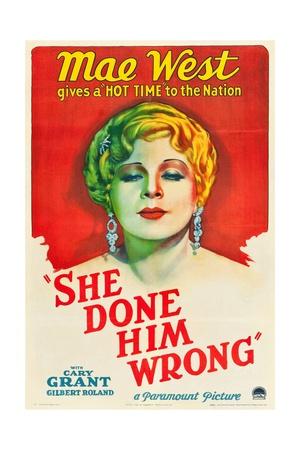
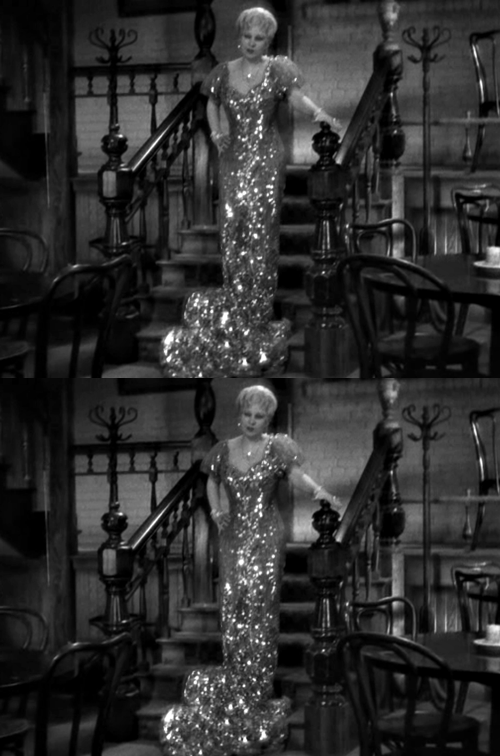
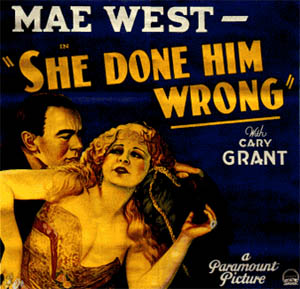
Bawdy Mae West had scandalized Broadway with her risque humor, and struggling Paramount Pictures snapped her to a movie deal. Her first was a supporting part in 1932’s NIGHT AFTER NIGHT, where she was allowed to rewrite her own dialog, and stole the show by purring sexually charged lines like “Goodness had nothing to do with it, dearie”. Mae’s presence helped refill Paramount’s coffers, and raised the hackles of censorship boards across America. It wasn’t long until the Production Code became strictly enforced, thanks in large part to Mae, but before then, she was given the spotlight in 1933’s SHE DONE HIM WRONG, based somewhat on her stage success DIAMOND LIL.
Like the play, SHE DONE HIM WRONG is set in The Bowery during the 1890’s, but here Diamond Lil is called Lady Lou, because the censors wanted to whitewash all vestiges of the ribald play. Diamond Lil or Lady…
When watching the 1933 film She Done Him Wrong, it helps to know a little something about American history.
It helps to know that the film was made at the tail end of the failed progressive experiment known as prohibition, an attempt to ban liquor in the U.S. which only served to make people idolize criminals and feel nostalgic for the time when you could just safely hang out in a saloon and get drunk with bunch of shady characters.
It helps to know that this film was made at a time when America was struggling through the Great Depression and, more than ever, movies were seen as an escape from reality. The Depression also created a situation where, much like today, most Americans felt as if they were on the outside of the good life and, as a result, the most successful films of the time deal with outsiders getting something over on the smug and judgmental insiders.
It also helps to know that She Done Him Wrong was one of the last of the pre-Code films. Though, by modern standards, the film may seem outwardly tame, the innuendo and subtext is anything but. In fact, She Done Him Wrong was considered to be so racy that some people were actually scandalized when it became the biggest box office success of 1933. (These were largely the same people who, 13 years before, celebrated the passage of prohibition.) The infamous production code was largely instituted to make sure that a film like She Done Him Wrong could never be given another chance to corrupt filmgoers.
What exactly made She Done Him Wrong so controversial?
Well, it took place in a saloon in 1890s. The saloon is owned by Gus (Noah Beery), who uses it as a front for prostitution and counterfeiting. This is a film that features a lot of people drinking a lot of alcohol and it’s also a film that goes so far as to suggest that having a drink or two is not necessarily the worst thing in the world. Captain Cummings (Cary Grant) runs a city mission that has opened up next to the bar and the film devotes a lot of time to poking fun at Cummings’s upright morality. (Of course, Cummings has a secret of his own, one which suggests that his crusading attitude is just a convenient disguise.) Though it would be repealed by the end of the year, Prohibition was still the law of the land when She Done Him Wrong was released and it’s fun to see how much the film has at the law’s expense. That’s the type of fun that would basically be banned by the Production Code.
The Production Code would also require that all criminals be punished for their crimes by the end of a film. In She Done Him Wrong, singer Lady Lou (Mae West) stabs to death the viscous Russian Rita (Rafaela Ottiano) and basically gets away with it. It’s true that Lou was acting in self-defense but what makes She Done Him Wrong unique (for its time) is that Lou shows no remorse and that the killing is handled rather flippantly. When the police, who have been searching the saloon for another criminal, burst into the room after Rita has been stabbed, Lou fools them by placing Rita’s corpse in a chair and combing her hair. (“Haven’t you ever seen anyone comb someone’s hair before?”) After the police leave, Lou has her bodyguard dispose of the body and Rita is never mentioned again. Again, this is something that would never be allowed happen under the Production Code.
And then there’s the naked painting of Lou that hangs in the saloon. Whenever it’s shown a screen, a man in a hat happens to be standing in just the right position to block the viewer from seeing the entire portrait. Again, this would never have been allowed to happen under the Production Code.
And perhaps the biggest indication that this is a Pre-Code film is Mae West herself. Reportedly, She Done Him Wrong was an extremely toned down version of West’s stage act but what was heard on-screen would certainly be enough to throw the guardians of decent society into a panic. Nearly every line that she utters in this film is a double entendre but it’s not only what Mae West says. It’s the way that she says it. West may not have been a great actress but she had enough attitude that she didn’t need to be. With every line, with every glance, with every movement, Mae West announces that she not only has sex but she enjoys it too. In the Pre-Code days, that was unusual. Once the Production Code went into effect, such a portrayal would be impossible.
As for the film itself — well, it’s pretty much just an excuse for Mae to be Mae. There’s a plot, of course. Lady Lou has many suitors and they all converge on the saloon at the same time. However, Lou’s got her eye on the upstanding Captain Cummings. (He’s a man in uniform, after all.) It’s not a great film by any stretch of the imagination but, if you’re into film history or if you’re curious to see how American social mores have changed (and occasionally, not changed) over the years, She Done Him Wrong is a must see.
She Done Him Wrong is only 66 minutes long and it’s the shortest film to ever receive an Oscar nomination for best picture. It received no other nominations and lost to Cavalcade.
Last night, as I struggled to get some sleep, I ended up turning on the television to HBO and watching a truly infamous film — 1970’s Myra Breckenridge. Based on a novel by Gore Vidal (a writer that I generally have little use for), Myra Breckinridge is infamous for being one of two X-rated film released by 20th Century Fox in 1970. (The other one was Russ Meyer’s Beyond The Valley of the Dolls.)
Why Was I Watching It?
Because I’ve read a lot of books devoted to “the worst films ever made.” And all of them mention 1970’s Myra Breckinridge as being one of the worst ever made. And having seen the film, I can say that they’re right.
What’s It About?
Well, that’s a good question. Okay, there’s a bisexual film critic named Myron Breckinridge (played by an actual film critic named Red Reed). Myron gets a sex change operation from a pot-smoking doctor played by John Carradine. “It won’t grow back,” Carradine warns him.
Next thing you know, Myron is Myra and is now being played by Raquel Welch. Pretending to be Myron’s window, Myra goes to the acting school that is run by Myron’s uncle Buck (John Huston) and ends up falling in love with an acting student (played, pretty badly in her film debut, by Farrah Fawcett). Unfortunately, Fawcett’s in love with a cowboy from Oklahoma so Myra ends up anally raping the cowboy with a big dildo.
Oh, and a 70 year-old Mae West in the film for some reason. She plays a talent agent.
It all sounds a lot more interesting than it actually is.
What Worked?
Nothing. Just in case I’m not being clear, allow me to clarify: Nothing. Seriously, this may indeed be the worst movie I have ever actually sat through. What’s said is that it didn’t even work on a “so-bad-its-good” level. I love trashy film but Myra Breckinridge isn’t really interesting enough to be trashy. It’s just an amazingly boring film that thinks it’s about sex.
I’ve also read some who have claimed that this film, bad as it is, has a certain camp appeal. And, if you’ve never actually seen a campy film, you might think that Myra Breckinridge is camp. However, camp is not boring. Myra Breckinridge is.
Actually, there is one scene that has an odd, “you’ve-got-to-see-this-crap” appeal to it and here it is. Mae West sings “Hard to Handle.”
What Doesn’t Work:
The entire freaking film. Seriously. I mean, I don’t even know where to begin or what specifically to point out because, if you simply take this film’s failings on a problem-by-problem basis, it creates the false impression that the film is somewhat watchable.
Okay, here’s a few things that I simply will not be able to live with myself if I don’t take a few moments to be a bitch about:
1) There’s a lot of bad movies that are distinguished by interesting or, at the very least, watchable performances. It’s as if the actors realize that they’re going to go down with the ship unless they bring something new to the film. (Meanwhile, so-called great films feature some of the worst performances this side of Avatar…) Unfortunately, Myra Breckinridge is not one of those films. The cast alternates beyond going insanely overboard (like John Huston and Rex Reed) to delivering their lines with a dull contempt that seems to be directed as much at us as at themselves (like Raquel Welch.)
By the way, Raquel Welch is actually one of my favorite of the old school film stars. For me, she’s a bit of a role model, a strong Latina who never felt the need to apologize for being both a sex symbol and an intelligent, succesful woman. But Welch really does give a pretty bad performance here. Then again, I would argue that she gives the material exactly the amount of effort it deserves.
2) As bad as the cast is, no one is as terrible as Mae West. The 70 year-old West came out of retirement to play her role here. Anyway, it’s hard to understand why she’s in this film. At one point, when she meets a 6’7 actor, she says she’s only concerned with the seven inches. Now, imagine this being said by your great-great-great-grandma and you have some idea what it’s like to watch her performance here.
3) This film was made in 1970 and it attempts to be all counter-cultural by having “hippies” wandering around in the background. As well, we get a lot of hard-hitting political satire. By that, I mean that various fat men in cowboy hats pop up and complain about “smut” and “nudity” in the movies. I guess the audience is supposed to go, “Oh my God, they’re talking about movies like this!” It’s for this reason that I think that Myra Breckinridge is actually secretly meant to be a piece of right-wing propaganda.
4) Finally, for no real reason, clips from old 20th Century Fox films are littered throughout the film, popping up randomly to…well, I was going to say “comment on the action,” but few of them manage to do that. Basically, it works like this: you see Raquel Welch anally raping a man with a dildo. And then you see a clip of Stan Laurel for a few seconds. Then, you’re back to Raquel anally raping the man. Suddenly, there’s a clip of Claudette Colbert smiling. Suddenly, Raquel’s back and she’s still anally raping the man. And by the way, I’m not just making this up so I’ll have an example. This is what actually happens in the film.
5) And again, allow me to clarify that this film — which features Raquel Welch using a dildo to anally rape a man — is still one of the most boring things ever made.
6) “Okay,” you’re saying, “if you hated it so much then why did you sit through the entire freaking movie, Lisa?” I did it because, once I start watching a movie, I can’t stop watching until it ends. That’s my addiction. That’s my curse. That’s a duty that I’ve proudly accepted as a film lover. And not even Myra Breckenridge is going to keep me from doing my duty.
“Oh my God! Just like me!” Moments:
Yes, I know that this is where I traditionally offer up some sort of teasingly vague comment about my first year at college or where I admit that I’m scared of dogs, heights, swimming, and the area directly behind the television. And you would be justified in thinking that a film that claims to celebrate sexual freedom and bisexuality would give me the perfect excuse to be all sorts of TMI.
But you know what? There were absolutely no “Oh my God! Just like me!” TMI moments in Myra Breckenridge because there was not one single moment that, in any way, rang true or seemed to possess any sort of insight about…well, about anything. For an X-rated film that was specifically about sexuality, Myra Breckinridge left me as dry as the Sahara.
So, sorry — for the first time, I can say that I watched something that had absolutely no “OMG! Just like me!” moments.

 Through the Shattered Lens