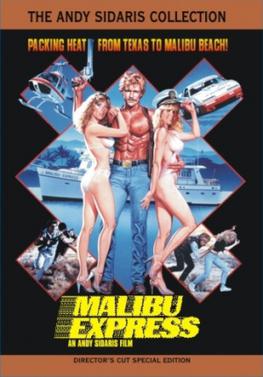
Other than being the protagonist of the 1985 film Malibu Express, just who is Cody Abilene (played, in the film, by Darby Hilton)?
He’s a private investigator. Judging from his accent, he’s from Texas. He drives a red sports car and he lives on a houseboat that he’s named the Malibu Express. He’s even got a painting of a caboose that stands on the docks next to his boat. (It all goes back to an old friend of his and how he wanted to “remember her caboose.”) He’s got nice hair and mustache and he looks like he could have had a career in 70s porn. Literally everyone that he meets wants to have sex with him. His best friend is a cop named Beverly (Lori Sutton). His girlfriend is a race car driver named Judy Khnockers (Lynda Wiesmier). “Khnockers … with an H.” Cody says that about a thousand times over the course of the film.
Cody loves his cars. Of course, it seems like he can’t go anywhere without running into three obsese rednecks who always demand that he race their son. (Their son is apparently a mechanical genius.) Cody always gives into their racing demands and he loses almost every time.
Cody also spends a lot of time talking to himself. Nothing he says is that interesting. I spent the entire movie waiting for him to say, “I hate pigs but yet I love bacon, what’s all that about?” He never did. I think the film would have been better if he had.
I should also mention that Cody is remarkably incompetent at his job. The movie opens with him at the shooting range, firing his gun and continually missing the target. Later on in the film, Cody’s accuracy will get better but he still always seem to be shocked whenever he actually hits his target. From what we hear in the film, it appears that Cody has the respect of his peers but I’m really not sure why. While he does solve the case, it’s mostly through dumb luck. Cody doesn’t find clues through detective work. Instead, he just kind of stumbles across them.
As for the case that Cody is investigating in Malibu Express … well, honestly, your guess is as good as mine. I watched the film and I could hardly follow the plot. Some of that is because this is one of those films that appears to have been edited with a chainsaw. But a lot of it is because the film’s plot has a make-it-up-as-you-go-along feel to it.
It starts with Cody being hired by the mysterious Contessa Luciana (Sybil Danning) to investigate who has been selling computer secrets to the Russians. Luciana has figured out that it has to be someone in the household of her friend, Lady Lillian Chamberlain (Niki Dantine). (Apparently, every aristocrat in Europe has relocated to Bel Air.) It doesn’t take long for Cody to discover that everyone in the house has a secret. For instance, one daughter is having an affair with a butler. A son-in-law is actually a drag queen. Another daughter has gotten involved with a sinister computer mogul.
The computer mogul sounds like a good lead to pursue but, before it occurs to Cody to do that, there’s a murder and Cody shifts his attention to trying to figure out who did the killing. But then suddenly, Cody’s being chased by three armed men so Cody shifts his attention yet again to trying to escape from them. Fortunately, the actual murderer doesn’t really seem to care that much about remaining undetected, which certainly works out well for Cody…
Malibu Express is an Andy Sidaris film. If you’ve ever seen a Sidaris film, you know better than to expect a nuanced or even narratively coherent film. Sidaris specialized in over-the-top B-movies with nonsensical plots, frequent nudity, and dialogue that was heavy on groan-worthy double entendres. Malibu Express was the first of his so-called triple “B” films (that stood for either Bullets, Bombs, and Babes or Bullets, Bombs, and Boobs, depending on who you ask). It’s definitely a flawed film. The plot makes no sense. The dialogue is often cringe worthy. The acting ranges from competent to awful. The editing … oh my God, don’t even get me started on how messy this film is.
And yet, it’s also an oddly likable film. If nothing else, the film seems to be aware of its flaws. It knows that it makes no sense and that Cody is incompetent and no one in real life would ever say 75% of the lines that are uttered in Malibu Express. It knows all of this but the film is determined to have fun and it’s hard to admire the film’s determination to full embrace the exploitation aesthetic. Watching Malibu Express, you can tell that Sidaris probably enjoyed himself will directing it. How much fun you have will depend on how much patience you have for Sidaris’s style of filmmaking.
Myself, I love over-the-top B-movies so I enjoyed it even if I couldn’t follow the plot.
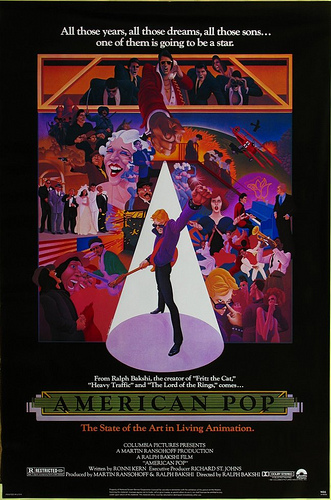 Long before South Park, The Simpsons, and Pixar, there was Ralph Bakshi. At a time when animation was considered to only be good for children, Bakshi shocked audiences and critics with animated films that dealt with mature themes and were definitely meant for adults. His first two films, Fritz the Cat (1972) and Heavy Traffic (1973), was the also the first two animated films to receive an X-rating. Bakshi satirized racism in the controversial Coonskin (1975) and Bakshi’s adaptation of The Lord Of Rings (1978) beat Peter Jackson’s by 23 years. It was after the critical and commercial disappointment of the heavily flawed but interesting Lord of the Rings that Bakshi decided it was time to make a film that would be more personal to him. The end result was American Pop.
 Through the Shattered Lens