That’s the plot of this 1957 film from director Bert I. Gordon. Chicago-haters will love this film, especially the scene where General Morris Ankrum announces that he has no choice but to nuke the entire city. If you don’t hate Chicago, you can still enjoy watching Peter Graves somehow retaining his dignity while dealing with the threat of giant locusts.
For the record, I’m enough of a country girl that I fully understand just destructive locusts can be. That said, when it comes to their appearance, they’re not the most intimidating creatures out there. The worst that can be said about them is that they look like really ugly grasshoppers. A giant grasshopper still looks like a giant grasshopper. And, needless to say, locusts do not attack humans.
(I’m also enough of a Southern girl that I can remember collecting the locust exo-skeletons that would always show up in the fall and winter.)
Here is the ludicrous and entertaining BeginningoftheEnd!
In 1951’s A Streetcar Named Desire, the emotionally fragile Blanche (played by Vivien Leigh) has come to New Orleans to live with her younger sister, Stella (Kim Hunter). From an old and formerly wealthy Southern family, Blanche has recently lost both her job as a teacher and the plantation where she and Stella grew up. Even before that, she lost her husband to suicide. And now Blanche has been reduced to living with Stella in the run-down apartment that she shares with her brutish husband, Stanley Kowalksi (Marlon Brando).
Stanley is tough and blue-collar, an earthy gambler whose bad manners stand in sharp contrast to Blanche’s attempts to present herself as being an elegant Southern belle. Stanley, who is convinced that Blanche has money that she’s hiding from her sister, goes out of his way torment Blanche. Stella, who is pregnant, tries to keep the peace between her sister and the man who claims to love her, his family, and the Napoleonic code. (“Stella!” Stanley yells at one point, the cry of a wounded animal who desperately needs his mate.) Blanche ends up going on a tentative date with Mitch (Karl Malden), one of Stanley’s co-workers, Stanley, who sees Blanche as a threat to the life that he’s created for himself, goes out of his way to destroy even that relationship. Blanche has secrets of her own and Stanley is determined to dig them up and use them to his own advantage. When Blanche refuses to allow Stanley to destroy the fantasy world that she’s created for herself, Stanley commits an act of unspeakable violence.
Based on the play by Tennessee Williams, A Streetcar Named Desire is a recreation of the film’s legendary Broadway production. Elia Kazan, who directed the theatrical production, does the same for the film. Marlon Brando, Kim Hunter, and Karl Malden recreate their stage roles and many of the minor characters are also played by the same actors who played them on stage. The only major change to the cast is Vivien Leigh, who replaces Jessica Tandy in the role of Blanche. Tandy had won a Tony for playing the role of Blanche but the film’s producer insisted on an actress who had more box office appeal. After both Bette Davis and Olivia de Havilland (both of whom would have had too strong of a personality to be believably pushed around by Stanley) declined the role, Vivien Leigh was cast. Leigh has played Blanche on the London stage and, perhaps even more importantly, her own fragile mental health mirrored much of what Blanche had gone through before moving to New Orleans.
A few changes were made to the play. In the play, it’s made clear that Blanche’s husband committed suicide after he was caught having an affair with another man. In the film, Blanche simply says that her husband was too sensitive. The film also includes a few scenes that are set outside of the apartment in an attempt to open up the play. (That said, the film still comes across as being rather stagey.) In the play, it’s made clear what Stanley does to Blanche while Stella is at the hospital. The film leaves it ambiguous, though still providing enough hints for the audience to figure it out on their own. Finally, the film ends with a suggestion that Stanley will ultimately suffer for his bad behavior. It’s hardly a happy ending but it’s still not as dark as what happens in the play.
The film definitely retains its theatrical origins. It’s very much a filmed play and again, it can feel rather stagey. But the performance are so strong that it really doesn’t matter. A Streetcar Named Desire was the first film to win three of the acting awards, with Oscars going to Hunter, Malden, and Leigh. Marlon Brando was nominated for Best Actor but did not win, largely because he was competing against Humphrey Bogart who, himself, had never won an Oscar. (The Brando snub would be rectified when he later won for On The Waterfront.) Brando’s performance as Stanley still holds up today. He’s so ferociously charismatic that it’s actually a bit scary to watch him. One can see what drew Stella to him, even though Stanley is very much not a good man. It’s a performance that will definitely take by surprise anyone who knows Brando only from his later years, when he was known for his weight and his oft-stated boredom with acting. A Streetcar Named Desire shows just how brilliant an actor Marlon Brando was at the start of his career. The intensity of Brando’s method acting matches up perfectly with Vivien Leigh’s more traditional style of acting and the film becomes not just the story of a domineering brute and a fragile houseguest but also a metaphor for the death of the antebellum South. If Blanche represents a genteel past that may have never existed, Stanley represents the brutality of the 20th Century.
Along with the similarly dark A Place In The Sun, A Streetcar named Desire was considered to be a front runner for the 1951 Best Picture Oscar. In the end, though, the voters went for the much less depressing An American In Paris.
A Streetcar Named Desire (1951, dir by Elia Kazan, DP: Harry Stradling)
The 1957 film, Beginning of the End, is perhaps the ultimate horror film for people who dislike Illinois.
Because it’s a Bert I. Gordon film and Gordon took his “Mr. Big” nickname seriously, it deals with giant monsters. In this case, the monsters are a bunch of locust who ate all of this radioactive grain that was being stored in a silo. The locusts grew to giant size and then they went on a rampage.
Fortunately, the rampage appears to be localized to Illinois. Apparently, the locusts have enough respect for state boundaries that they know better than to hop into Indiana, Missouri, or Wisconsin. Instead, the locusts take out the farming community of Ludlow and then start making their way to Chicago, perhaps hoping to battle the Chicago Outfit for control of the city’s politics. Do they seriously think Mayor Daley is just going to sit back while a bunch of locusts overrun his city?
The government wants to cover up the locust rampage because they don’t want to risk a mass panic in the 47 states that they actually care about. (This film came out before Alaska and Hawaii joined the Union.) However, when enterprising reporter Audrey Aimes (Peggie Castle) comes across the remains of Ludlow and discovers that the U.S. military has taken over the area, she is determined to discover what happened. She hooks up with Dr. Ed Wainwright (Peter Graves), whose work in making food bigger led to the giant locust attacks in the first place. In most movies, Ed would shoulder most of the blame for the locust attack but Beginning of the End seems to understand that these things happen when you’re dousing food with radiation and then keeping the food in a poorly secured silo.
Of course, the main reason why it’s not Ed’s fault is that Ed is played by Peter Graves and seriously, who could blame anything on Peter Graves? Graves was one of those actors who could deliver even the silliest of dialogue with a straight face and he certainly gets to do that in Beginning of the End. He seems to be taking the situation seriously, even if no one else is.
One reason why it is a little bit difficult to take the situation seriously is because it’s about giant locusts. Now, make no mistake about it. I’m enough a country girl that I know how destructive locusts can be. The problem is that locusts may be destructive but they don’t look all that menacing. Even giant locusts just look like really ugly grasshoppers. This film uses a lot of rear projection and still photography to create the idea of giant locusts crawling over buildings and threatening the soldiers who have been sent to fight them. As is so often the case with Bert I. Gordon’s film, there’s a definite charm to the cheap special effects. But still, locusts are locusts.
Chicago haters will love the scene where General Hanson (Morris Ankrum) announces that the locusts have only left him with one option, the drop an atomic bomb and wipe the city off the face of the Earth. Fortunately, Ed is there to suggest another solution. Good old Peter Graves. I don’t know what we would have done without him.
As a final note, I’ll just mention that the poster for this film is actually more exciting than the film itself:
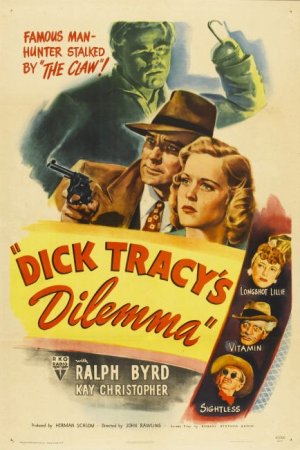
The 10th film in Mill Creek’s Fabulous Forties box set was 1947’s Dick Tracy’s Dilemma. According to Wikipedia, this was the third Dick Tracy film to be produced by RKO Pictures. In case you couldn’t guess from the title, Dick Tracy has a dilemma in this film. I assume that, in the first two films, he had a problem and a quandary.
Clocking in at just an hour, Dick Tracy’s Dilemma takes place over the course of one long and very dark night. Three men rob the Flawless Furs Warehouse and kill the night watchman. The leader of the gang (played by Jack Lambert) is known as the Claw because, instead of a right hand, he has a prosthetic hook, which he can use to either beat or claw people to death. (It all depends on his mood.) The Claw also loves cats so he can’t be all bad.
Investigating the murder is Detective Dick Tracy (Ralph Byrd). This was the first Dick Tracy film that I’ve ever actually watched so I can’t claim to be an expert on the character. But judging from this film, Dick Tracy’s dilemma is that everyone around him is either extremely stupid or extremely evil. For example, Dick’s partner, Patton (Lyle Latell), is useless. When Dick’s number one informant, a fake blind beggar named Sightless (Jimmy Conlin), attempts to get some important information to Dick, he has the misfortune of running into Dick’s idiot friend, a Shakespearean actor named Vitamin (Ian Keith). Vitamin mishears the information and he delivers his lines with so much over-the-top flourish that, by the time he tells Dick that Sightless wants to speak to him, the poor beggar has already been murdered by The Claw.
Seriously, people have been talking about how dark Batman v. Superman is but just check out Dick Tracy’s Dilemma. The Claw is a sadistic killing machine and, in the end, it seems like it’s more dumb luck than good police work that leads to Dick Tracy tracking him down. The film ends with smiles all around, despite the fact that it’s only been a few hours since poor Sightless was clawed to death. If Vitamin wasn’t a drunk old actor, Sightless wouldn’t be dead. For that matter, Dick Tracy is the one who pressured Sightless to act as an informant in the first place.
Seen today, Dick Tracy’s Dilemma seems more like an episode of an old cop show than an actual movie. It’s easy to be dismissive of it but I don’t know. If I had been alive in 1947 and saw this movie when it was originally released, I probably would have enjoyed it. Ralph Byrd makes a convincing hero and there is a sense of genuine menace to Jack Lambert’s performance as The Claw. That said, don’t even get me started on Vitamin.


 Through the Shattered Lens