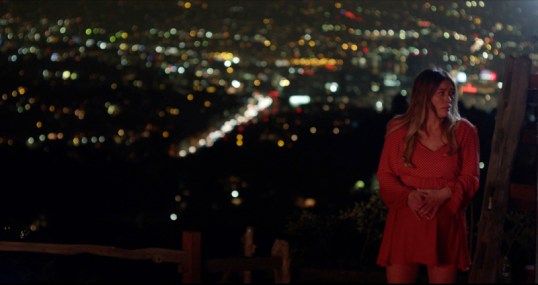
Spring Break On The Lens: Aileen Wournos: American Boogeywoman (dir by Daniel Farrands)


In 2021’s Aileen Wuornos: American Boogeywoman, Peyton List stars at Aileen, who prefers to be called Lee.  Lee has fled an unpleasant and abusive home in Michigan and she has made her way down to Florida.  With no money and no formal education, she’s been forced to make a living as a truck stop prostitute.  However, on July 4th, 1976, she happens to stumble across a party on the beach.  She befriends Jennifer (Lydia Hearst), who invites Lee to stay at her beach house.  Though Lee quickly overstays her welcome, she does meet Jennifer’s widowed father, Lewis Fell (Tobin Bell).  Lewis is enchanted by Lee’s crude but enthusiastic personality.  Lee is enchanted by Lewis’s money.  Soon, they’re married.  But when Lewis’s daughter and friends start to dig into Lee’s mysterious past, Lee resorts to murder to protect her secrets.

The idea of making a movie about future serial killer Aileen Wournos hanging out around the Florida beach and marrying the kindly president of a yacht club may sound like an unlikely one but when has that ever stopped anyone?  Oddly enough, American Boogeywoman is loosely based on the truth.  Before she became the fraggle-toothed serial killer who was immortalized in two Nick Broomfield documentaries and by Charlize Theron in Monster, Aileen Wournos was briefly married to a yacht club president named Lewis Fell.  The marriage was even announced in the society pages.  Of course, the marriage didn’t last long.  Aileen was accused of striking Lewis with his own cane and the two of them ended up getting a divorce.  That said, it would appear that the majority of American Boogeywoman was fictionalized.  Aileen was never accused of murdering anyone before she started the killing spree that eventually landed her on Florida’s crowded death row.  In the film, Aileen also claims to have murdered her own brother after he suddenly turned up in a cheap Florida motel and demanded money.  In real life, Aileen’s brother died in Michigan, long after Aileen had cut off contact with her family.

The film opens with Aileen already on death row, talking to a documentarian about her marriage.  Occasionally, throughout the film, the documentarian will interrupt Aileen’s story and he’ll point out that what she’s saying doesn’t really make sense.  (For instance, he points out that there’s no way that Aileen’s brother could have died in both Florida and Michigan.)  For the most part, Aileen shrugs off his comments but the character of the documentarian is an important one.  His character serves to comment on the strange nature of fame and crime in America.  Aileen Wournos may be an unbalanced killer but she’s also a celebrity.  She’s enough of a celebrity, the film tells us, that even after her death, two films will be made about her.  One of those films will win an Oscar.  The other film will be American Boogeywoman.  At its heart, American Boogeywoman is an examination of the morbid streak that secretly runs through American culture.  As such, it is slightly more interesting than the typical serial killer exploitation film.

American Boogeywoman was directed by Daniel Farrands, who has recently made a career out of directing somewhat distasteful true crime thrillers.  His most famous film, The Haunting of Sharon Tate, is surprisingly effective.  His worst film, The Murder of Nicole Brown Simpson, is perhaps one of the most offensive films made over the past decade.  Farrands is not a bad director but his choice in material will always be problematic for many viewers.  American Boogeywoman is one of his better films, if just because it has enough self-awareness to realize how ludicrous it all is.
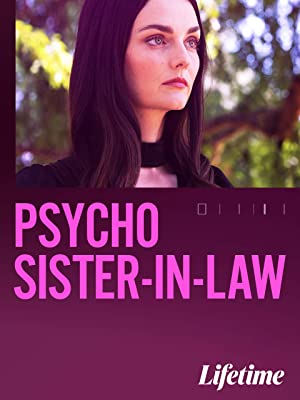
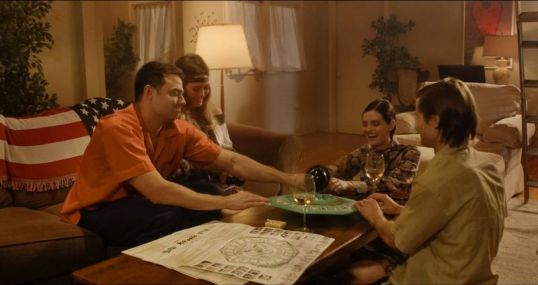
Lifetime Film Review: Psycho Sister-In-Law (dir by Jake Helgren)


When one of your in-laws is a psycho, it’s going to lead to some tense family gatherings.  There’s just no way to get around it.  Have you seen those Vrylar commercials where people are screaming at random strangers or the mother is locked away in the kitchen and sobbing all the way through her daughter’s birthday party?  Well, that’s nothing compared to what it’s like to have a murderer drop by a wedding, a reunion, or even a funeral.

From the start of Psycho Sister-in-Law, we know that Zara Downes (Lydia Hearst) is not the ideal in-law.  This is largely due to the seeing Zara murder a woman in Las Vegas.  Now, admittedly, the woman that Zara murdered was kind of mean and she was keeping Zara from finding success as an actress but it’s 2020 and there are other ways to deal with an annoying co-worker.  Murder is never the answer!

Zara, of course, claims that she has had a difficult life.  Her father was very rich man but Zara grew up without him.  Instead, he gave most of his attention and affection to his son, Nick (Brando Eaton) and his fiancée, Callie (Diora Baird).  That’s largely due to the fact that Zara was the result of an affair that he had while married to Nick’s mother.  Still, when Mr. Downes dies, Zara is invited to the reading of the will.

When the will is read, Zara is annoyed to discover that she’s inherited less than both Callie and Nick.  So, Zara sets out to ingratiate herself with Nick and his pregnant wife, Haley (Andrea Bowen).  Zara also goes out of her way to try to upset Callie. When Nick says that he’s considering giving their father’s mansion to Callie, Zara puts her evil plans into overdrive.

And really, who can blame her?  It’s a really nice house!  I mean, I know I say that about almost every Lifetime film but Psycho Sister-In-Law really does feature one of the nicest mansions that I’ve ever seen.  Obviously, I don’t want to compare myself to Zara because she does kill a few people over the course of the movie but still, I’m not totally sure that I wouldn’t go a little bit crazy over that house myself.

Most Lifetime films do require a certain suspension of disbelief.  That’s something that we’ve all come to accept about the Lifetime genre and I’m certainly not going to complain about it.  The fact that people in these movies often make stupid mistakes is one of the things that make them so entertaining.  (And before we get too judgmental regarding fictional characters, who among us hasn’t made a stupid mistake or two?)  That said, Psycho Sister-In-Law really stretches that suspension of disbelief to its breaking point.  I mean, it’s nice that Haley wants everyone to get along but, at some point, you really do have to be willing to put your foot down and say, “Hey, if you’re obviously plotting on killing everyone in the house, you’re going to have to leave.”  Zara’s villainy was so obvious that you really did have to wonder if Haley and Nick were just being intentionally blind to it.

That said, the melodrama is certainly embraced and the house is really nice.  There’s a neat and unexpected twist towards the end of the movie and Lydia Hearst appears to be having a blast playing her murderous role.  It’s a fun movie, even if Nick and Haley’s naiveté will have you rolling your eyes until you’re dizzy.

The TSL’s Grindhouse: The Haunting of Sharon Tate (dir by Daniel Farrands)


The Haunting of Sharon Tate is a frustrating film to review.

On the one hand, it’s an undeniably well-made horror film.  It’s surprisingly well-paced.  It creates an atmosphere of nonstop dread.  It’s the type of movie that makes you keep an eye on the shadows in the room.  This is the type of movie that makes your heart race and leaves you uneasy about every unexpected noise that you hear.  It’s a dark and disturbing horror film and it features an excellent lead performance from Hillary Duff in the title role.  While watching the film, you care about her and you don’t want anything bad to happen to her.  That makes the film’s shocks and scares all the more frightening.

On the other hand, though, The Haunting of Sharon Tate features a premise that will leave even the most dedicated grindhouse horror fan feeling more than a bit icky.

The Haunting of Sharon Tate is hardly the first horror film to be based on the infamous Manson murders.  In fact, it’s not even the only one to be released this year.  We’re approaching the 50th anniversary of the Tate murders so last May saw the release of Charlie Says and Quentin Tarantino’s highly-anticipated Once Upon A Time In Hollywood is set to be released in July.  What sets The Haunting of Sharon Tate apart from the other Manson films is that it’s told totally from the point-of-view of Manson’s victims.  Manson is only seen briefly and the other members of his so-called “Family” wander through the movie like dead-eyed zombies.  This is the rare Manson film that doesn’t try to portray that grubby little racist hippie as being some sort of outlaw folk hero and, regardless of what you think of the rest of the film, that’s definitely a good thing.

Instead, this movie focuses on Sharon Tate.  The film opens with a black-and-white recreation of an interview that Sharon gave a year before her murder, in which she discusses whether or not dreams can tell the future.  We then jump forward to August of 1969.  Sharon is 8-months pregnant and staying at 10050 Cielo Drive.  Her husband, Roman Polanski (who is kept off-screen for the entire movie), is in Europe.  Staying with Sharon is her ex-boyfriend, Jay Sebring (Jonathan Bennett) and her friends, heiress Abigail Folger (played by real-life heiress Lydia Hearst) and Abigail’s boyfriend, Wojciech Frykowsky (Pawel Szajda).  Also on the property is caretaker Steve Parent (Ryan Cargill), who is staying in a trailer and enjoys working on electronics.

(For the most part, the film sticks to the generally established facts when it comes to depicting the friendship between Sharon, Jay, Abigail, and Fykowsky.  However, it takes a lot of liberties with its portrayal of Steve Parent.  As opposed to how he’s portrayed in the film, Parent was actually an 18 year-old friend of the property’s caretaker who, because he was in the wrong place at the wrong time, became the first victim of the Tate murders.  By most accounts, he never met Sharon or any of the other inhabitants of the main house.)

In the film, Sharon is haunted by premonitions.  She has dreams in which she sees her friends being murdered by feral human beings.  She gets disturbing phone calls and she hears weird voices talking about someone named Charlie.  Her friends keep telling her that the nightmares are just a result of the stress that she’s under but Sharon is convinced that they’re a warning.  (Oddly, some of the scenes in which her friends dismiss her concerns are reminiscent of Polanski’s Rosemary’s Baby.)  After an hour of build up, the Family finally arrives at Ceilo Drive and, because of her dreams, Sharon is ready for them and able to fight back.  Or is she?  Can history be changed? the film asks, Or has our fate already been determined?

So, here’s the good thing about The Haunting of Sharon Tate:  It’s clearly on Sharon’s side.  It doesn’t glorify Manson and his family.  Hilary Duff gives a touching and, at times, heart-breaking performance as Sharon Tate and the film holds her up as a symbol of hope, optimism, kindness, and everything else that was lost as a result of Manson’s crimes.  The film itself is well-directed and genuinely scary and the final shot is haunting.

Here’s the bad thing about The Haunting of Sharon Tate:  It may be well-made but it’s still exploiting a real-life tragedy, one in which six people lost their lives.  (That’s not counting all of the other murders that Manson ordered.)  To be honest, if the film was called The Haunting of Jessica Smith, I probably wouldn’t have any reservations about recommending it to horror fans.  Instead, it’s called The Haunting of Sharon Tate and that makes it very hard to watch the film with a clear conscience.  Do the film’s technical strengths make up for the film’s inherent ickiness?  That’s the question that every viewer will have to ask and answer for themselves.

I will say this: I do think that The Haunting of Sharon Tate is a thousand times better than something like Wolves At The Door, in which Sharon was portrayed with all the depth of a Friday the 13th summer camp counselor.  The Haunting of Sharon Tate left me feeling feeling frightened, disturbed, and, because of my struggle to reconcile the film’s technical strengths with its morally dubious premise, more than a little annoyed.  It also left me mourning for Sharon Tate and every other victim of Manson and his brainwashed gang of zombies.  Is the film a tribute to Sharon or a crass exploitation of her memory?  At times, it seems to be both which is one reason why it’s such a frustrating film.

Well-made and problematic to the extreme, The Haunting of Sharon Tate is as close to a modern grindhouse film as we’re going to get in today’s antiseptic age.  Whether or not that’s a good enough reason to sit through it is a question that each viewer will have to decide for themselves.