Film Review: Into the Dark (dir by Lukas Hassel)


Into the Dark

“Congratulations!  You just destroyed government property!” —

33963 (Lee Tergesen) in Into the Dark (2014)

The quote above comes from a 14-minute short film that I was recently fortunate enough to have the opportunity to view.  If you’ve read my previous reviews on this site, then you probably know that I’m not a huge fan of government property in general so, as you can imagine, that line made me smile.  Within the context of the film, it also provided a brief moment of triumph for two men who have both reached a point where they have to be happy for whatever temporary victory they may happen to achieve.

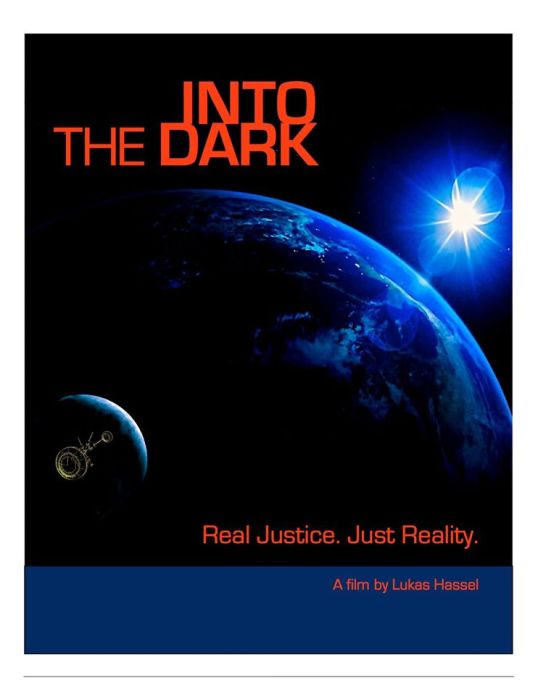
Into the Dark opens with a haunting image of an urban skyline.  The moon hangs over the city and, as we watch, we briefly see that something has been launched into the night sky.  That object is a small capsule that includes two men who have been strapped in back-to-back.  The two men are identified not by name but by number.  58257 (Lukas Hassel, who also wrote and directed Into the Dark) is angry and shouts at the unseen people who are watching him.  Meanwhile, 33963 (voiced by Lee Tergesen) gives him advise on how to turn off a strobing blue light and tells him that, no matter how loudly he shouts, nobody watching can hear a word that he’s saying.  No one on Earth is interested in what these two men have to say for themselves.  Instead, the audience simply wants the catharsis of seeing what happens to them.

As we listen, it becomes apparent that these two men have broken the law and this space ride is a part of their punishment.  33963 was a political revolutionary while 58257’s crimes are a bit more ambiguous.  Every few seconds, a condescending computerized voice tells them to think about what they’ve done.  As their punishment approaches, 33963 begs 58257 to just talk to him and to allow him to experience some sort of human interaction…

Into the Dark may take place in the future but it deals with a very modern reality: we live in a very bloodthirsty time and that’s especially true in the way that we treat those who have been convicted of breaking the law.  At a time when people feel like they have less and less control over their own fates, there’s a need to punish those who break “the rules,” never mind the fact that some rules make more sense than others.  At any given times, you can turn on the television and watch reality shows about cops arresting lawbreakers, attorneys prosecuting the accused, and guards watching the convicted.  These shows presents us with a world where the is no difference between a murderer and some guy who happened to have a little bit of weed in his car and where the only thing that matters is that people are being held responsible for breaking the rules that it’s assumed the viewer automatically and unquestioningly obeys.  These shows allow an insecure society to feel superior.

That’s one reason why Into the Dark is so memorable.  The final twist, the truth of why Hassel and Tergesen are in that capsule together, is totally plausible.  It’s something that we, as an audience, know is probably going to end up happening some day.  When the plausibility of that twist is mixed with the emotional power of the performances of Tergesen and Hassel, the end result is a thought-provoking look at crime, punishment, and the manufacturing of televised reality.

Another thing that makes Into The Dark so memorable is that the end credits mention that the majority of this film was shot in “Lukas Hassel’s apartment.”  You wouldn’t know that from watching the film, which takes wonderful advantage of the production’s low-budget.  The inside of the capsule is claustrophobic and cramped in the way that you would expect an intergalactic jail cell to be small and cramped.  Despite almost entirely taking place in one small set, Hassel and cinematographer Henry Lee never allow the action to get stagey. Instead, it’s a fully cinematic experience and the fact that it was shot in someone’s apartment should give hope to aspiring independent filmmakers every where.

Into the Dark is currently playing on the festival circuit.  You can find out more about the film here.  And you can also check out it’s Facebook page.  Or, if you’re at the Queens World Film Festival on March 18th or the Maryland Film Festival on March 28th, you can check it out there as well!
Three Films From Jeremiah Kipp: Berenice, Minions, and Painkiller


I recently had the chance to view three short horror films that were directed by Jeremiah Kipp.  Before I get into the specifics of each film, let me just say that I recommend all three of them.  As a director, Kipp does a good job of building and maintaining the proper atmosphere of dread that’s necessary for good horror (especially good short horror) to work.  If you’ve read my previous reviews on this site or over at Horrorcritic.com, you know that I am an unapologetic fan of surreal and dream-like horror and, needless to say, that’s what all three of the films below deliver.

berenice-bloody

“You and I have some unfinished business from back in the day.” — Berenice (2014)

The first film that I watched was Berenice, a 19-minute adaptation of a short story by Edgar Allan Poe.  Though the story has been updated so that it now takes place in present day New York, Berenice closely follows the original Poe short story.  Edward (Thomas Mendolia) is a mentally unstable man who seems to spend most of his time locked away in his room, where he obsessively tinkers with a light.

When his cousin, Berenice (Cheryl Koski), moves in with him and his parents, Edward is, at first, reluctant to get close to her.  However, he is slowly won over by the fact that Berenice is as much as an outsider as he is.  She is dying from an unknown illness and regularly suffers seizures.  While everyone else chooses to ignore Berenice, Edward grows closer and closer to her.  But, haunted by visions of her savagely biting off his lower lip, Edward cannot stop obsessing over her teeth…

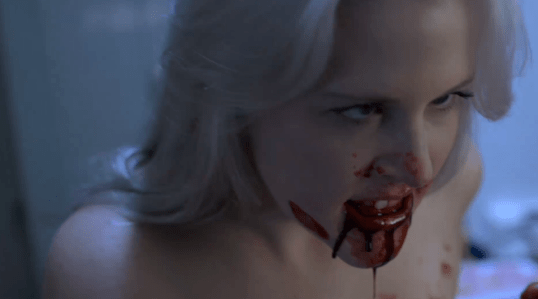
Full of gloomy atmosphere, Berenice is an effectively morbid mood piece.  It can be appreciated as a literary adaptation but, even if you haven’t read Poe’s original short story, Berenice still works as a succession of increasingly surreal and disturbing images.  In many ways, Berenice can be positively compared to the work of the great French director, Jean Rollin.  A scene where Berenice and Edward visit a cemetery brings to mind a similar scene from Rollin’s Two Orphan Vampires.  And, in the role of Berenice, Cheryl Koski bares more than a passing resemblance to Francoise Blanchard, the star of Rollin’s The Living Dead Girl.  In the scenes were blood runs down her chin or she suddenly appears awkwardly walking naked down a dark hallway, Koski could be Blanchard’s twin.

Speaking of Cheryl Koski, she’s like a force of nature in this film.  Whether she’s somewhat desperately trying to get people to talk to her at a party or awkwardly flirting with Edward, or biting someone’s face off, Cheryl Koski gives an energetic, heartfelt, and even poignant performance.  Playing the far more repressed Edward, Thomas Mendolia deserves praise as well.  It’s not easy to make introversion compelling but he does it.

Berenice is part of a horror anthology called Creepers, which can be ordered from Creepersfilm.com

minions-long

“There’s a cruelty in your heart. Is it love or is it hate?” — The Minions

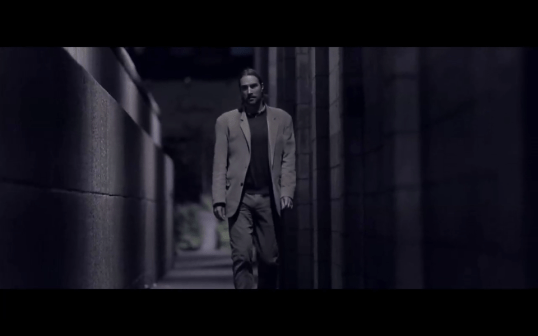
Speaking of dream-like, the next Kipp film that I watched was practically a filmed nightmare and I mean that in the best possible way.  The Minions opens with William (played by Lukas Hassel, who has a really handsome movie star look about him) standing in a dark room.  As he stares out a window, he has a conversation with an unseen woman.  Their dialogue is wonderfully cryptic.  We see flashbacks of William walking down the streets of Manhattan.  He meets two girls who appear to be drunk. He escorts them back to their apartment and he promises the drunker of the two a kiss when they reach her destination.  Needless to say, the girls are not quite what they seem and a kiss is more than just a kiss…

The Minions is only 11 minutes long but it’s an amazingly effective and atmospheric 11 minutes, full of creepy images and growing paranoia.  Looking over the notes that I took while watching the movie, I notice that I twice jotted down that The Minions has a “great soundtrack.”  That’s not just in reference to the music, though the film’s score is appropriate ominous.  Instead, I meant that The Minions is just a fascinating film to which to listen.  The music playing in the background, the footsteps of people walking through the city, the sound of constant (but never seen) traffic, and the melody of Lukas Hassel’s voice; they all combine to provide the perfect soundtrack for the film’s shadowy and haunting images.

It all adds up to a very haunting piece of moody atmosphere.

PLK1

“You’ll pay for this, won’t you?” “Someone will. Someone always does.” — Painkiller (2014)

The final Jeremiah Kipp short film that I watched was Painkiller, a wonderfully over-the-top look at pain and pleasure.

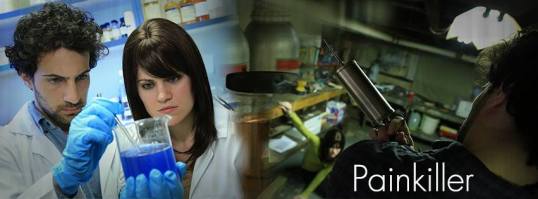
Two scientists (Kelly Rae LeGault and Berenice‘s Thomas Mendolia) are looking for a non-addictive way to treat the pain of being ill, a substitute for the drugs that — while they may relieve pain — are ultimately so addictive that they put the patient’s health at risk.  They engineer an organism (one that actually looks a bit like a miniature version of theTtingler from the classic Vincent Price film) that will attach itself to a patient’s nervous system.  The organism feeds on pain and releases endorphins while feeding.  LeGault volunteers to be the test subject and, in a scene that is full of Cronenberg-style sexual imagery, Mendolia inserts a gigantic hypodermic needle into her spine.

As they soon discover, the inserted organism works.  In fact, it works far too well.  LeGault soon becomes addicted to pain and when she doesn’t get it, she goes as far as to attack Mendolia with an iron.  (That scene made me go, “Agck!,” largely because it reminded me of when I was four and I accidentally grabbed an iron and burned my fingertips.)  Even a dominatrix, hired by Mendolia, fails to satiate LeGault’s need for pain.

However, a mysterious man in a suit (played by Jerry Janda) shows up and says that LeGault is exactly what he’s been looking for…

Now, I’m not going to tell you too much about the man in the suit because that would give away the film’s twist.  I’ll just say that Jerry Janda gives a really good and creepy performance here.  When, towards the end of film, he explains that somebody always pays, he does so with just the hint of a self-satisfied smirk, one that tells you everything that need to know about the character and how he views the world.

Along with playing that creepy man, Jerry Janda also wrote the script for Painkiller and what a script it is.  It neatly straddles the line between horror and parody, as does Kipp’s direction.  Ultimately, it’s a film that suggests that addiction is a part of human nature and that pleasure and pain need each other in order to survive.

Want to see Painkiller?  You can click here to buy or rent the film!