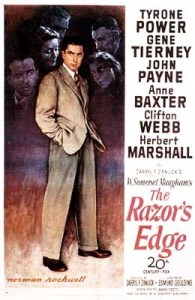
Lisa Reviews An Oscar Nominee: The Razor’s Edge (dir by Edmund Goulding)


Oh, 1919!  What a year.  The Great War had ended, leaving much of Europe devastated.  American soldiers were coming home and, scarred by the horrors they had experienced, becoming members of a lost generation.  The Spanish Flu was infecting millions, on the way to eventually wiping out 3% of the world’s population.  It was a grim time so it’s no surprise that many chose to close their eyes and pretend like everything was fine.  Only a few people were willing to look at the world and say, “There has to be something more.”

The 1946 film The Razor’s Edge tells the story of one such man.  Before the war, Larry Darrell (Tyrone Power, Jr.) was like most of his friends back in Chicago.  He was carefree.  He was wealthy.  He was engaged to marry the beautiful but self-centered Isabel (Gene Tierney).  But then he went off to fight in World War I and the experience changed him.  On the final day of the war, another soldier sacrificed his life to save Larry and Larry is now haunted by that man’s death.  No longer sure about his place in the world, Larry announces that he’s rejecting his former life.

Of course, that’s an easy thing to do when you’re rich.  Larry is lucky enough to have an inheritance that he can live off for a few years.  All of his former friends think that Larry’s just struggling to adjust to being back home and they expect that he’ll get over it soon enough.  Isabel’s uncle, Elliott (Clifton Webb), thinks that Larry’s acting like a total fool.  For Larry’s part, he no longer cares what any of them think.  He’s going to travel the world, seeking enlightenment.

While Larry’s searching, life goes on without him.  Isabel ends up marrying one of Larry’s friends, Gray Maturin (John Payne).  Larry’s best friend from childhood, Sophie (Anne Baxter), suffers a personal tragedy of her own and, when Larry next meets her, she’s living as a drunk on the streets of Paris.  Larry keeps searching for the meaning of it all.  He works in a coal mine.  He discusses philosophy with a defrocked priest.  Eventually, he ends up in the Himalayas, where he studies under a Holy Man (Cecil Humphreys).

It’s an intriguing idea and still a relevant one.  Unfortunately, the movie doesn’t really work because Larry tends to come across as being a little bit full of himself.  I could imagine someone like Henry Fonda working wonders with the role but Tyrone Power seems totally miscast as Larry.  When you look at Power, you find it hard to believe that he’s ever had a bad day, much less a need to spend months hiding in the Himalayas.  He comes across as the last person you would necessarily want to take spiritual advice from.  The fact that Webb, Tierney, Payne, and Baxter are all perfectly cast only serves to enforce just how miscast Power is.  It’s a well-intentioned film with nice production values but it’s never quite compelling.

The Razor’s Edge was based on a novel by W. Somerset Maugham.  Interestingly, the film features Maugham as a character, played by Herbert Marshall.  Even more interesting is the fact that the film was apparently remade in 1984, with Bill Murray cast as Larry Darrell.  I’ve never seen the remake so I have no idea if Murray is an improvement on Power.

(Also, since I’ve been pretty critical of Power in this review, let me recommend Witness For The Prosecution, in which Power is much better cast.)

The Razor’s Edge was nominated for Best Picture but lost to another film about returning vets, The Best Years of Our Lives.

Cleaning Out The DVR #6: Watch On The Rhine (dir by Herman Shumlin)


After I finished watching Around The World In 80 Days, I decided to watch the 1943 film, Watch on the Rhine.  Though both films are immortalized in the record books as a multiple Oscar nominee, Watch on The Rhine might as well have taken place in a totally different universe from Around The World In 80 Days.  Based on a play by the always politically outspoken Lillian Hellman, Watch On The Rhine is as serious a film as Around The World In 80 Days is frivolous.

It’s also somewhat infamous for being the film for which Paul Lukas won an Oscar for best actor.  When Lukas won his Oscar, he defeated Humphrey Bogart, who was nominated for his iconic performance in Casablanca.  This is justifiably considered to be one of the biggest mistakes in Oscar history and, as a result, there are people who will tell you that Watch On The Rhine is a totally undeserving nominee, despite having never actually seen the film and not being totally sure who Paul Lukas was.

Up until I watched the film yesterday, you could have included me among those people.

What’s interesting is that Watch On The Rhine almost feels like a companion piece to Casablanca.  Both films were resolutely anti-fascist, both of them dealt with a member of the Resistance trying to escape from a German agent, and both films climaxed with a gunshot.  The part played by Paul Lukas, a German engineer named Kurt Muller, feels like he could be an older version of Casablanca‘s Victor Laszlo.  Finally, whereas Casablanca centered around “letters of transit,” Watch On The Rhine centers around money.  Kurt is smuggling money to the Resistance.  Teck de Brancovis (George Coulouris), a dissolute Romanian count, demands money in exchange for not informing the Germans of where Kurt’s location.

(Of course, both Casablanca’s letters and Watch on the Rhine’s money are an example of what Hitchcock called the MacGuffin.  The letters and the money are not important.  What’s important is that both films use the thriller format to inspire viewers to support the war effort.)

The film takes place in 1940, when America was still officially neutral.  Kurt and his American wife, Sara (Bette Davis), have secretly entered the United States through Mexico.  Officially, they are only visiting Sara’s brother (Donald Woods) and mother (Lucille Watson) in Washignton, D.C.  Unofficially, they are looking for political sanctuary.  However, Kurt still finds himself drawn back to Germany, especially after he finds out that one of his friends in the Resistance has been arrested by the Gestapo.

Not surprisingly, considering its theatrical origins, Watch On The Rhine is a very talky and a very stage-bound film.  Almost all of the action takes place in one location and a good deal of the film’s running time is devoted to Kurt giving speeches.  Don’t get me wrong, that’s not a complaint.  Though the film may have been released at the height of the war, the play was written at a time when America was still officially neutral and many elected officials were adamant that, even if it meant Hitler taking over the entire continent, America should never get involved in the affairs of Europe.  Watch On The Rhine was Hellman’s attempt to both expose what was happening in Germany and to rally them to the anti-fascist cause.  Watch On The Rhine may be propaganda but its anti-Nazi propaganda and who can’t appreciate the importance of that?

When it was originally released, Watch On The Rhine was sold as a Bette Davis vehicle.  To be honest, Davis doesn’t really do much in the film.  She supports her husband and she has a few sharp words for Teck but, otherwise, her role is definitely secondary to Paul Lukas.  Davis took the role because she believed in the film’s message.  It’s a good message and, for that matter, Watch On The Rhine is a pretty good film.  It’s well-acted, intelligently written, and perfectly paced.

But what about Paul Lukas’s Oscar?  Well, let’s state the obvious.  Humphrey Bogart should have won the award for Casablanca.  That doesn’t mean that Paul Lukas doesn’t give a worthy performance.  He originated the role on stage and he does a good job of bringing the character to life on film, bringing a sincere intensity to even the most stagey of Kurt’s monologues.  Whenever Lukas speaks, he’s explaining to the filmgoers why the U.S. must take a stand against Hitler and his followers.  Considering that Watch On The Rhine was released at the height of World War II, I imagine that this, more than anything, led to Lukas winning his Oscar.

Watch On The Rhine was also nominated for Best Picture.  It was deserved nomination but, in this case, the Academy made the right decision and gave the Oscar to Casablanca.