It’s Mardi Gras weekend so I’m going to guess right now that people are flooding into Louisiana.
I’ve always loved Louisiana. My family lived in Shreveport for nearly two years, from December of ’96 to May of ’98. It was the last state that we lived in before returning to Texas and it’s a place that I’ve visited a few times since. (Shreveport, I might add, also celebrates Mardi Gras. It’s just that it tends to be a little bit more sedate in Shreveport than in New Orleans.) Louisiana is a state that is full of atmosphere and eccentric historical oddities. If you ever think your political leaders are crazy, do a google search on “Edwin Edwards” or “Earl Long.” If you ever think there’s never been a stranger moment in history than now, read T. Harry Williams’s biography of Huey Long.
Anyway, today’s music video of the day is all about Louisiana. Radney Foster’s Louisiana Blue has a nice mellow mood to it. Consider it to be the calm before the storm.
As I’ve mentioned in a few other reviews, filmmakers have always loved to make movies about the crazy demagogues that we have historically tended to elect down here in the South. Sometimes, those movies are serious and thought-provoking, like All The King’s Men.And sometimes, like in Hold That Co-Ed, a film will attempt to play up the inherent humor in rabble rousing. And then you’ve got films like Adaand Hurry Sundown, which are so melodramatic that those of us down South just have to shake our heads in amazement that people up North actually believe this stuff.
The 1989 film Blaze (which is currently making the rounds on cable) is a part of this cinematic tradition of films about flamboyant Southern politicians. It’s part comedy and part melodrama and, perhaps not surprisingly, it takes place in 1950s Louisiana.
(Why isn’t that surprising? Listen, my family used to live in Louisiana. I still visit Louisiana on a fairly regularly basis. Louisiana is crazy. That’s one reason why I love it.)
Blaze is based on the true story of Gov. Earl K. Long (played here by Paul Newman). The younger brother of former Governor Huey P. Long (who himself served as the basis for the character of Willie Stark in All The King’s Men), Earl served as governor for three non-consecutive terms. He was a flamboyant populist, in the style of his older brother, the type who campaigned as one of the “common” people and who was either extremely corrupt or extremely progressive, depending on which historian you happen to be reading.
In Blaze, Earl is nearing the end of his third term. Because the state’s constitution does not allow a governor to succeed himself, Earl is currently campaigning for lieutenant governor, with the plan being that one of Earl’s allies will be elected governor and will then resign so that Earl can succeed him. While this is traditionally the sort of thing that voters in Louisiana would love, Earl is struggling because some voters are angry over his support for the civil rights movement.
Earl is also struggling because he’s just met Blaze Starr (Lolita Davidovich), a much younger stripper from West Virginia. For Earl, it’s love at first sight and soon, Blaze feels the same way. Soon, she and Earl are going across the state together. However, after Earl’s opponents arrange for him to be sent to a mental asylum, Blaze is forced to consider that she might be too big of a political liability to remain with the man she loves.
If that all sounds incredibly romanticized — well, it is. After I watched Blaze, I did a little bit research on Earl and Blaze. To say the film is fictionalized would be an understatement. (Though, interestingly enough, Earl actually was sent to a mental asylum while serving as governor.) But is that really a surprise? Would audiences rather watch a movie about a corrupt, old racist who regularly cheated on his wife or would they rather watch a romanticized love story with hissable villains and moments of crowd-pleasing comedy?
As for the film itself, it’s okay. It moves a bit too slowly for its own good and it’s never quite as enthralling as you might hope it would be, but both Paul Newman and Lolita Davidovich are well-cast and have a likable chemistry. I related to the film’s version of Blaze Starr, mostly because we’re both redheads with big boobs who have a natural distrust of authority figures. If you’re into Southern politics and you’re not obsessed with historical accuracy, you might enjoy Blaze.
My sixth and (to date, anyway) final home state is Louisiana, where my family called Shreveport home from December of 1996 to May of 1998. Louisiana was the last state I lived in before moving back to Texas, where I’ve remained ever since.
Whenever people find out that I used to live in Louisiana, they always seem to automatically assume that means that I either lived in New Orleans or next door to the family from Duck Dynasty. They always seem to be somewhat disappointed to learn that I lived in Shreveport, which has a lot more in common with East Texas than with the things that most people visualize when they think about Louisiana. However, I will always have good memories of Shreveport and let me tell you why. For most of my childhood, I had a really bad stutter and, as a result, I was extremely shy. However, shortly after my 12th birthday, my stutter went away. Whether it was the result of spending hours with speech therapists or if it’s just something that I outgrew, Shreveport will always be the city where I stopped stuttering. (And, it should be noted, Shreveport may not be New Orleans but it still celebrates Mardi Gras. It’s just that the celebrations in Shreveport are a bit more …. sedate.) So, seriously — don’t say a word against Shreveport.
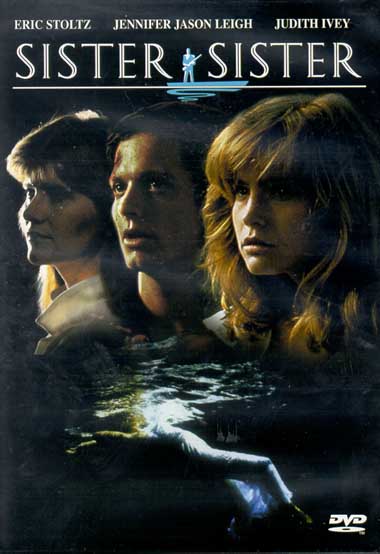
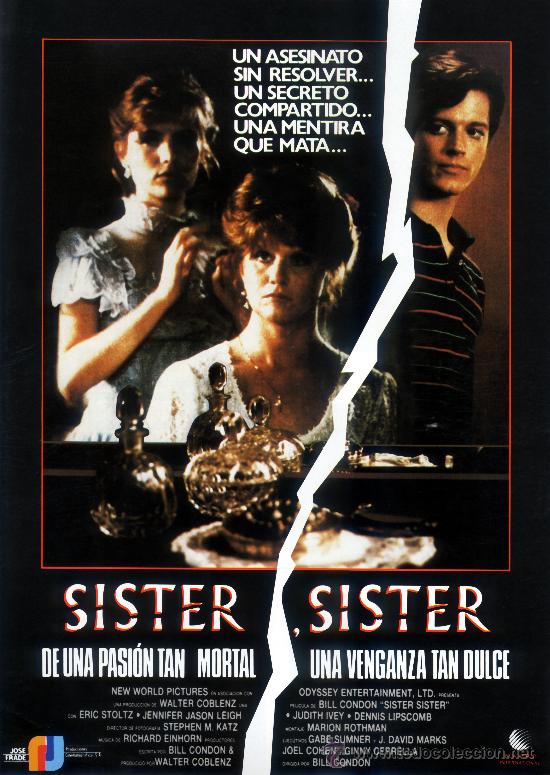
Besides, Shreveport has a wonderful atmosphere all of its own. In fact, the same thing can be said about all of Louisiana. With its long history and unique culture, Louisiana is perhaps the most atmospheric state in the union and that atmosphere is perfectly displayed in Sister, Sister, an effective little thriller from 1987.
Sister, Sister tells the story of two sisters living in a dilapidated mansion on the bayous. The older sister, Charlotte (Judith Ivey) is in love with Sheriff Cleve Doucet (Dennis Lipscomb) but she knows she can never marry him because she has to watch and protect her younger sister, Lucy (Jennifer Jason Leigh). Lucy is mentally unstable and claims that she can communicate with the ghosts that live in the bayous.
Charlotte and Lucy have turned their mansion into the boarding house and they rent a room to Matt (Eric Stoltz), a congressional aide who is taking his vacation in the bayous. Matt takes an interest in Lucy, which raises the suspicions of Etienne (Bejamin Mouton), a sinister handyman who appears to be obsessed with Lucy himself. As you can probably guess, nobody in this film is quite who he or she appears to be and it all leads to the uncovering of dark secrets from the past.
So, let’s just start with the obvious. The plot of Sister, Sister doesn’t make much sense. If you think about it, you’ll find a lot of improbabilities. So, my suggestion is that you just don’t think about it. Instead, watch the film for the performances of Judith Ivey and Jennifer Jason and the atmosphere of the bayous. Making his directorial debut here, future Twilight director Bill Condon captures a lot of haunting images of the bayou and his direction emphasizes mood over cheap thrills. The end result is a horror film that might not be scary but it certainly is creepy and stays with you after it’s over.
If nothing else, Sister, Sister is an effective B-movie. It’s also a nice showcase for my former home state of Louisiana.
This rather lengthy sequence comes towards the end of Walter Hill’s 1981 action film, Southern Comfort. Two national guardsmen (played by Keith Carradine and Powers Boothe), after spending the majority of the movie being chased through the Louisiana bayou by “bad” Cajuns, find a few moments of fleeting peace with “good” Cajuns. While I love the way Hill builds up the tension in the scene, it’s the authentic atmosphere that makes this sequence memorable. Hill filmed this sequence with nonprofessional extras who pretty much just did their thing.
(As a sidenote: I’m fluent in French but less so in Cajun.)
Be warned: two hogs are gunned down and gutted about halfway through this scene. Since this film was made by Walter Hill and not Umberto Lenzi, I doubt the hogs were specifically murdered just for the movie. To be honest, as a former farm girl who has spent more than a little time down around the bayous, I find it diffilcult to cry too hard over a hog. Trust me, they’re nothing at all like Babe.
The music here, by the way, was performed by the legendary Dewey Balfa.

 Through the Shattered Lens