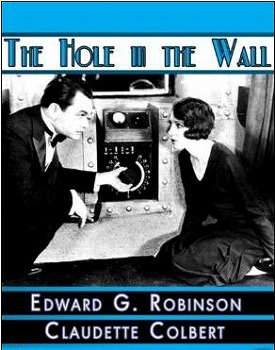
Film Review: The Hole In The Wall (dir by Robert Florey)


Released in 1929, at the dawn of the sound era, The Hole In The Wall tells the story of The Fox (Edward G. Robinson) and two women known as Madame Mysteria.

The Fox is a con artist, a veteran criminal who takes care of the people working for him.  He may not be an upstanding citizen but he seems to truly care about his sidekick Goofy (Donald Meek) and his partner-in-crime, Madame Mysteria (Nellie Savage).  Madame Mysteria is a fake psychic.  She sits in a chair and does readings while The Fox sends her a series of electric shocks in morse code to let her know what she should say about each victim of their con.  They’ve got a pretty good thing going until Madame Mysteria is killed in a train accident.

(Since this film is from 1929, the train accident is recreated with a miniature train that falls off a track in what appears to be a plastic city.  Basically, it looks like a primitive YouTube video made by an enthusiastic toy train hobbyist.  It may not be convincing but there’s something charming about just how cheap it all is.)

Shortly after Mysteria is killed, Jean Oliver (Claudette Colbert) wanders into The Fox’s shop.  Jean is looking for a job and for revenge.  As she explains it, she used to have a good job in a department store until her manager accused her of stealing.  Though Jean was innocent, she still spent some time in jail.  Her life was ruined.  Now, she wants to be the new Madame Mysteria and she wants to kidnap the daughter of the woman who accused her.  She doesn’t want to get any ransom or anything like that.  Instead, she wants to raise the little girl to become a criminal.  Fox and Goofy agree, which leads me to wonder if the Fox is really as clever as he thinks he is.  Is Jean really the only person they could find to be the new Madame Mysteria?  Surely they could find a Madame Mysteria who doesn’t demand they commit a major felony just for her services.  Still, kidnap the little girl they do and strangely enough, she never seems to be upset over being taken from her parents.  (Even more strangely, we don’t actually see or learn the details of how she was kidnapped.  She just suddenly shows up at the Fox’s home.)  Goofy becomes a babysitter and Jean becomes Madame Mysteria.

By an amazing coincidence, the reporter (boring David Newell) who decides to write a story on the amazing psychic Made Mysteria just happens to be Jean’s ex-boyfriend!  While the Fox falls in love with Jean and the police search for the abducted child, Jean herself starts talking to the dead….

In many ways, The Hole In The Wall is typical of the melodramas that came out during the early sound era.  The majority of the supporting actors are still adjusting to acting with sound and the action often feels rather stagey.  That said, it’s an entertaining film, largely due to the performance of Claudette Colbert and Edward G. Robinson, both of whom were just starting their careers and on the cusp of stardom.  This was Robinson’s first role as a gangster and he snarls with style while Colbert actually keeps the audience guessing at her motivations.  The Hole In The Wall is definitely a film from a different era but, for a film that was made nearly 100 years ago, it holds up remarkably well.

Lisa Reviews An Oscar Nominee: Shanghai Express (dir by Josef von Sternberg)


(With the Oscars scheduled to be awarded on March 4th, I have decided to review at least one Oscar-nominated film a day.  These films could be nominees or they could be winners.  They could be from this year’s Oscars or they could be a previous year’s nominee!  We’ll see how things play out.  Today, I take a look at the 1932 best picture nominee, Shanghai Express!)

Welcome to China, circa 1931.  The country is beautiful, mysterious, and dangerous.  Civil War has broken out and living in China means being caught between two equally brutal forces, the government and the Communists.  Captain Doc Harvey (Clive Brook) is scheduled to ride the so-called Shangai Express, the train that will take him from Beiping to Shanghai.  The Governor-General is ill and Doc Harvey is the only man in China who operate on him.

For Doc, it’s a matter of duty.  However, soon after boarding, he discovers that he is traveling with the infamous Shanghai Lily (Marlene Dietrich).  Though Doc has never heard of her, everyone assures him that Shanghai Lily is one of the greatest courtesans in China.   When Doc does finally meet her, he’s shocked to discover that Shanghai Lily is his former lover, Magdalen.  Did his decision to break up with her lead to Magdalen becoming a courtesan?

“It took more than one man to change my name to Shanghai Lily,” she replies.

However, Doc and Lily aren’t the only two people with their own personal drama taking place on the train.  The train is full of passengers, all of whom have their secrets.  Some of the secrets are minor.  One woman spends most of the trip trying to keep anyone from discovering that she’s smuggled her dog onto the train.  Other secrets are major.  It is suspected that one of the passengers might be working for the rebels.  And then there’s people like Sam Salt (Eugene Pallette), who is addicted to gambling and Eric (Gustav von Syffertitz), the opium dealer.  Looking over it all is a Christian missionary (Lawrence Grant) who considers both Lily and her companion, Hui Fey (Anna May Wong), to be fallen women.

It’s not an easy journey, no matter how nice and romantic the train may be.  If the express isn’t being stopped by government soldiers, it’s being hijacked by a warlord who not only wants to stop Doc from performing the operation but who also wants to take Lily back to his palace…

Shanghai Express is pre-code drama at its best.  Director Josef von Sternberg delivers an ornate mix of opulence and melodrama, never shying away from the story’s more flamboyant possibilities.  Marlene Dietrich, appearing in her fourth film for von Sternberg, gives a strong and unapologetic performance as Shanghai Lily.  Just as Lily never apologizes for who she is, the film both refuses to judge her and condemns anyone who would try.  The film’s sympathy is purely with Dietrich and Wong as they do what they must to survive in a world dominated by men who are either judgmental, brutish, or weak.  (Within just a few years, the Hays Code would make it impossible for a film like Shanghai Express to be made by an American studio.)  With one very important exception, the entire cast is strong, with Warner Oland and Eugene Pallette especially turning in strong support.  The only exception is Clive Brook, who comes across as being a bit too dull to have ever won the the heart of Shanghai Lily.

Shanghai Express is not the best von Sternberg/Dietrich collaboration.  That would be the brilliantly insane Scarlet Empress.  However, it’s still a wonderfully entertaining melodrama.  It was nominated for best picture but lost to another entertaining melodrama, Grand Hotel.

http://www.youtube.com/watch?v=F3Qljls-FkI