 Private detective Mike Hammer (Mickey Spillane) has spent the last seven years in the gutter. Ever since his secretary, Velda, disappeared, Hammer has stopped working cases and, instead, spends all of his time drinking and passing out in alleys. That is where he is found by his old friend, Captain Pat Chambers (Scott Peters). Pat tells Mike that there has been a shooting. A man named Richie is dying in the hospital and want to speak to him. According to Richie, he was shot by the Dragon, the same communist super villain that Velda is currently hiding from. That sobers Hammer up. In fact, Mike Hammer is so tough that it only takes him a few minutes to shake off seven years of alcoholism. Mike discovers that Richie’s murder is also connected to the murder of a senator. Mike’s investigation leads him to both the senator’s bikini-clad wife (Shirley Eaton) and a communist conspiracy to take over the world. What is strange is that it never leads him to Velda. Maybe he would have found her if The Girl Hunters had gotten a sequel.
Many films were based on Mickey Spillane’s Mike Hammer novels but The Girl Hunters is unique because it stars Mickey Spillane as Hammer. Spillane was not much of an actor but he was a genuine tough guy who, even after he became a successful writer, still looked like he had gone a few rounds with the world so he was not necessarily miscast in the role of Hammer. The main problem with The Girl Hunters is that the mystery is not that interesting. Mike Hammer does not really investigate anything. He just goes from fight to fight. At the end of the movie, he does come up with a clever trick to catch the killer but since there is only one suspect, the killer’s identity is not a surprise.s The Girl Hunter is worth seeing for Shirley Eaton in a bikini and the novelty of Mickey Spillane playing his most famous creation but Kiss Me Deadly is still the best Mike Hammer film.
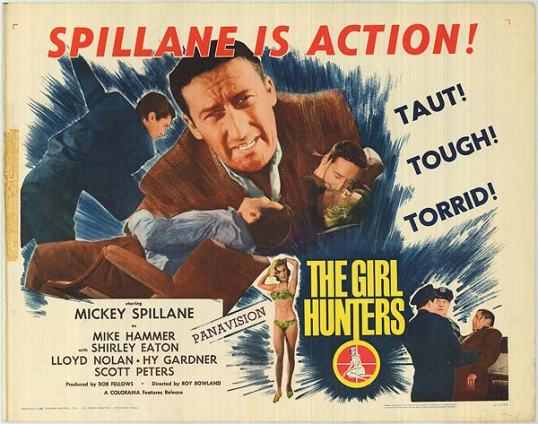
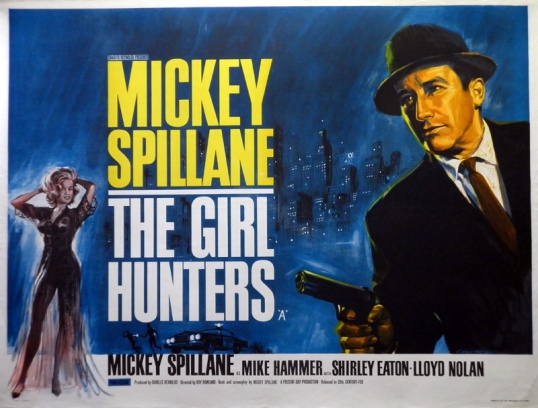
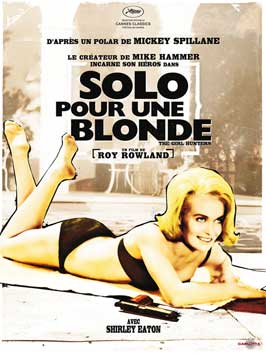
The French poster leaves no doubt about The Girl Hunters’ main selling point.

 Through the Shattered Lens