Horror Film Review: The Wave (dir by Dennis Gansel)


(Thank you shout-out to my friend Mark for recommending this film!)

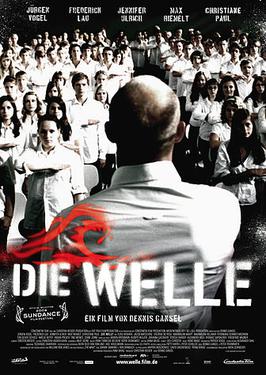
The 2008 German film, The Wave, opens with history teacher and water polo coach Rainer Wenger (Jurgen Vogel), driving to class while listening to the Ramones’s Rock and Roll High School.  

Rainer may be a middle-aged authority figure who expects his water polo players to train hard and to always put winning above everything but he still considers himself to be a punk rock rebel, an anarchist who brags about all of the protests that he was involved with.  Rainer is upset when he learns that he has been assigned to teach a week-long course on “autocracy.”  He very much wanted to teach a class on “anarchy” but that class has been assigned to the most uptight and autocratic teacher in the school.  Already feeling resentful, Rainer becomes even more annoyed when it becomes clear that the majority of his students are convinced that there will never be another dictatorship in Germany.

Rainer decides to show them how easily fascism can take root by becoming a dictator in his classroom.  Rainer orders the students to call him “Mr. Wegner.”  He tells them to all wear the same uniform of jeans and a white shirt to class and when his most intelligent student shows up for class wearing a red blouse because she “doesn’t look good in white,” Rainer refuses to call on her when she raises her hand in class.  Mr. Wegner institutes assigned seating, controlling who can sit with who.  Everyone is required to stand up if they want to speak.  When one student says that he doesn’t want to do any of this, Rainer kicks him and his friends out of class.  All three of them eventually return.

Rainer’s experiment works a bit too well.  The students come to love being a part of the movement that they come to call The Wave.  The Wave ostracizes outsiders, both in school and outside.  The Wave covers the town in graffiti, announcing their presence.  The Wave doesn’t really have a set goal but the students in Rainer’s class are now obsessed and fanatically loyal to it.  One former outcast, Tim (Frederick Lau), becomes so devoted to the cause that he even starts carrying a gun to school so he can defend the other members of The Wave….

If this all sounds familiar, it’s because The Wave is based on the novelization of the American television special of the same name.  The German version of The Wave, however, is far more cynical than the American version.  Whereas the American version features Bruce Davison as a mild-mannered but always well-intentioned liberal who realizes that his classroom experiment had gone too far, the German version features a teacher who, despite his self-proclaimed radicalism, comes to enjoy the ego boost of being a dictator in the classroom.  (Rainer, of course, puts his fascism in superficial left-wing terms, railing against the corporations that make expensive clothing and the individualism that he claims was keeping his class from coming together.)  Rainer becomes willfully blind to what he has created.  And if the American version of The Wave featured students who eventually learned a lesson and voluntarily walked away from the group they had previous celebrate, the German version presents students who are not willing to abandon their cause, even when their leader tells them that it is time to move on.  If the American version featured students who were just play-acting as fascists, the German version features students who go from being blithely unconcerned with the prospect of dictatorship to being the enthusiastic foot soldiers in a cause that has no reason to exist outside of controlling the lives and thoughts of others.  If The American version ended with hope for the future, the German version ends with tragedy.

It’s a dark film.  Some might claim that The Wave is not a horror film but, by the end of the movie, Rainer’s students have become as relentless and destructive as the zombies from a Romero film or the fanatics who often showed up in Wes Craven’s pre-Scream movies.  It takes just one week to transform them from being ordinary teenagers to being the shock troops in a directionless but destructive revolution.  They are asked to surrender their individuality and their power to think for themselves and all of them do so without much hesitation, with the desire to belong suddenly superseding everything else about which they claimed to care.  Consider this well-acted and disturbing film to be an example of the horror of everyday life.
Film Review: Munich — The Edge of War (dir by Christian Schwochow)


Munich — The Edge of War opens in 1932, at Oxford University, where three graduating students are toasting their futures as a part of the “mad generation” that’s come to age in the aftermath of World War I.  Six years later, two of them will reunite as the world appears to be on the verge of another great war.

One of them, Hugh Legat (George McKay), is a secretary to the English Prime Minister, Neville Chamberlain (Jeremy Irons).  Chamberlain, haunted by the death and destruction of the Great War, is convinced that Europe can have “peace in our time,” through a policy of negotiation and appeasement.  He is aware of the men who have come to power in Italy and Germany and he’s certainly heard the rumors that they are planning on conquering Europe themselves.  However, Chamberlain is almost in denial about the reality of the situation, at one point suggesting that Hugh write a polite letter to Mussolini requesting that Mussolini tell Hitler to tone down his rhetoric.

Hugh’s classmate, Paul von Hartmann (Jannis Niewöhner), returned to Germany after graduating from Oxford.  At first, he was an enthusiastic backer of Hitler and the Nazi party.  He was rewarded with a position as a translator in the Foreign Office.  However, Paul has since become disillusioned with Hitler and is painfully aware of the anti-Semitism that has become a part of everyday life in Berlin.  Paul regularly meets with a group of generals who are plotting a coup against Hitler.  The generals believe that, if they allow Hitler to invade Czechoslovakia, the German people will rise up in order to avoid being led into another war and that they will cheer as the generals march into Hitler’s office and place him under arrest.  Paul worries that the generals are being naïve.  Adding to Paul’s problems is a former childhood friend named Franz Sauer (August Diehl).  Sauer is a new member of the SS and he has a disconcerting habit of showing up anywhere that Paul happens to be, almost as if he is aware that Paul is not the dedicated civil servant that he pretends to be.  When Paul receives a stolen document that reveals the details of Hitler’s true plans for Europe, he and Hugh team up to try to keep Chamberlain from singing the Munich Agreement.

Looking over the events that led to World War II, one question that historians frequently ask is why did Neville Chamberlain consistently refuse to stand up to Hitler despite Hitler’s growing acts of aggression.  Why did Chamberlain knowingly turn a blind eye to every treaty and agreement that Hitler broke or ignored?  Why, with Hitler openly declaring his plans to conquer Europe, did Chamberlain and so many others insist that Hitler’s actions would somehow be different from his words?  Was Chamberlain just naïve or was he, like so many others who had been traumatized by the Great War, in willful denial about the inevitability of conflict with Hitler?  Was Chamberlain just a politician trying to keep a war-weary public happy or did he truly believe that signing an agreement with Hitler would somehow lead to “peace in our time?”  Munich — The Edge of War suggests that all of the above may be true, with Jeremy Irons playing Chamberlain as being an old school establishmentarian, one with sincere intentions but also one who is incapable of truly understanding the new reality that has been brought about by the desolation of World War I.  As played by Irons, Chamberlain is occasionally sympathetic but, even more frequently, he’s obstinate in his short-sightedness and his insistence that he alone understands how to deal with Hitler.  He’s not necessarily a bad man but he’s definitely not the right man for the times.

Of course, the majority of the film focuses not on Chamberlain but instead on Paul and Hugh.  George McKay and Jannis Niewöhner both give good performances as two civil servants who know the truth but find it impossible to get anyone to listen to them.  Niewöhner is especially effective as Paul, capturing not only his disillusionment with Germany but also his disgust for himself for having been previously fooled by Hitler’s rhetoric.  Like Chamberlain, Paul was also in denial about Hitler’s true beliefs.  The difference is that Paul has learned from his mistake and is now desperately trying to reveal the truth, even if no one else wants to hear it.

It’s a good and effective film, one that works both as a historical drama and an espionage thriller.  The film is at its best when it focuses on what daily life is like when a nation is living in the shadow of the possibility of war.  Hugh comes home to discover his son wearing a gas mask and he has to convince his wife to leave London for the weekend, even though he can’t specifically tell her why.  Meanwhile, Paul lives in a Berlin that’s full of imposing architecture and seemingly happy people but with a shadow of menace hanging over every street corner.  The city’s new buildings, built to celebrate Hitler’s vision of a new Germany, are all disturbingly pristine, as if they only exist so that evil can hide behind their impressive facades.  And in the background of every scene in Berlin, there are the uniformed men with their red armbands and their haughty glares.

It’s said that hindsight is 20/20 and, indeed, it’s easy to look at someone like Neville Chamberlain and dismiss him as just being a tragically failed and foolish politician.  And there is definitely an argument to be made that he was.  (That’s certainly how I tend to view him.)  Still, Munich — The Edge of War does a good job of capturing not only the feeling of a world on the verge of war but also the motivations of those who closed their eyes to what was coming and also to those who did not.  That we know that Paul and Hugh’s efforts are ultimately to be for naught adds a poignant sadness to the scenes of them trying to get someone to listen to them but it also makes for a powerful viewing experience.  How many eyes were open in the 30s?  How many eyes are closed today?