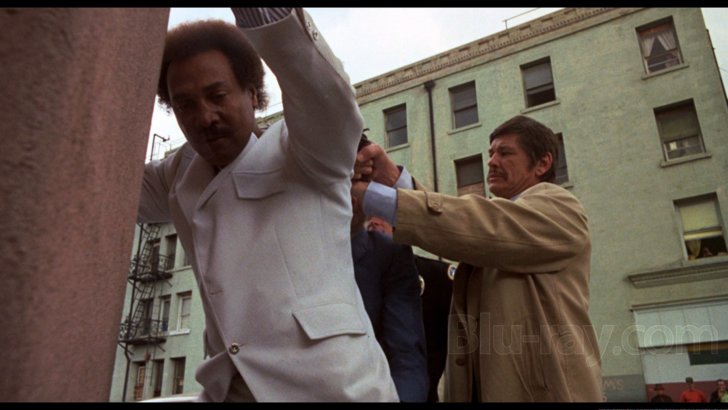
Brad reviews THE STONE KILLER (1973), starring Charles Bronson!


THE STONE KILLER opens in Spanish Harlem with detective Lou Torrey (Charles Bronson) following a young man, who had just shot a cop, into an abandoned building. When the young man refuses to turn himself in, and even tries to shoot Torrey, he gets blown away. In trouble with his superiors on the force, and being dragged in the press for the shooting, Torrey decides to change locations and continue his law enforcement career under his friend Les Daniels (Norman Fell) in Los Angeles. Soon after he arrives in Los Angeles, Torrey and his partner Mathews (Ralph Waite) are working a case against a drug dealer, when they arrest “Bootlace” Armitage (Eddie Firestone), a drug addict, but also a well-known hitman from New York. Torrey is delivering the “mechanic” back to New York for outstanding warrants when Armitage says that he is willing to give up some big information on “Wexton” in exchange for a reduced sentence. When Armitage is gunned down in what is obviously a professional hit, it’s clear that there is something going on that involves the name Wexton. We soon learn more as we meet mafia leader Al Vescari (Martin Balsam). As Vescari walks through a cemetery, he tells the leader of his operation, Lawrence (Stuart Margolin), of his plans to get revenge for a string of mafia killings that occurred 42 years earlier by using “stone killers,” in this case, former military men with no connection to the mob. As the film moves forward, Detective Lou Torrey and his fellow cops will eventually put the pieces together and find themselves taking on these “stone killers” and the mob! 

I’ll just go ahead and say up front that I’m a big fan of THE STONE KILLER these days, but that’s because the movie has grown on me over the years with repeat viewings. When I first watched the film as a teenager in the 1980’s, I enjoyed it as a tough cop film, but it wasn’t one of my favorites. I think that part of the reason I didn’t appreciate it as much back then is the more convoluted plot of the film. Most Bronson films have simple and easy to follow plot lines, but THE STONE KILLER includes a somewhat complicated mafia assassination plan, and it also sends the cops on wild goose chases that have nothing to do with the actual story. Watching the film as an adult, I appreciate Director Michael Winner taking us with him on some of those 1970’s flavored tangents that include getting to hang out with some hippies at an ashram, as well as some unjustly accused black militants. 

Even though the plot is more complicated than the average Charles Bronson film, director Michael Winner gives us some of the best action sequences of Charles Bronson’s career. There are two sequences in particular that stand out to me. After the impressive opening scenes where Torrey blows away the gun wielding young man in Spanish Harlem, it takes a while to get to the next extended action sequence, but it’s definitely worth the wait. The scene involves Detective Torrey in a car chase where he’s after one of the stone killers, Albert Langley (Paul Koslo), who’s on a motorcycle. In an era of great car chases, this is a doozy that features many amazing and dangerous stunts. The late 60’s and early 70’s are an embarrassment of riches for cinematic car chases and this one stands the test of time. The next great action sequence occurs later in the film when Detective Torrey and the cops bust the home and facility where the killers have trained for the planned massacre. Bronson is still in his physical prime in 1973, and his athletic prowess is clearly on display as he slides across floors, jumps on tables, and does anything else that is required to take down the bad guys. The film is not wall to wall action, but what’s here is as badass as it gets. 

Detective Lou Torrey is a really good role for Charles Bronson. In his best roles, Bronson is tough, but you can also tell that he cares about other people. That’s definitely the case here as he consistently shows empathy for some of the people he’s after. For example, at the beginning of the film, he has to shoot the young man in Spanish Harlem in self-defense, but he later explains to his sister that he didn’t want to do it, even expressing some understanding of how the young man may have found himself in that situation. A little later while arresting a drug dealer with his partner Mathews, Torrey is clearly disgusted when his partner uses racial slurs during the arrest. Torrey then talks to the man with respect and gets the needed information to arrest the man buying the drugs. There are further examples later in the film as he deals with other drug addicts and militants. I say none of this to insinuate that Bronson’s character is weak in any way. Rather, he seems to want to do his job and arrest criminals in a professional manner. He’s also a complex character in some ways as he will bend the rules to get what he needs if he has to. He does end up punching the car thief, Jumper (Jack Colvin), a couple of times during an interview. While this is definitely not legal, in the context of this film, it’s required in order to get to the facts of the case. Bronson is actually quite great in the film. 

Besides international superstar Charles Bronson, Michael Winner put together an amazing cast for THE STONE KILLER. Martin Balsam had won an Oscar a few years earlier, and he’s good here as the mafia boss with four decades worth of patience for revenge. Ralph Waite is also excellent as Bronson’s incompetent, racist partner Mathews. It’s hard to believe the guy would go on to play Papa Walton based on the ignorance he shows in both this film and in the Bronson/Winner collaboration CHATO’S LAND from the prior year. It’s fun watching both Norman Fell and John Ritter work together in this film, especially knowing that they would be making television history a few years later on the classic TV sitcom “Three’s Company.” The last two actors I want to mention are Stuart Margolin as the leader of the stone killers, Lawrence, and Paul Koslo as the bi-sexual badass musician Albert Langley. Both actors, especially Koslo, are good here and would have important roles with Bronson the next year as well. Margolin was an important character in DEATH WISH, and Koslo may have even outdone his work here the next year as a particularly slimy weasel in MR. MAJESTYK. Oh yeah, be sure to look for a short, uncredited cameo from B-movie queen Roberta Collins! I also want to shout out the musical score from Roy Budd, who also did the score for GET CARTER (1971). Thanks to Budd’s work, the opening credits are very cool and memorable. 

THE STONE KILLER was marketed as Charles Bronson’s “Dirty Harry” and meant to be his breakout hit in America. Unfortunately, while the film was an international hit, the actual grosses in the United States were respectable but not as much as the filmmakers had hoped for. As such, we didn’t get any more entries in the case log of Detective Lou Torrey and Bronson would have to wait another year for his American box office breakout with DEATH WISH. But that’s okay because THE STONE KILLER has stood the test of time as an excellent 1970’s cop film, emerging in my personal rankings as a major feather in the cap of Charles Bronson’s career. 

Film Review: X-15 (dir by Richard Donner)


James Stewart, Charles Bronson, and Mary Tyler Moore!?  All in a film directed by Richard Donner!?

Well, kind of.

James Stewart does not actually appear onscreen in 1961’s X-15.  However, he does provide the narration, explaining to us the origins of the NASA’s X-15 project and why it’s important that America be the first to explore and conquer space.  He talks about the men who risked their lives to test the rocket and the women who supported them and who started every day with the knowledge that they might never see their husband again after he left for work.  There’s something undeniably comforting about hearing Stewart’s voice in this film.  It’s the voice of an idealized America.  It’s a little weary.  There’s definitely a bit of age in the voice.  It’s the voice of a man and a country that has had to survive a lot, especially over the past few years.  But it’s also an incurably optimistic voice.  You hear that voice and you know that everything is going to be okay.

Richard Donner’s directorial debut, X-15 is a docudrama that often plays out like a commercial for the X-15 and America’s young space program.  The film mixes actual footage of the X-15 with scenes of the pilots returning (and sometimes not returning) home.  The emphasis is on each man doing what needs to be done to make the program a success and each woman doing what she has to do to support her man.  Throughout the film, there are scenes where the wives and the girlfriends of the pilots hear sirens and explosions and silently hope that they won’t be the one getting the call.

Making her film debut, Mary Tyler Moore plays Pamela, the girlfriend of pilot Matt Powell (played, in rather dull fashion, by David McLean).  When Pamela first arrives at the base, the wives warn her about overreacting to every explosion.  Major Rinaldi (Brad Dexter) warns her to not even try to get pregnant because that would take Powell away from the program.  (When Rinaldi talks to Pamela, he comes across as more than just being a 50s-style sexist.  That would be expected, considering that the film was made in 1961.  Instead, Rinaldi actually comers across as being rather threatening.  It’s kind of disturbing, to be honest.)  Pamela comes to understand the importance of Matt’s work and Matt …. well, Matt’s kind of dull.

Actually, despite being played by wonderful character actors like James Gregory and Kenneth Tobey, just about every man in this film is kind of boring.  This is one of those films that celebrates the idea of cold, hard professionalism.  No one shows much emotion, even when one of the pilots is killed in an accident.  No one is blamed.  No one is shouted at.  It’s just something that happens and everyone understands the risks.  It’s actually an admirable attitude and one reason why I have a thing for pilots.  But the deliberate blandness of the pilots in X-15 makes it difficult to keep track of who’s who.  The only male actor who makes a real impression is Charles Bronson, playing Lt. Col. Brandon.  Bronson’s incredible screen presence makes up for the fact that his character doesn’t have much of a personality.

That said, it’s a bit of a disappointment that Jimmy Stewart is not onscreen and Mary Tyler Moore has to share her scenes not with Bronson but instead with the dull David McLean.  When the film was released in 1961, it was providing audiences with something that they hadn’t seen before and I imagine it was truly exciting to see a rocket fly, however briefly, into space.  However, modern audiences have seen Top Gun and Top Gun: Maverick.  I’ve seen The Right Stuff, which covers much of the same material as X-15.  As a result, when viewed today, X-15 is a bit dull and features little of the flair that would characterize Richard Donner’s later directorial efforts.  Today, the main reason to watch the film is for Stewart, Moore, and Bronson.  Not having them acting opposite each other feels like a huge missed opportunity.

Retro Television Review: The Judge and Jake Wyler (dir by David Lowell Rich)


Welcome to Retro Television Reviews, a feature where we review some of our favorite and least favorite shows of the past!  On Sundays, I will be reviewing the made-for-television movies that used to be a primetime mainstay.  Today’s film is 1972’s The Judge and Jake Wyler!  It  can be viewed on YouTube.

Judge Meredith (Bette Davis) is a retired criminal court judge who has developed a severe case of hypochondria.  She lives in a mansion that she never leaves.  Anyone who comes to see her must be personally vacuumed by her butler before they can be allowed to stand in her presence.  She hates people who take too long to get to the point and she also has little use for people who are rude on the phone.  She especially dislikes cigarettes and refuses to have even an unlit one in her presence.

Jake Wyler (Doug McClure) is an ex-con who is currently on supervised probation.  Despite his criminal past, he’s a likable and amiable guy and, every morning, he wakes up with a new woman in his bed.  Jake enjoys tweaking authority and he always has a pack of cigarettes on him somewhere.

Together, they solve crimes!

They actually do!  The judge is dealing with retirement by running her own detective agency, one that is exclusively staffed by people that she previously sentenced to prison.  Jake does most of the leg work as far as the agency is concerned.  The Judge calls him every morning and demands to know why he’s not working harder.  Jake would rather just sleep-in but working for the judge is a part of his parole.  She could easily send him and everyone else working for her back to prison.  This sounds like a pretty unfair situation to me and the Judge is so demanding that I think it could be argued that she’s an abusive boss.  But, because this is a pilot for a TV show and the Judge is played by Bette Davis, everyone is very loyal to her.

At the start of the film, Jake reveals to Robert Dodd (Kent Smith) that his wife, Caroline (Lisabeth Hush), has been cheating on him with Frank Morrison (Gary Conway).  When Robert is later found dead in a hospital room, the official verdict is that he committed suicide.  However, his daughter, Alicia (Joan Van Ark), claims that her father was murdered.  At first, both Jake and the Judge suspect that Alicia just wants to collect a bigger life insurance settlement but it turns out that Dodd’s beneficiary wasn’t even Alicia.  The money is going to his second wife, the one who was cheating on him.  While the Judge yells at people on the phone, Jake investigates the death of Robert Dodd.

The Judge and Jake Wyler is a mix of comedy and mystery.  Jake has a way with a quip and the majority of the suspects, including John Randolph and Eric Braeden, all have their own eccentricities.  Director David Lowell Rich does a good job of keeping the action moving and the mystery itself is actually pretty interesting.  Surprisingly, the show’s only real flaw is Bette Davis, who seems to be rather bored in the role of Judge Meredith.  Even though the character seems to have been specifically written for her trademark caustic line delivery, Davis delivers her lines with little enthusiasm.  One gets the feeling that she wasn’t particularly happy about the idea of having to do a television pilot.

Davis need not have worried.  The Judge and Jake Wyler did not turn into a series.  That said, the movie is an entertaining and diverting murder mystery.