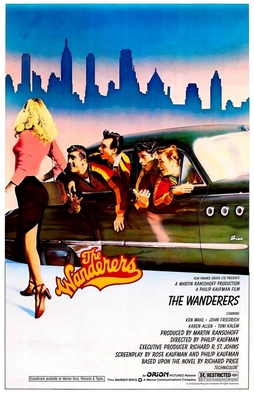
 In 1963, teenage Richie Gennaro (Ken Wahl) may not be much of a high school student but he’s the coolest kid on his block. He’s the leader of the Wanderers, an Italian-American street gang. Among his friends are the neurotic Joey (John Friedrich), Turkey (Alan Rosenberg), and Perry (Tony Ganios — yes, Meat from Porky’s), who has just moved to the Bronx but whose height and ability to fight makes him a key member of the Wanderers. Richie dating Despie (Toni Kalem), the daughter of the local mob boss (Dolph Sweet). However, when Richie meets Nina (Karen Allen), he wonders if there’s something more out there than just spending the rest of his days in the Bronx.
Based on a novel by Richard Price, The Wanderers has always been overshadowed by 1979’s other big gang movie, The Warriors. That’s too bad because they’re both great films. Walter Hill has always said that he envisioned The Warriors as being set in the near-future. The Wanderers, on the other hand, is very much a film about the past. An episodic movie that is more about capturing a time and a place as opposed to telling a traditional story, The Wanderers portrays 1963 with a mix of nostalgia and realism. The soundtrack is heavy with early rock and roll. There’s a scene where Richie sees a group of adults crying as they watch the coverage of John F. Kennedy’s assassination. Nina listens to Bob Dylan at a coffeehouse and the local mob boss is a fan of The Hustler. But for Richie and his friends, adulthood is something to be put off for as long as possible. Life is about wearing their jackets, giving each other a hard time, trying to get lucky, trying not get slapped upside their heads by their parents, and preparing for the big football game against a rival gang. When a Marine recruiter tricks the members of one gang into enlisting, it’s a big deal to Richie because he no longer has to worry about being harassed by them. Those of us watching, however, know that Vietnam is in thee future. Scenes of Richie and Joey joking around are combined with moments of sudden violence. For the most part, the Wanderers and their neighborhood rivals are amiable rivals but, take a wrong turn, and you might find yourself being chased by the viscous Ducky Boys. For Richie, his life revolves around being a Wanderer but nothing can last forever and the film ends with a celebration that feels like a last hurrah for a changing world. Some will escape The Bronx and find a new world with new possibilities and new freedoms. There’s a particularly interesting subtext to the friendship of Perry and Joey, with the film ending on a subtle note that suggests that there’s more to their relationship than just being members of the same gang.
The end result is one of the best coming-of-age stories out there. Ken Wahl, John Friedrich, Alan Rosenberg, and Tony Ganios all give excellent performances as the main Wanderers. Karen Allen and Toni Kalem are perfectly cast as the two women who represent Richie’s possible future. (The strip poker scene is a highlight.) Kalem’s Despie represents the Bronx while Allen’s Nina represents the world outside and the film treats both of them with respect. At first, Despite might seem like a stereotype but she soon proves herself to be more aware of what’s actually going on around her than anyone realized. Richie may like Nina but it’s hard to imagine him ever being truly happy away from his home.
The Wanderers deserves more attention than it has received over the years. It’s funny, touching, and sometimes scary. (The Ducky Boys, despite their name, will haunt you.) Wander over and watch it.
 Through the Shattered Lens