Film Review: La Dolce Vita (dir by Federico Fellini)


The great director Federico Fellini was born, on this day, 125 years ago.

He was born in Rimini.  That’s in Northern Italy.  (The Italian side of my family comes from Southern Italy and yes, there is a difference.)  Fellini was 19 years old when he enrolled in law school but records, which were admittedly spotty at the time, seem to indicate that he never attended a single class.  Instead, Fellini found work as a writer, working first as a journalist and then a screenwriter.  (He was one of the many credited for writing the screenplay for Rome, Open City.)  He began his directing career as a neorealist in the 50s but soon crafted his own unique style, one which openly mixed humor with drama and fantasy with earthiness.  Fellini established himself as one of the world’s best directors, a filmmaker who made art films that not only entertained but also provoked thought.  Fellini was a director who embraced life’s contradictions as well as being a strong anti-authoritarian who rarely commented on politics but did make known his distaste for communism.  He was also one of Mario Bava’s best friends.

My favorite Fellini film is 1960’s La Dolce Vita.

Ah, to be rich, decadent, and jaded in Rome in the early 60s!  Or maybe not.  Sometimes, being jaded is not as much fun as it seems.

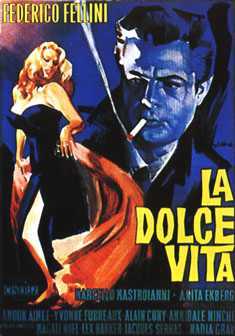
La Dolce Vita is largely remembered for the scene in which actress Sylvia (Anita Ekberg) and journalist Marcello (Marcello Mastroianni) wade into Rome’s Trevi Fountain.  While that it is a great and sensual scene and justifiably famous (and, in fact, the film’s poster was originally a shot of Ekberg in the fountain despite the fact that the scene is only a small part of a 3-hour movie), it’s often overlooked that the scene itself does not have a happy ending.  When Marcello and Sylvia return to Sylvia’s hotel, Sylvia is slapped by her loutish boyfriend (played by Lex Barker).  Marcello, meanwhile, has a fiancée named Emma (Yvonne Furneaux) who is recovering from a recent overdose.  Even though Marcello swears that he loves Emma and that he would do anything for her, he is still compulsively unfaithful.

When we first meet Marcello, he’s in a news helicopter, watching as a statue of Jesus is flown over Rome.  However, Marcello is distracted by the sight of a group of women sunbathing on a nearby rooftop and he tries to get their phone numbers before returning to following the statue.  That pretty much sets the tone for most of what we see of Marcello over the course of La Dolce Vita.  He’s searching for the profound and transcendent but he frequently gets distracted by his own more earthy desires.

The film follows Marcello as he encounters different people in Rome and the surrounding area.  Some of them are rich and some of them are poor.  All of them are looking for something but none of them seem to be quite sure what it is.  A possible sighting of the Madonna brings a crowd of people to the outskirts of Rome, where everyone asks for something but the end result is only chaos.  A meeting with an intellectual friend of Marcello seems to offer a solution to Marcello’s ennui until a tragedy reveals that his friend was even more lost than Marcello.  (The film’s sudden tragic turn took me very much by surprise when I first saw it, despite the fact that countless filmmakers have imitated the moment since.)  A possibly important conversation on a beach is made unintelligible by the crashing waves and, instead of providing enlightenment, it ends with a shrugs and an enigmatic smile.  There’s a definite strain melancholy running through the film though there’s also a certain joi de vivre to many of Marcello’s adventures.  Marcello is torn between seeking transcendence and seeking pleasure.  Fellini shows us that both are equally important.  It’s left to use to decide whether the pleasure is worth the heartache and vice versa.

La Dolce Vita is visually stunning portrait of life in Rome at a very particular cultural moment.  Marcello Mastroianni is the epitome of decadent cool in the lead role but he’s also a good enough actor to let us see that Marcello is never quite as proud of himself or as happt with his life as everyone assumes he is.  La Dolce Vita may be about a specific cultural moment but, as a film, it is timeless.
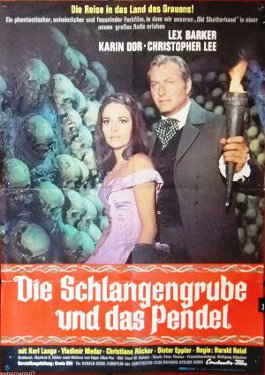
Horror Film Review: The Torture Chamber of Dr. Sadism (dir by Harald Reinl)


On Saturday night, I watched the 1967 German horror film, The Torture Chamber of Dr. Sadism.

I have to say that the film itself turned out to be quite a bit more entertaining than I was expecting it to be.  It was an entertaining and atmospheric horror film, the type where travelers rode in stage coaches to gothic castles and Christopher Lee showed up as the villain.  However, I was very disappointed to discover that, while the film did feature a torture chamber, there was not a character named Dr. Sadism anywhere to be found.  In fact, I don’t think that the word “Sadism” was even mentioned in the film.

Of course, The Torture Chamber of Dr. Sadism was not the only title by which this film was released.  As was typical of horror films in the 60s (especially international horror films), this film had many different titles.  In Germany, it was known as Die Schlangengrube und das Pendel.  It was also released under titles like The Blood Demon, The Crimson Demon, The Snake Pit and the Pendulum, and The Castle of the Walking Dead.  That’s a collection of good names.  It’s just too bad that they were all given to one film as opposed to being spread out amongst several films.

The Torture Chamber of Dr. Sadism (or whatever you want to call it) opens with a public execution.  Count Regula (Christopher Lee) has been found guilty of the murder of 12 virgins.  Regula is forced to wear a gold mask with a rather awkward smiley face on the front of it.  He is then forced to lie down in the town square and his wrists and his ankles are tied to four horses.  As the red-hooded executioner looks on, the horses run in four different directions and, though we don’t actually see it, Count Regular is ripped apart.  Agck!

35 years later, Baroness Lilian von Brabent (Karin Dior, wearing a purple gown that is simply to die for) and her lawyer, Roger Mont Elise (Lex Barker) are invited to pick up an inheritance that is due to the Baroness.  The only catch is that they’ll have to ride a stagecoach all the way to a forbidding castle that the locals refer to as being Blood Castle.  On the way to the castle, they are joined by a highwayman who is pretending to be a priest (Vladimer Medar) and the Baroness’s maid (Christiane Rucker).  They are ride through a forest where the trees are full of human limbs.  They battle some mysterious robbers.  They discover a burned out church and an apparent madman living inside the ruins.  Eventually, they reach the castle where the resurrected Count Regula waits for them, along with his undead, green-blooded servant, Anatol (Carl Lange).  Count Regula is eager to sacrifice a 13th virgin so that he can become immortal.  Apparently, this will grant Regula immortality, which he does not yet have despite the fact that he’s somehow recovered nicely from being dismembered and beheaded.  Regula announces that the Baroness will be his next virgin victim.

(See, there’s actually very real advantages to not waiting.)

The Torture Chamber of Dr. Sadism is one of those films that is described as being based on the writings of Edgar Allan Poe.  In this case, that means that Roger ends up in a pit with a pendulum swinging over him.  For a film with a title like The Torture Chamber of Dr. Sadism (or even The Blood Demon), there’s not really a lot of gore in this film.  Instead, the film focuses more on creating and maintaining a properly gothic atmosphere.  It’s surprisingly entertaining, largely due to the ominous design of the torture dungeon, Christopher Lee’s villainy, Vladimer Medar’s comedic relief, the beauty of Karin Dor, and the square-jawed heroism of Lex Barker.  Lee, in particular, deserves some credit for embracing the melodrama in his role as Regula.  Lee knows exactly the type of film in which he’s appearing and he appropriately modulates his performance.

Whatever title you see it under, The Torture Chamber of Dr. Sadism will keep you entertained.


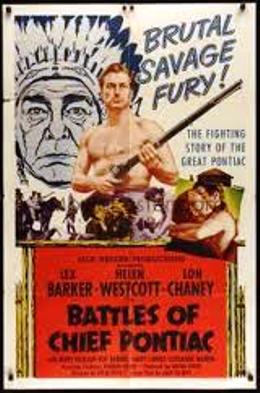
Battles of Chief Pontiac (1952, directed by Felix E. Feist)


A decade before the start of the American Revolution, the British have managed to force the French out of the Great Lakes region.  Fort Detroit has been established to oversee the area and provide protection from the Odawa tribe.  Chief Pontiac (Lon Chaney, Jr.) believes that the Odawa and the White Man can live in peace but his beliefs are challenged when the British bring in a brutal German mercenary, Col. von Weber (Berry Kroeger), to patrol the land.  After Col. von Weber and his soldiers massacre a village, Pontiac and the Odawa prepare for war.

Lt. Kent McIntire (Lex Barker, who was best known for playing the role of Tarzan in several movies) is a Colonial officer and a scout who is convinced that he can broker a peace between the Odawa and the British.  Odawa respects and trusts McIntire but when von Weber tries to wipe the Odawa out by sending them small pox-infected blankets, Pontiac realizes that there can be no peace and he launches an attack on Fort Detroit.

Though hardly a great film, Battles of Chief Pontiac deserves some credit for its sympathetic portrayal of the Odawa People.  From the start, the film makes clear that everything that the Pontiac does, he does out of self-defense.  Even the most enthusiastic of his warriors, Hawkbill (Larry Chance), is not fighting because he wants to fight but he’s fighting because it is evident that von Weber is not going to leave the Odawa any other choice.  Though the small pox-ridden blankets were actually given to a different tribe, just the fact that Battles of Chief Pontiac acknowledges that it happened sets it apart from many other B-movies of the period.  Though not a Native American himself, Lon Chaney, Jr. gives a surprisingly dignified performance as Pontiac and he doesn’t allow the character to become a caricature.  Again, that alone is enough to set Battles of Chief Pontiac apart from a lot of the other films of the period.

Battles of Chief Pontiac still cheats by laying the blame on the Hessians, the German mercenaries who, historically, were not even present in North America until they were hired by the British during the American Revolution, which happened ten years after Pontiac’s siege of Fort Detroit.  Berry Kroeger plays Von Weber as if he was a high-ranking Gestapo officer who somehow found himself in the 18th Century.  By making Von Weber the villain, the film lets the British off the hook.  The only mistakes that the British officers make in Battles of Chief Pontiac is that they trust a German and fail to listen to the advice of the all-American Lex Barker.

Battles of Chief Pontiac has a narrator who sounds like he would have been better suited for an educational filmstrip about hygiene and its epic ambitions are thwarted by its low-budget.  There’s a not very interesting love story between McIntire and a white woman (Helen Westcott) who is being held prisoner by the Odawa.  The movie’s intentions go a long way towards making up for the flaws but they can’t do all the work.  At least, Barker, Chaney, and Kroeger manage to keep thing interesting.

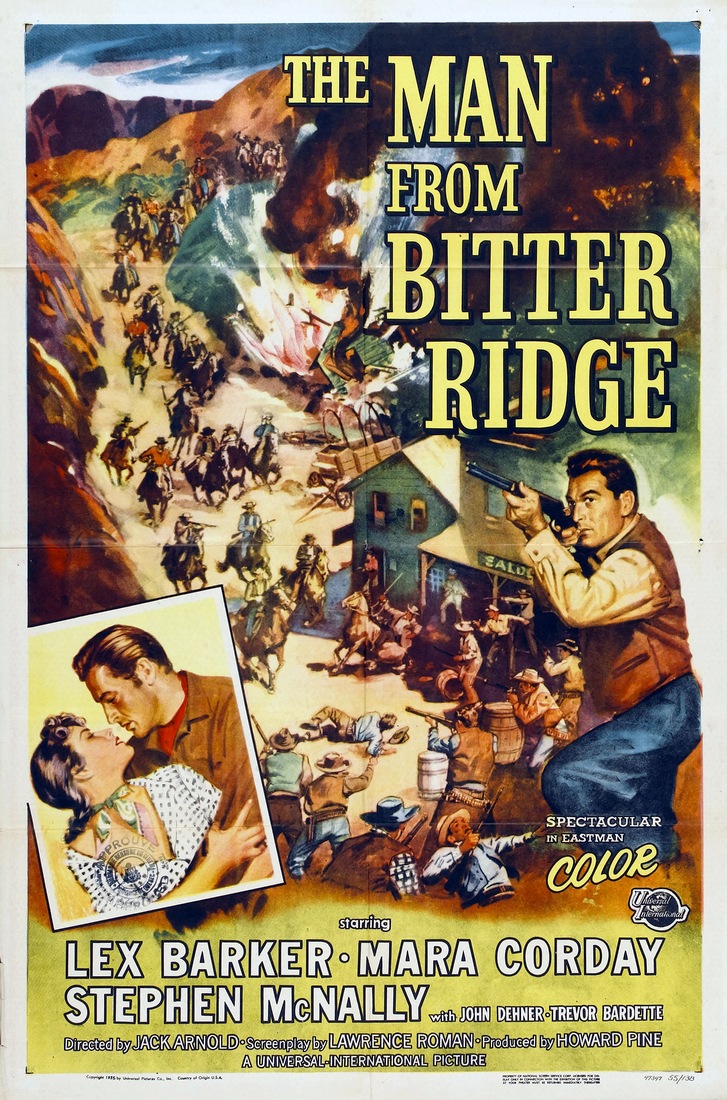
The Man From Bitter Ridge (1955, directed by Jack Arnold)


When Jeff Carr (Lex Barker) comes riding into the town of Tomahawk, he’s nearly lynched by the townspeople, who are convinced that Carr must be responsible for a series of recent stagecoach robberies.  Luckily, before they can finish the deed, they discover that Carr has actually been sent by the government to investigate the very same robberies!

Once the townspeople realize that Carr isn’t responsible, they go back to blaming the the local sheepherders.  When Carr investigates the number one suspect, Alec Black (Stephen McNally), he quickly realizes that Ale is not the guilty party.  Carr and Alec team up to solve the crime but complicating their efforts is the fact that Carr has fallen in love with Alec’s girl, Holly (the beautiful Mara Corday).

The Man From Bitter Ridge is mostly a generic Western but the plot does have one interesting wrinkle.  The man who is actually behind the stagecoach robberies is planning on using the stolen loot to fund his political career!  This is actually historically accurate, as many outlaws in the post-Civl War west attempted to either redeem or protect themselves by seeking political office and many of those efforts were funded by money that had been stolen from the very people who were now expected to vote for them.  Several of the outlaws were actually successful in their efforts, proving that the more things change, the more they stay the same.

Otherwise, The Man From Bitter Ridge is a typical B-western with Mara Corday’s lovely screen presence providing occasional relief from the bland performances of Barker and McNally.  The movie does wrap up with an exciting gun battle in the town square but. overall, The Man From Bitter Ridge is most just for for B-western completists and fans of Mara Corday.

Scenes That I Love: Anita Ekberg and Marcello Mastroianni In The Trevi Fountain


La_Dolce_Vita_(1960_film)_coverart

Anita Ekberg, RIP

This famous and iconic scene is taken from Federico Fellini’s 1960 film, La Dolce Vita.  The film follows tabloid journalist Marcello (Marcello Mastroianni) over the course of 7 days and 7 nights.  He spends the 2nd day pursuing a famous actress named Sylvia (Anita Ekberg).  As the day comes to an end, he finds Anita wading into the Trevi Fountain.

As famous and celebrated as this scene is, it’s often forgotten that it ultimately ends with Sylvia being slapped by her loutish boyfriend, Robert (Lex Barker).  That slap is not included in the video below but that’s okay.  For today, at least, let’s allow Sylvia her happiness.

http://www.youtube.com/watch?v=T4kZjU7zGbU