Gun Lords of Stirrup Basin (1937, directed by Sam Newfield)


On the frontier, crooked lawyer Gabe Bowdre (Karl Hackett) is trying to secure all of the local water rights for himself and that means running off both the homesteaders and the ranchers.  Bowdre and his men try to start a range war between the ranching Stocktown family and the homesteading Dawsons.  Meanwhile, Dan Stockton (Bob Steele) has fallen in love with Gail Dawson (Louise Stanley) and marries her mere minutes before someone shoots his father in the back.

Gun Lords of Stirrup Basin has all the common elements that usually come with a B-western.  I have lost track of how many times I have watched Karl Hackett play a crooked businessman who tries to start a range war to win either the water rights or the property deeds.  Bob Steele spent a good deal of his career beating up Karl Hackett on screen.

What sets Gun Lords of Stirrup Basin apart is the Romeo and Juliet angle.  While it’s predictable, the love story between Dan and Gail still adds more emotional depth than is usually found in these movies.  The scene where all of the ranchers glare daggers at Dan’s new wife is powerful.

Bob Steele’s as good a hero as usual and Karl Hackett is a dastardly villain.  Gun Lords of Stirrup Basin runs a little less than an hour, making it a good western for an afternoon break.

Billy The Kid In Texas (1940, directed by Sam Newfield)


Billy the Kid (Bob Steele) escapes from a Mexican prison (where he was being held on a trumped-up charge) and ends up in Corral City, Texas with his old friend, Fuzzy Jones (Al St. John).  This version of Billy the Kid may be an outlaw but he’s a really nice outlaw.  He holds up two men who had previously held up a express wagon but he turns over the loot after he and Fuzzy are appointed the new law in Corral City.  The bad outlaws don’t want Billy the Kid or anyone else as their new sheriff so they bring in a notorious gunslinger (Carleton Young) to help them keep the town under their control but it turns out that Billy and the gunslinger have a past that no one knew about.

Bob Steele played Billy the Kid in a series of films, until Buster Crabbe took over the role in 1942.  Steele was a convincing cowboy and a convincing gunman but he wasn’t a convincing kid.  Of course, this version of Billy the Kid didn’t have much in common with the real Billy the Kid.  The movie version of Billy the Kid got into a lot of trouble but it was usually due to a misunderstanding.

Billy the Kid In Texas is definitely a Poverty Row western.  It looks cheap and it was cheap but it did feature a good fight scene between Bob Steele and Charles King and the relationship between Billy the Kid and Carleton Young’s gunslinger also added some extra dimension to the otherwise predictable story.  This film is okay for western fans who aren’t sticklers for historical accuracy.


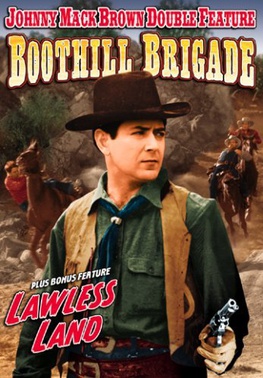
Boothill Brigade (1937, directed by Sam Newfield)


Rancher Jeff Reynolds (Frank LaRue) used to be one of the good guys on the frontier but he’s recently changed.  He fired all of his loyal ranch hands and instead hired a motely crew of outlaws.  He’s buying up land and evicting the squatters who have been living there.  About the only good thing he does is hire Lon Cardigan (Johnny Mack Brown) to be his new herd boss.  Lon is engaged to Reynolds’s daughter, Bobbie (Claire Rochelle).  With the help of Bobbie and comic relief cook Calico Haynes (Horace Murphy), Lon tries to figure out why Reynolds is now doing the bidding of the evil John Porter (Ed Cassidy).

The title is the most exciting thing about this movie, which is one of those old B-movies that puts the “creak” in creaky.  There’s surprisingly little gunplay but there is a lot of horse riding.  For a film that runs less than an hour, a surprising amount of it is just shots of people riding from one location to another.  The horses’ hooves sound impressive on the soundtrack but it’s not exactly exciting.  As always, Johnny Mack Brown is a convincing cowboy.  It’s a good thing he looks like he knows what he’s doing when he’s riding a horse!  The plot was standard B-western fluff.  Johnny Mack Brown appeared in a ton of westerns and almost all of them seemed to feature the same range war.  There are better Johnny Mack Brown movies out there.  This one is for completists only.

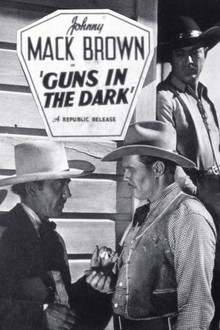
Guns In The Dark (1937, directed by Sam Newfield)


In Mexico, two American cowboys, Johnny Darrel (Johnny Mack Brown) and Dick Martin (Julian Madison) join a poker game to try to win some money and help out their buddy, Oscar (Sid Saylor).  When they discover that cantina owner Manuel Mendez (Ted Adams) has rigged the game, a fight breaks out.  The lights turn off.  In the darkness, several guns are fired.  When the lights come back up, Dick is dead.  Mendez convinces Johnny that he accidentally shot his friend in the fight.  Guilt-stricken, Johnny tosses aside his guns and returns to Texas.

Johnny has sworn that he will never shoot another gun but when he’s hired to work at a ranch owned by Joan Williams (Claire Rochelle), he finds himself in the middle of a range war between Joan and Brace Stevens (Dick Curtis), with Mendez also making an unwelcome return to Johnny’s life.  Even after Johnny discovers the truth about what happened that night at the cantina, he doesn’t pick up a gun.  Instead, Johnny fights the bad guys with lassos and plates.

Guns In The Dark is only 54 minutes long and it features actors who will be familiar to any fan of the old B-westerns.  Sidekcick Sid Saylor’s stuttering schtick gets old quickly but Johnny Mack Brown is as likable as always in Guns In The Dark and he comes across as being an authentic cowboy even when he’s not carrying a gun  Given that this film features even more horse chases than the typical Johnny Mack Brown b-western, it’s good that Brown is so convincing.  What isn’t convincing is how stupid Johnny Darrel is required to be in order for him to fall for Mendez’s lie in the first place.  I appreciated the change of pace from Brown just using a gun to stop the bad guys but I wish the reason behind it had been more convincing.  This isn’t one of Johnny Mack Brown’s more memorable westerns though, as always, it’s easy to see why he was one of the early stars of the genre.