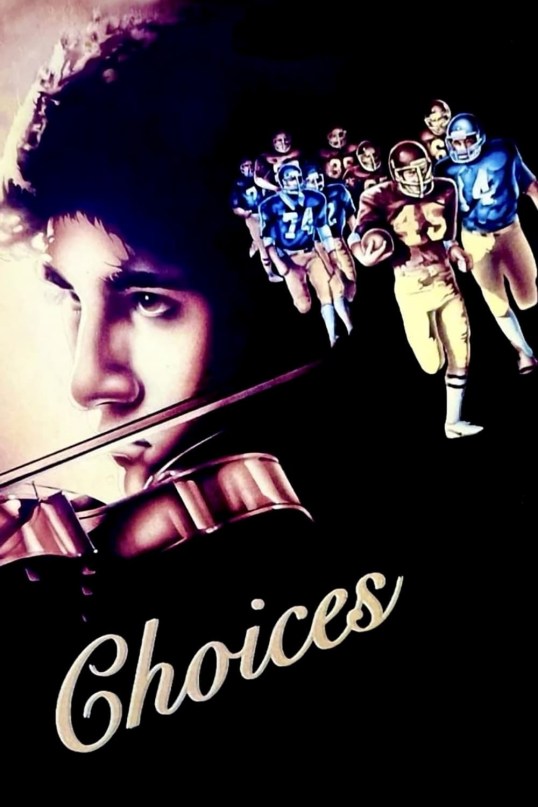
So, I Watched Choices (1981, Dir. by Silvio Narizzano)


John Carluccio (Paul Carafotes) is the star running back on his high school football team until the district’s new chief doctor (Dennis Patrick) rules that John can no longer play because he’s partially deaf and wears a hearing aid.  Coach Rizzo (Val Avery) protests but John is off the team.  John stops hanging out with his squeaky clean best friend (William R. Moses) and instead becomes friends with the school delinquent (Stephen Nichols).  John starts smoking pot and gets a bad attitude.  Whenever anyone tries to help him or suggests that he can live a productive life even without football, John gets angry.  Can his new girlfriend (Demi Moore) turn his life around?

I really wanted to feel bad for John and cheer him on as he fought to be allowed to play football but he was such a mopey character that it was hard.  He acted like the rest of the team should have refused to play until he was allowed to rejoin them.  It didn’t help that the new running back was just as good as John ever was.  Eventually, John discovered that he loved music and Demi Moore but even all of that felt like it came out of nowhere.  I know a lot of people who have had setbacks as bad as John’s who managed to get through them without treating everyone around them terribly.

Demi Moore is the big “name” here but she’s only in the movie for a few minutes.  I recognized a few of the other actors.  William R. Moses later played Ken Malansky in the Perry Mason movies and Stephen Nichols will always be Patch on Days of our Lives.

If you’re looking for football action, you won’t find it here.  My choice, if I could do it again?  Don’t watch.

The Conquering Hero: Baby Blue Marine (1976, directed by John D. Hancock)


The year is 1943 and America is at war.  All young men are expected to join the Marines and fight for their country but the Corps is not willing to accept just anyone.  Marion (Jan-Michael Vincent) wants to continue a family tradition of service but, as his drill sergeant (Michael Conrad) puts it, Marion just is not pissed off enough to be a Marine.  Marion is kicked out basic training and told to go home.  He is given a blue uniform to wear on his jury so that anyone who sees him will know that he couldn’t cut it.

Ashamed of his failure and in no hurry to confront his family, Marion takes the long route home.   While having a drink in California, he meets a Marine (Richard Gere) who did not get kicked out of basic training.  Though not yet 30, this shell-shocked Marine already has a head of gray hair, which he says he got from the horrors of war.  The Marine is due to return to the fighting in Europe but, upon meeting Marion, he sees a way out. When Marion gets drunk, the Marine knocks him out, switches uniforms with him, and goes AWOL.

When Marion comes to, he discovers that everyone that he meets now judges him by his new uniform.  Strangers buy him drinks.  Other servicemen try to pick fights with him.  When he stops off in a small Colorado town, a local waitress (Glynnis O’Connor) falls in love with him and nearly everyone that he meets assumes that he must be a hero.  Marion doesn’t exactly lie about his past.  Instead, he simply allows people to believe whatever they want to believe about him.  It seems like an idyllic situation until three prisoners from a nearby Japanese internment camp escape and the towns people expect Marion to help capture them.

Loosely plotted and sentimental, Baby Blue Marine is a dramatic version of Preston Sturges’s Hail The Conquering Hero.  Though the film has a gentle anti-war message, it’s actually more about nostalgia for a simpler and more innocent time.  If the film had been made at height of the Vietnam War, it might have been more angrier and more cynical.  But, instead, this is one of the many post-Watergate films that wistfully looked back upon the past.  When Marion settles into the town, he finds what appears to be a perfect and friendly home.  Only the nearby internment camp and the town’s hysteria over the escape prisoners serve as reminders that things are never as ideal as they seem.  Jan-Michael Vincent gives one of his best performances as the well-meaning Marion and actors like Richard Gere, Bert Remsen, Katherine Helmond, Dana Elcar, Michael Conrad, Bruno Kirby, and Art Lund all make strong impressions in small roles.

One of the few films to be produced by television mogul Aaron Spelling, Baby Blue Marine is not easy to find but worth the search.