Though the Academy of Motion Picture Arts and Sciences claim that the Oscars honor the best of the year, we all know that there are always worthy films and performances that end up getting overlooked. Sometimes, it’s because the competition too fierce. Sometimes, it’s because the film itself was too controversial. Often, it’s just a case of a film’s quality not being fully recognized until years after its initial released. This series of reviews takes a look at the films and performances that should have been nominated but were, for whatever reason, overlooked. These are the Unnominated.
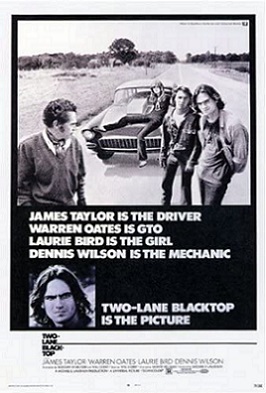
The 1971 road film, Two-Lane Blacktop, is a movie about four people whose real names are never revealed. Indeed, their names are never as important as what they’re driving.
Named after his car, GTO (Warren Oates) is a talkative man who likes to brag on himself and who picks up hitchhikers so he can talk to them. We don’t learn much about GTO’s background. For someone who talks as much as he does, GTO doesn’t reveal much about who he is when he’s not driving. It’s easy to imagine him as a salesman, traveling across the country and desperately trying to make his quota before the sun goes down. With the way that he picks up hitchhikers and his need to convince everyone of his own skill and prowess behind the wheel, it’s easy to imagine that he’s probably recently divorced and still dealing with suddenly being on his own. He seems to have something to prove, not only to everyone around him but especially to himself. One gets the feeling that the life he had suddenly collapsed and he took to the road to escape it all but he still hasn’t reached the point where he can handle truly being alone. For all of his talk, it doesn’t take long to notice that GTO isn’t quite as worldly as he claims he is.
A chance meeting leads to GTO getting into a cross-country race with The Driver (James Taylor) and the Mechanic (Dennis Wilson), two young men who are driving a 1955 Chevy and who make their money by engaging in street races. (They’re also quick to steal a license plate when no one’s looking.) The Driver and the Mechanic don’t talk a lot and, when they do, it’s in terse and somewhat awkward sentences. (Both Taylor and Wilson were musicians who made their acting debut with this film. Their natural stiffness and lack of emotion works well for their characters.) The Driver and the Mechanic seem to communicate solely through driving. They pick up The Girl (Laurie Bird) and both the Driver and the Mechanic seem to have feelings for her but it’s pretty obvious that their true love will always be for their car.
Two-Lane Blacktop is a road movie, a movie that really doesn’t have much of a plot (the cross-country race soon ceases to be a real race) but which does have some beautiful footage of America in 1971 and an outstanding performance from the great character actor, Warren Oates. Easy Rider was advertised as being a film about a man who looked for America and couldn’t find it. That’s actually a better description of Two-Lane Blacktop, a film about three uniquely American men who have embraced the car culture that is at the center of life in America but who are still, more or less, lost in their home country. Oates, always talking and refusing to give up or even acknowledge the fact that he doesn’t really know much about how cars work, represents the so-called silent majority. Wilson and Taylor are the next generation, their long-hair branding them as outsiders while their skill with a car and their desire win represents what we’re told is the best of the American competitive spirit. What makes the film unsettling is the feeling that all three of them are using their cars as a way to avoid dealing with the reality of their lives.
Two-Lane Blacktop may sound a bit pretentious and it is. The metaphors get a bit heavy-handed. That said, as directed by Monte Hellman, it’s both a gorgeous travelogue and a valuable time capsule, a document of life in the late 60s and early 70s. Hellman directed the film on the road. When we see the Mechanic stealing a license plate so no one down south will know that he and the Driver are actually from California, it’s a powerful scene because it was actually filmed on location, in the South. This isn’t a film that was shot on a backlot. This is a film that was shot across America and it captures the country at a time when, much like today, no one was really sure what the future held for its politics or its culture. It may be a film about three men who are obsessed with cars but it’s also a portrait of a country in an almost directionless state of turmoil.
Two-Lane Blacktop was promoted as being the next Easy Rider but it turned out to be a notorious box office failure. James Taylor and Dennis Wilson never did another movie. Warren Oates continued as a busy character actor while Laurie Bird died of an intentional drug overdose in 1979. Director Monte Hellman’s directorial career continued but his days of being courted by the major studios were over. However, as the years passed, audiences started to discover Two-Lane Blacktop and now, it’s considered to be a cult classic.
Given its failure at the box office, Two-Lane Blacktop was ignored by the Academy. The Oscar for Best Picture went to another film that featured a memorable car chase, The French Connection. While Two-Lane Blacktop may not have deserved to win Best Picture (not over nominees like The French Connection, The Last Picture Show, Fiddler on the Roof, and A Clockwork Orange), it certainly is far more memorable movie than the fifth film nominated that year, Nicholas and Alexandra. If nothing else, Warren Oates deserved a nomination for his supporting performance. The Academy may not have embraced Two-Lane Blacktop but, fortunately, film lovers eventually would.
Previous Entries In The Unnominated:
 Through the Shattered Lens