Doctor Who — The Leisure Hive, Meglos, Full Circle, State of Decay, Warrior’s Gate, The Keeper of Traken, Logopolis


The 18th season of Doctor Who started with the show getting a new producer, John Nathan-Turner.  Depending on who you ask, Nathan-Turner was either the best or the worst thing that ever happened to Doctor Who.  He pushed the series away from what he felt was the “silliness” of the previous season and, in doing so, he alienated both Tom Baker and Lalla Ward.  (Ward was close friends with Douglas Adams, whom Nathan-Turner blamed for turning the show silly.)  Nathan-Turner pushed for more serious stories and for better production values.  He also hated K-9, which upset a lot of younger viewers.  My personal feeling is that Nathan-Turner was not a good producer for Tom Baker’s Doctor but he was a great producer for Peter Davison’s interpretation of the character.  As for the Colin Baker and Sylvester McCoy years, let’s keep things cheery and not go there.

By the end of the 18th season, Tom Baker, Lalla Ward, and John Leeson (the voice of K-9) had left the show.  Completing my look back at Doctor Who, here are Tom Baker’s final serials.

The Leisure Hive (1980, directed by Lovett Bickford)

John Nathan-Turner hated K-9.  If there was any doubt about that, consider that his first serial as the show’s producer opens with the Doctor and Romana on holiday Brighton.  K-9, for some reason, rolls out to the ocean and explodes, taking him out of commission until the Doctor can rebuild him.

Personally, I would have been happy if this entire serial had just been Tom Baker and Lalla Ward on that beach in Brighton.  Nathan-Turner may not have been a fan of the Doctor and Romana working together by Baker and Ward but viewers like me definitely disagreed.  Alas, it is not to be.  Romana wants a real holiday (Brighton, in a reminder of just how British Doctor Who really was, doesn’t count) so she and the Doctor and the remains of K-9 go to the leisure planet of Argolis.  Unfortunately, Argolis is having financial problems and is at risk of being taken over by the Foamai.  When the Doctor is framed for a strangulation murder that was committed with a scarf, he is forced to stand trial and become an experimental test subject.

It’s an okay start for Season 18, though Tom Baker, for the first time since taking over the role of the Doctor, was starting to look disinterested.  John Nathan-Turner was eager to get away from the “silliness” of the previous season but, ironically, a story set on a leisure planet and featuring an intergalactic crime syndicate would have very much benefitted by Douglas Adams’s sense of humor.

Meglos (1980, directed by Terence Dudley)

The Doctor is asked to help broker a peace between two warring planets.  Unfortunately, Meglos — a sentient cactus — traps the TARDIS in a time loop and then plots to thwart the peace.

When viewers think of this serial, they usually remember Meglos taking on the form of the Doctor and Tom Baker wearing makeup that made him look like a humanoid cactus.  That’s because the plot is nothing special, though I do appreciate that we finally got to see what it’s like to be stuck in a time loop.  Jacqueline Hill, who played Barbara when the serial first began, appears as Lexa, a high priestess of the planet Tigella.

Full Circle (1980, directed by Peter Grimwade)

Having been ordered to return Romana to Gallifrey, the Doctor instead materializes on a swampy plant that is located where Gallifrey should be.  The TARDIS has slipped into E-Space, a small pocket universe.  As for the planet that they’ve landed on, it’s inhabited by swamp monsters, a group a humans who live around a crashed starliner, and a mad scientist.

The idea of E-Space was an interesting one and Lalla Ward gives one of her strongest performances of the series, as Romana is briefly possessed in this episode.  Unfortunately, this episode also introduced Adric (Matthew Waterhouse), an annoying child genius who became the Doctor’s newest companion.  Adric was one of the least popular of John Nathan-Turner’s additions to Doctor Who.  A few seasons later, Adric would be blown up while fighting the Cybermen and there would not be a dry eye in the house.

Tom Baker, unhappy with Nathan-Turner’s ideas and annoyed with Waterhouse decided to leave the role while filming this serial.  Waterhouse reportedly cursed at Baker while filming one scene.  They should have left the little punk behind just for doing that.

State of Decay (1980, directed by Peter Moffatt)

Still trapped in E-Space, The TARDIS materializes on a planet where the villagers live under the shadow of a dark tower. Ruled over by three cruel lords, Zargo, Camilla, and Aukon, the villagers are forced to regularly sacrifice their young to appease their rulers. The Doctor, Romana, K-9, and Adric investigate and discover that Zargo, Camilla, and Aukon are vampires! After being defeated by the Time Lords, the vampires retreated into E-Space, where they found a new planet to rule. Of course, that little tosser Adric wants to become a vampire. Why Romana and the Doctor didn’t leave Adric behind on the vampire planet, I’ll never understand.

Even the weaker seasons of Doctor Who usually featured at least one classic serial and, in the case of Season 18, it was State of Decay.  For all of the justified criticisms of John Nathan-Turner time as producer, he did make an attempt to improve the show’s production design and it paid off with this atmospheric serial that paid homage to the great vampire films while also retaining its Doctor Who identity.  Tom Baker seems to be rejuvenated by the clever script and he and Lalla Ward’s chemistry is allowed to shine.  K-9 even gets to do something other than getting kicked around.  State of Decay is a Doctor Who classic.

Warrior’s Gate (1981, directed by Paul Joyce and Graeme Haper)

Still trying to escape E-space, the TARDIS materializes on a similarly trapped spaceship that is run by Captain Rorvik (Clifford Rose).  Learning that the ship is carrying an enslaved race known as the Tharils, the Doctor set them free.  The Tharils help the Doctor reenter N-Space.  However, Romana decides to stay behind to help the Tharils.  The Doctor gives her K-9 and then leaves with Adric.  The Doctor should have left Adric behind too.

This was Lalla Ward’s final episode and both she and Romana deserved a better send-off.  Romana deciding to disobey the Time Lords, I can understand.  Leaving the Doctor, even to help the Tharils, doesn’t seem like something Romana would have done.  John Nathan-Turner finally got his wish, though.  K-9 stayed with Romana.  What are Romana and K-9 going to do in an alternative universe?  They don’t even have a TARDIS.

The only highlight of this episode was Clifford Rose’s manic performance as Captain Rorvik.  Otherwise, it was a forgettable send-off for two great companions.

The Keeper of Traken (1981, directed by John Black)

The Doctor and annoying Adric are summoned to the planet Traken, where the Master (Geoffrey Beevers) is attempting to capture a power source that will give him a new set of regenerations.  (The Master doesn’t look as badly decayed here as he did during The Deadly Assassin.)  With the help of the Keeper of Traken, Tremas (Anthony Ainley), and Tremas’s lovely daughter Nyssa (Sarah Sutton), the Doctor is able to stop the Master.  However, as soon as the Doctor leaves, the Master emerges from a long clock and somehow merges with Tremas’s body, giving him a new set of regenerations.

Despite the presence of Adric, this is not a bad story.  The Master makes his return and, in the final minutes of the serial, Anthony Ainley takes over the role.  Ainley would play The Master for the rest of the original show’s run.  While Ainley’s Master was always more cartoonishly evil than Roger Delgado’s, he still proved to be a worthy adversary for the Fourth, Fifth, Sixth, and Seventh Doctors.

Logopolis (1981, directed by Peter Grimwade)

This is it.  This is final serial to feature Tom Baker as the Doctor.  Things start with the Doctor materializing the Tardis around an actual police box in an effort to fix his chameleon circuit.  The Master then materializes his TARDIS around the Doctor’s.  It all fun and games until the universe starts to unravel and the Doctor sacrifices his life while literally holding space and time together.  Along the way, the Doctor gets two new companions, Nyssa (who has been traveling with the Master under the impression that he’s her father) and Teagan (Janet Fielding), an outspoken Australian flight attendant who entered the TARDIS thinking that it was a police call box.

Whatever else you might want to say about season 18, it gave Tom Baker a fitting send-off.  After seven years of saving civilizations and planets, the Fourth Doctor finally saved the entire universe.  Perhaps knowing how traumatized viewers would be to see the Fourth Doctor die, this episode featured Peter Davison (familiar to viewers as Tristan Sebring from All Creatures Great And Small) as the Watcher, a mysterious figure who merged with the Doctor at the end of the serial and turned out to be his Fifth Incarnation.

I had hoped to discuss some of the Fifth Doctor’s adventures this October but time has caught up with me.  (It’s a pity because Peter Davison more than made the role of the Doctor his own and several of his serials — Kinda, Snakedance, and Enlightenment to name just three — are worthy of being considered classics.)  For me, as someone who to watch Tom Baker’s Doctor on PBS while growing up, this does seem like the right place to stop.

For now.

The TSL’s Daily Horror Grindhouse: Vampire Circus (dir by Robert Young)


One of the greatest Hammer vampire films didn’t even star Christopher Lee.  In fact, it wasn’t even a Dracula film.  Instead, it was the story of a circus.

1971’s Vampire Circus tells the dark story of a Serbian village called Stetl.  Early in the 19th century, the children of Stetl are dying.  The superstitious villagers believe that Count Mitterhaus (Robert Tayman) might be responsible.  In fact, they suspect that Count Metterhaus might be a vampire!  Why?  Well, first off, he only seems to be around during the night.  Secondly, he lives in a big spooky castle.  Third, he’s a count and don’t all counts eventually become vampires?

Now, it would be nice to say that all this turned out to be a case of the villagers letting their imaginations get the better of them but nope.  It turns out that they’re pretty much right.  One night, the local teacher, Albert Muller (Laurence Payne), sees his own wife, Anna (Domini Blythe) leading a child towards the dark castle.  It turns out that Anna has fallen under the spell of Count Mitterhaus.  The villagers promptly drive a stake through the Count’s heart, though he manages to do two things before dying.  First off, he curses the town and announces that the blood of their children will give him new life.  Secondly, he tells Anna to escape and track down his brother.

Fifteen years later and, as one might expect, Stetl is a town under siege.  However, the town is not being attacked by vampires.  (Not yet anyway.)  Instead, the town has been hit by the plague and, as a result, it’s been isolated from the outside world.  Men with guns have surrounded the town and are under orders to kill anyone who tries to leave or enter.  Some in the village believe that this is the result of the Count’s dying curse while others just see it as more evidence of man’s inhumanity to man.  Regardless, it’s not good situation.

Fortunately, escape arrives in the form of the Circus of the Night!  That’s right, a gypsy carnival suddenly appears in town.  How did it manage to slip by the blockade?  Who knows and who cares?  What’s important is that the villagers, especially their children, need an escape from their grim existence and the Circus seems to offer something for everyone.  There are dancers.  There are acrobats.  There’s the mysterious tiger woman.  There’s a mirror that makes you see strange things.  And, of course, the are vampires….

That’s not really a shock, of course.  The name of the film is Vampire Circus, after all.  What always takes me by surprise is just how ruthless and cruel the vampires are in this film.  Even by the standards of a 1970s Hammer film, this is a blood-filled movie but, even beyond that, the vampires almost exclusively seem to target children.  Fortunately, all of Stetl’s children tend to be a bit obnoxious but it’s still a shock to see two fresh-faced boys get lured into a mirror where they are both promptly attacked by a vampire.  (And don’t even get me started on what happens when one of the vampires comes across a boarding school.)  Make no mistake, this circus is not made up of the type of self-tortured, romanticized vampires that have dominated recent films.  These vampire are utterly viscous and without conscience.  In other words, these vampires are actually frightening.

The members of the circus are, themselves, a memorable bunch.  David Prowse is the hulking strongman.  Lalla Ward and Robin Sachs are the achingly pretty, innocent-faced twin acrobats who greedily drink the blood of anyone foolish enough to wander off with them.  Some members of the circus can transform into animals.  What’s interesting is that not all of the members of the circus are vampires.  Some of them, I guess, are just groupies.

Featuring the reddest blood that you’re ever likely to see and a cast of memorably eccentric character actors, Vampire Circus often feels more like an extremely dark fairy tale than a typical Hammer vampire film.  Clocking in at 87 minutes, Vampire Circus is a briskly paced dream of carnivals and monsters.


Film Review: Barabbas (dir by Richard Fleischer)


Who was Barabbas?

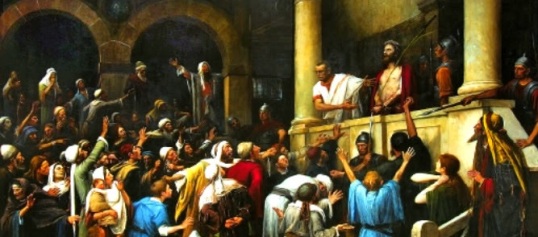
The simple answer to that is that Barabbas was the prisoner who, according to the Gospels, Pontius Pilate released during Passover.  As the story goes, Pilate gave the people the choice.  He could either release Barabbas or Jesus.  For what crime was Barabbas being held?  The Gospel of Matthew merely says that Barabbas was a “notorious prisoner.”  Mark and Luke both write that he was involved in a recent riot and that he was a murderer.  The Gospel of John refers to him as being a bandit, which may have been another term for revolutionary.  Regardless of what crime he had committed, the people overwhelmingly called for Barabbas to be released and for Jesus to be crucified.  What happened to Barabbas after he was set free is not recorded but has been the subject of a good deal of speculation over the centuries.

(Of course, there are some scholars who believe that the Barabbas story was simply an invention of later writers, designed to shift the responsibility for the crucifixion away from the Romans.  There’s also some who say that Jesus and Barabbas were actually the same person and that the inclusion of the Barabbas story was meant to indicate that Jesus was actually a revolutionary who was working to free Judea from Roman role.  I imagine Dan Brown will eventually base a novel on this theory, so look forward to hearing your grandma debating the historicity of Barabbas at some point in the future.)

Back to the original question, who was Barabbas?

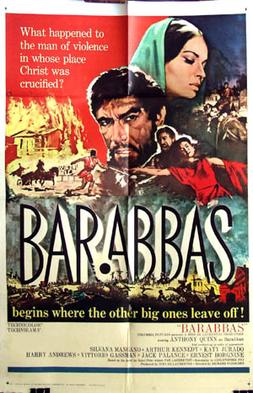
According to the 1961 film of the same name, Barabbas was Anthony Quinn.

Based on a novel by the Nobel Prize-winning Swedish author, Pär Lagerkvist, Barabbas opens with Pilate (Anthony Kennedy) making his infamous offer.  Barabbas or Jesus?  Perhaps the only person more shocked than Pilate by the people’s decision is Barabbas himself.  A brutish and violent man, Barabbas is looking forward to returning to his old life but, as he leaves the prison, he finds himself fascinated by the sight of Jesus stoically carrying the cross, heading to the fate that Barabbas was spared.  Later, Barabbas witnesses the Crucifixion and is shaken when, upon Jesus’s death, the sky turns black.

(Director Richard Fleischer shot the Crucifixion during an actual solar eclipse, so that the sky actually did turn black during filming.  It’s a stunning scene.)

For the rest of his life, Barabbas is haunted by both his narrow escape from death and his subsequent notoriety.  When Barabbas tries to reunite with his former lover, Rachel (Silvana Mangano), he discovers that not only does she now want nothing to do with him but that she has also become a follower of Jesus.  (Later, in a surprisingly graphic scene, Rachel is stoned to death.)  Barabbas becomes convinced that he cannot die and he becomes increasingly reckless in his behavior.  Over the next few decades, he finds himself sold into slavery and forced to spend 20 years working in the harsh sulfur mines of Sicily.  He befriends a Christian named Sahak (Vittorio Gassman) and, with him, is trained to be a gladiator by the sadistic Torvald (Jack Palance).  Eventually, Barabbas finds himself rejected by both the Romans and the Christians while Rome burns all around him.

Barabbas is a film that really took me by surprise.  I’ve seen a lot of Biblical and Roman films from the 50s and 60s and I was expecting that Barabbas would be another sumptuously produced but slow-paced epic, one that would inevitably feature stiff dialogue and overly reverential performances.  I mean, don’t me wrong.  I happen to love spectacle and therefore, I enjoy watching most of those old historical and religious epics.  But still, for modern audiences, these films can often seem rather … well, hokey.

But Barabbas was totally different from what I was expecting.  As wonderfully played by Anthony Quinn, Barabbas wanders through most of the film in a state of haunted confusion.  Even at the end of the film, after he’s met St. Peter (Harry Andrews), Barabbas doesn’t seem to fully understand what he believes or how he’s become one of the most notorious men in Rome.  Quinn plays Barabbas almost like a wild animal, one that has been cornered and trapped by his own infamy.  The more Barabbas struggles against his fate, the more trapped he becomes.  Barabbas may be a brute but, the film suggests, even a brute can find some sort of redemption.  Quinn gets good support from the entire supporting cast.  Jack Palance is perfectly evil as Torvald while Vittorio Gassman, Silvana Mangano, and Ernest Borgnine bring some needed nuance to characters who, in lesser hands, could have just been cardboard believers.

Barabbas is a surprisingly dark film.  When Rachel is stoned, the camera doesn’t flinch from showing just how cruel an execution that was.  Nor does the camera flinch from the violent brutality of the gladiatorial games.  When Barabbas is sold into slavery, the sulfur mines of Sicily are depicted in Hellish detail and practically the only thing that saves Barabbas from spending the rest of his life being smothered under a cloud of sulfur is a giggly Roman woman who decides to buy Barabbas so that he can serve as a good luck charm.  The scenes of Barabbas’s skill of a gladiator are contrasted with the bloodthirsty crowd demanding and cheering death.  Even when Barabbas joins the Christians in the Roman catacombs, he discovers that they want nothing to do with him, suggesting that they believe in forgiveness for everyone but him.  The spectacle of Rome is displayed but so is the terror of what lies underneath the city’s ornate surface.  If Barabbas is occasionally a ruthless or unsentimental character, one need only look at the world he lives in to understand why.

With the exception of a few slow scenes at the start of the film, director Richard Fleischer does a good job of keeping the action moving.  It’s a long film but it never becomes a boring one.  In the end, thanks to Quinn’s performance and the film’s unflinching portrayal of life in ancient Rome, Barabbas is a biblical epic for people who usually don’t like biblical epics.