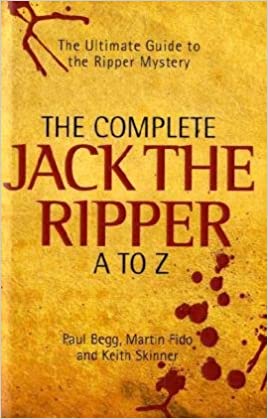
Book Review: The Complete Jack The Ripper: A to Z by Paul Begg, Martin Fido, and Keith Skinner


We will never actually know who Jack the Ripper actually was.

People will always be offering up theories, of course.  His crimes were so terrible and his nickname was so memorable and the fact that he was never caught is, to modern audiences spoiled by true crime shows and detective movies, so improbable that there’s a tendency to assume that Jack the Ripper must have been someone significant in his everyday life.  Everyone from Queen Victoria’s son to Lewis Carroll to Oscar Wilde has been accused over the years.

My personal theory is that Jack the Ripper was a nobody.  He didn’t have any medical training.  He wasn’t a part of a grand conspiracy.  He had no motive beyond his own hatred of women.  He stalked prostitutes because they were easy targets.  His murders were savage because he was a sadist who wanted to show off the power that he felt he had over his victims.  He got away with his crimes not because he was clever or protected but just because, in 1888, the police had no experience with a serial killer like Jack the Ripper.  In all probability, the killer was some anonymous loser, one of the many strange and angry men who could probably be spotted in Whitechapel on any foggy night.  

Unfortunately, after more than a 130 years of mystery, no one wants to admit that Jack the Ripper was probably some guy that no one’s ever heard of.  There’s a tendency to assume that he had to be someone important or, at the very least, someone who was at least mentioned in a handful of books about the Whitechapel murders.  Sadly, far too many people are under the impression that Patricia Cornwell solved the case in 2002.  In Portrait of a Killer, Cornwell accused the painter Walter Sickert of being the murderer.  Her main argument consisted of an inconclusive DNA test and an apparent inability to appreciate Victorian-era art.  Cornwell didn’t care much for Sickert’s paintings and therefore, Sickert had to be history’s most notorious murderer.  It’s a bit silly but a lot of people bought into it because it was Patricia Cornwell making the accusation.

To those people who insist that the murderer had to be a Victorian celebrity, I would point them to The Complete Jack the Ripper: A to Z.  Published in 2010, this book is the definitive guide to the Ripper murders.  It contains entries for every suspect, every victim, every policeman, every clue, and every theory.  There’s a lot of information to be found in this book.  In fact, there’s so much information that it’s easy to see how the actual killer could slip through the cracks and, unseen by the overwhelmed and underprepared legal authorities, disappear into the dark shadows of history.  Along with presenting a clear-eyed and nonbiased look at the suspects and the theories, the book is also to be commended for what it tells us about Jack the Ripper’s victims, who are too often forgotten when it comes to discussing the crimes.  So much time is spent on Jack’s identity that the women he murdered are often pushed to the side.  This book does not make that mistake.

This is the definitive book on Jack the Ripper, whoever he may have been.

Love On The Shattered Lens: Romeo and Juliet (dir by Franco Zeffirelli)


Happy Valentine’s Day!

Now that the Oscars and the Sundance Film Festival are over with, it’s time to start a new series of reviews here on the Shattered Lens.  For the rest of February, I will be looking at some films that deal with the universal topic of love.  Some of these films will be romantic.  Some of them will be sad.  Some of them might be happy.  Some of them might be scary.  Some of them might be good.  And some of them might be bad.  In fact, to be honest, I haven’t really sat down and made out a definite list of which films I’ll be reviewing for Love On The Shattered Lens.  Instead, I figure I’ll just pick whatever appeals to me at the moment and we’ll see what happens!

Let’s start things off with the 1968 film version of William Shakespeare’s Romeo and Juliet.

“Oh my God!  Romeo and Juliet are hippies!”

Well, that’s not quite true.  I mean, it is true that Romeo (played by Leonard Whitting) and Juliet (Olivia Hussey) are played by actual teenagers in this version of the classic play.  It’s also true that, even though the film is set in a painstakingly recreated version of 15th century Verona, almost all of the actors have what would have then been contemporary haircuts.  Romeo, Benvolio (Bruce Robinson), and Mercutio (John McEnery) all have longish hair, dress colorfully, and look like they could all be in the same band, covering the Beatles and writing songs about dodging the draft.  Even Tybalt (Michael York) seems a bit counter-cultural in this version.

As played by Olivia Hussey, Juliet comes across as being far more rebellious in this version of Romeo and Juliet than in some of the others.  It’s hard to imagine that Olivia Hussey’s Juliet would have much patience with Juliets played by Norma Shearer, Claire Danes, Hailee Steinfeld, or even the version of the character that Natalie Wood played in West Side Story.  Olivia Hussey’s Juliet is always one step away from running away from home and hitch-hiking to the free Rolling Stones concert at the Altamont Speedway.  Like the audience that the film was intended for, Romeo and Juliet both know that their parents are out-of-touch and that their friends are only temporary.  Embracing love and pursuing all that life has to offer is what matters.

Was this the first film version of Romeo and Juliet to make explicit that the two characters had consummated their marriage?  I imagine it was since it was apparently also the first version of Romeo and Juliet to feature on-screen nudity.  That’s quite a contrast to the largely chaste 1936 version, in which Norma Shearer and Leslie Howard both seemed determined to keep a respectable distance from each other.  Leonard Whiting and Olivia Hussey have an amazing chemistry together.  They’re the two prettiest people in Verona and they just look like they belong together.  From the minute they meet, you believe not only that they would be attracted to each other but that they’re also meant to be lovers.

Of course, we all know the story.  The Capulets and the Montagues are rival families.  Juliet is a Capulet.  Romeo is a Montague.  Juliet’s cousin, Tybalt, kills Romeo’s friend Mercutio.  Romeo kills Tybalt.  Juliet fakes her death.  Romeo commits suicide.  Juliet wakes up and does the same.  The Prince shows up and yells at everyone.  This film version moves around some of the events and it leaves out a few scenes but it actually improves on the play.  For instance, poor Paris (Roberto Bissaco) doesn’t die in this version.  Seriously, I always feel bad for Paris.

Throughout it all, director Franco Zeffirelli emphasizes the youth of the characters.  It’s not just Romeo and Juliet who are presented as young.  The entire Montague and Capulet feud is largely portrayed as being just a silly turf war between two competing high school cliques.  When Tybalt and Mercutio have their fateful duel, it starts out largely as a joke and, when Tybalt kills Mercutio, it comes across as if it was an accident on Tybalt’s part.  Tybalt appears to be just as shocked as anyone, like a scared kid holding a smoking gun and trying to explain that he didn’t know it was loaded when he pulled the trigger.  When Mercutio curses both the Capulets and the Montagues, it’s all the more powerful because Mercutio is undoubtedly wondering how the duel could have so quickly gone from playful taunting to a fatal stabbing.  The entire conflict between the Montague and the Capulets is a war that makes no sense, one in which the young are sacrificed while the old retreat to the safety of their homes.

Romeo and Juliet was a hit in 1968 and it’s still an achingly romantic film.  Whiting and Hussey generate more chemistry in just the balcony scene than Leonardo Di Caprio and Claire Danes did in the entirety of Baz Luhrmann’s version of the tragic tale.  Along with being a box office hit, it was also a critical hit.  The Academy nominated it for best picture, though it lost to Oliver!