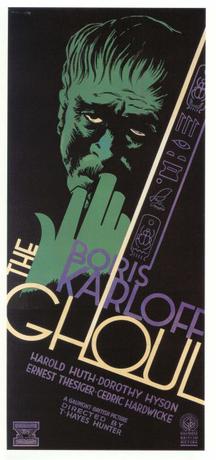
Horror Film Review: The Ghoul (dir by T. Hayes Hunter)


Some actors can make just about anything worth watching.  That’s certainly the case with Boris Karloff and 1933’s The Ghoul.

In The Ghoul, Karloff plays Prof. Henry Moriant.  The professor is an Egyptologist, a world-renowned expert on the dead.  Moriant is now facing death himself, sick in bed and ranting about how he wants to be treated after he passes.  Nigel Hartley (Ralph Richardson) stops by the mansion while pretending to be a vicar and offers to comfort Prof. Moriant in his last moments.  The butler, Laing (Ernest Thesiger), explains that Moriant has never had much use for traditional religion.  Instead, Moriant believes in the Gods of Egypt.

In death, Moriant wants to be buried with an Egyptian jewel in his hands.  He believes that, after he dies, he will exchange the jewel with the Egyptian God Anubis and he will be reborn with amazing powers.  However, when Moriant passes, Laing keeps the jewel for himself and attempts to hide it from the countess number of people who show up at the mansion, all seeking either the jewel or just information about Moriant’s estate.  Moriant may not have been loved in life but everyone clearly loves his money.

Boris Karloff is not actually in that much of The Ghoul.  He dominates the start of the film, ranting from his deathbed.  And then, towards the end of the film, he rises from the dead and attacks those who he thinks have betrayed him and stolen the jewel.  He’s only onscreen for a few minutes but he dominates those minutes.  Karloff’s screen presence is undeniable.  When he’s in a scene, he’s the only person that you watch.  When he’s not in a scene, you find yourself wondering how long it’s going to take for Karloff to return.

That’s not to say that the other actors in The Ghoul aren’t good.  The cast is full of distinguished names.  Along with Richardson and Thesiger, Cedric Hardwicke, Anthony Bushnell, Dorothy Hyson, and Kathleen Harrison all wander through the mansion and try to avoid getting caught up in Karloff’s vengeance.  Harrison provides the film’s comic relief and I actually enjoyed her flighty performance.  The film itself is so darkly lit and full of so many greedy characters that it was nice to have someone on a totally different wavelength thrown into the mix.  That said, the majority of the actors are stuck with paper-thin characters and aren’t really allowed the time to make much of an impression.  This is Karloff’s film, from the beginning to end.  And while the film itself is definitely a bit creaky, Karloff is always enjoyable to watch.

The Ghoul was made at a time when Karloff, having become a star with Frankenstein, was frustrated with the roles that he was being offered in America.  He returned to his native UK and promptly discovered that he was just as typecast over there as he was in the United States.  For a long time, The Ghoul was believed to be a lost film.  However, in 1968, a copy was discovered in Egypt of all places.  It’s unfortunate that the film itself isn’t better but there’s no denying the power of Karloff the performer.


Lisa Reviews An Oscar Nominee: In Which We Serve (dir by Noel Coward and David Lean)


“This is the story of a ship….”

The 1942 British war film, In Which We Serve, opens with footage of the HMS Torrin, a destroyer, being constructed in a British shipyard.  When the Torrin is finally finished, the men who worked on it cheer as it leaves on its maiden voyage.  The film then abruptly jumps forward to the year 1941.  The Torrin is sinking, the victim of German bombers.  The surviving members of her crew float in the ocean, holding onto debris and watching as their home for the past few years capsizes and slowly goes underneath the surface of the water.  Even as the Torrin sinks, German planes continue to fly overhead, firing on the stranded men and killing several of them.

As the men fight to survive both the ocean and the Germans, they remember their time on the Torrin.  Captain Kinross (Noel Coward, who also wrote the script and co-directed the film) thinks back to 1939, when he was first given command of the Torrin.  He remembers the early days of the war and the time that he spent with his wife (Celia Johnson) before leaving to do his duty.  As the captain of the ship, Kinross was a tough but compassionate leader.  He expected a lot out of the men but he also came to view them as his second family.  Meanwhile, Shorty Blake (John Mills) thinks about his wife and his newborn son back in London.  Everyone on the Torrin has left their families behind.  Some of them even lose their loved ones during the war, victims of the relentless German Blitz.  But, even as they float in the ocean, everyone continues to fight on, knowing that there will be bigger ships to replace the Torrin and that Britain will never surrender.

In 1942, British film producer Anthony Havelock-Allan approached Noel Coward and asked him if he would be interested in writing the screenplay for a morale-boosting propaganda film.  Coward agreed, on the condition that he be given complete control of the project and that the film deal with the Royal Navy.  Though one might not immediately think that the author of drawing room comedies like Easy Virtue and Private Lives would be the obvious choice to write a war film, Coward’s family actually had a long tradition of serving in the Navy and Coward based a good deal of the film’s action on the wartime exploits of his friend, Lord Mountbatten.  Though there was initially some concern about Coward’s insistence that he should play the lead role on top of everything else, the Ministry of Information fully supported the production of In Which We Serve.

However, Corward knew that he would need help directing the film.  He asked his friend, John Mills, for advice and Mills suggested that Coward should bring in, as co-director, “the best editor in Britain,” David Lean.  Though Lean was initially only meant to handle the action scenes, Coward quickly discovered that he didn’t particularly enjoy all of the detail that went into directing a film.  As a result, David Lean ended up directing the majority of the film.  This would be Lean’s first film as a director and he would, of course, go one to become one the top British directors of all time.

(Also of note, frequent Lean collaborator Ronald Neame served as the film’s cinematographer.  Neame later went on to have his own career as a director.  In 1972, Neame directed another film about a capsized ship, The Poseidon Adventure.)

As for the film itself, In Which We Serve is an unapologetic propaganda film, carefully crafted to inspire the British people to support the war effort and also to win over the sympathy of American viewers.  (During the film’s production, America had finally entered the war but there were still skeptics, at home and abroad.)  Along with being a war film, In Which We Serve is also a rather touching and heartfelt tribute to the strength and determination of the British people.  Though it’s a rather grim film at times and it doesn’t shy away from the fact that lives are going to be lost in the battle to defeat Hitler, it’s also a rather inspiring film.  The sacrifice will be great, In Which We Serve tells us, but it will also be worth it.  The entire ensemble — including future director Richard Attenborough, making his film debut as a frightened sailor — does an excellent job of creating memorable characters, some of whom only appear for a few fleeting moments before meeting their fate.

In Which We Serve was a box office hit in both the UK and the US.  It was Oscar-nominated for Best Picture of the year, though it ultimately lost to another film about World War II, Casablanca.