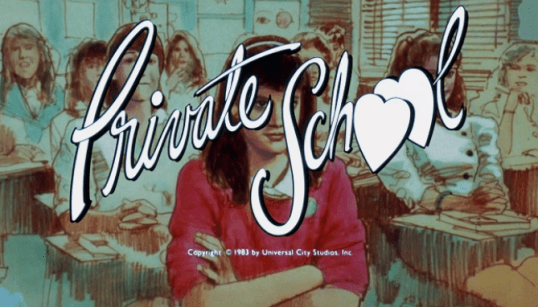
In my previous two Back To School reviews, I took a look at two classic teen comedies. Fast Times At Ridgemont High and Risky Business both used and manipulated the standard teen comedy trappings to tell unusually nuanced stories about growing up. These are films that used the audience’s familiarity with the genre to tell stories that ultimately challenged the viewer’s preconceived notions and expectations. Having considered those two films, let us now consider Private School, a film that used all of the standard teen comedy clichés to make a very standard teen comedy.
According to the film’s trivia page on the IMDB (how’s that for an authoritative source!?), Private School was “”was supposedly market researched from stem to stern in order to ensure mass teen appeal”. And it’s true because there’s literally nothing in Private School that you couldn’t find in almost every other teen comedy released in the 1980s. In fact, Private School often feels like a compilation of clips from other teen comedies.
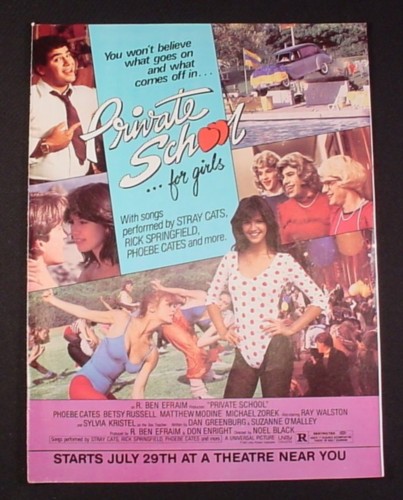
For instance, the film tells the story of two groups of three. There’s the three girls who attend Cherryvale Academy: good girl Christine (Phoebe Cates), bad (and rich) girl Jordan (Betsy Russell), and vaguely asexual tomboy Betsy (Kathleen Wilhoite). And then there’s three guys who attend Freemount Academy. There’s a fat guy named Bubba (Michael Zorek), a short guy named Roy (Jonathan Prince) and a nice guy named Jim (Matthew Modine). Bubba is dating Betsy. Christine is dating Jim. Jordan is dating no one because she’s too busy trying to steal Christine’s boyfriend. Roy is also single, largely because adding a fourth girl would throw off the film’s group-of-three dichotomy.
There’s also a lot of boobs, largely because Private School was made to appeal to teenage boys and you really have to wonder how many of them left the theater thinking that all they had to do to get a girl to disrobe was spill some fruit juice on her dress and then suggest that she take it off. There’s even a scene where Jordan rides a horse naked because — well, why not?
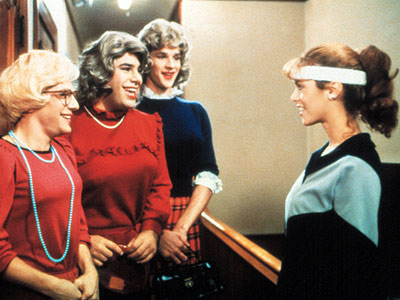
And then there’s an extended sequence where each of the three boys puts on a wig, a red dress, way too much lipstick and then sneak into the girl’s dormitory because cross-dressing is always good for a few easy laughs. Despite their best attempts to speak in falsetto voices, Jim, Bubba, and Roy make for three of the least convincing women that I’ve ever seen but, to the film’s credit, that’s kind of the point. It’s a stupid plan that leads to stupid results.
Of course, the film is also full of terrible adult authority figures. And why not? It’s not like anyone over the age of 18 was ever going to watch the film. So, of course, Jordan’s father is going to be lecherous old perv with a trophy wife. And, of course, all of Cherryvale’s teachers are going to be a collection of spinsters and alcoholics. In the end, the only adult who isn’t a raging hypocrite is the friendly town pharmacist (played by Martin Mull) who, of course, is mostly present so he can make Jim feel nervous about buying condoms.
And, ultimately, Private School is one of those films that wants to be racy and dirty (in order to appeal to teenage boys) while also being sweet and romantic (in order to appeal to teenage girls). The main plot revolves around Jim and Christine’s plans to go away for a weekend so that they can have sex for the first time and the film actually handles this pretty well. Matthew Modine and Phoebe Cates both have a really sweet chemistry. They’re a really cute couple and you hope the best for them. But there’s just so many complications, the majority of which could have been avoided by Jim not being an idiot. It never seems to occur to Jim that maybe he’d finally be getting laid if he wasn’t always doing things like dressing up in drag and trying to sneak into the girl’s dormitory.
That doesn’t necessarily mean that Private School is a terrible film. As far as boob-obsessed teen sex comedies go, Private School is actually pretty well-done and watchable. The cast is likable and director Noel Black keeps the action moving. Even the film’s nominal villain is likable, with Betsy Russell playing Jordan as being more mischievous than spiteful. But, ultimately, what makes Private School memorable is the fact that it is so predictable, that it does literally contain every single cliché that one would expect to find in a teen comedy. This is a film so determined to not bring anything new to the genre that it becomes an oddly fascinated study in how to maintain a status quo.
In fact, perhaps the most innovative thing about Private School is the song that plays over the opening credits. The song — which is called You’re Breakin’ My Heart and is performed by Harry Nilsson — starts with: “You’re breaking my heart/you’re tearing it apart/so fuck you…”
That’s about as close to being subversive as Private School ever gets.
 Through the Shattered Lens