Horror Film Review: Dark Intruder (dir by Harvey Hart)


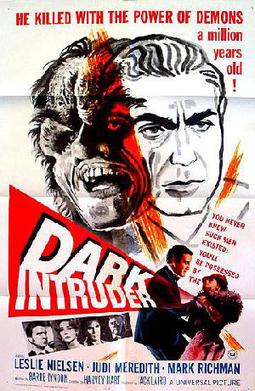
The 1965 film, Dark Intruder, takes place in San Francisco in 1890.

Murders are being committed on the foggy streets of the city that was once known as Yerba Buena.  Women are being stalked through allies and attacked by a caped figure who seems to thrive on the darkness.  At each murder, a hideous statuette is left behind.  The statuette seems to depict a winged demon emerging from the back of a man’s head.  With each murder, the demon appears to be growing closer and closer to fully escaping from the man.

The police are baffled and the press is suggesting that London’s infamous Jack the Ripper has come to California.  (Well, where else would he go?  I kid, California, I kid!  I love you, California.  Well, I love some parts of California, at least.)  As the police often due when they have a case with supernatural overtones, they turn to local socialite and bon vivant, Brett Kingsford (Leslie Nielsen).

Brett lives in a mansion, where he wakes up nearly every morning with a hangover.  He enjoys life but he’s also found time to become an expert on the occult.  He even has a giant plant in his library that perks up whenever there’s a paranormal presence nearby.  Brett is engaged to Evelyn Lang (Judi Meredith), who speaks in an annoyingly high voice.  When the police bring the statuettes to Brett, he takes them to a psychic named Chi Zeng for advice.  Chi Zeng (played by Peter Brocco, who you may have guessed was not Chinese) reveals that the statuette represent a Sumerian demon that is inhabiting the body of a human.  The demon has to commit seven murders so that it can freed from its host and then allowed to commit as many terrible acts as it wants.

Who is the demon possessing?  Brett’s friend, Robert Vandenburg (Peter Mark Richman), fears that it could be him.  Brett tries to assure Vandenburg that he has nothing to worry about but as Brett continues his investigation, he comes to realize that Vandenburg actually may have a lot to worry about….

Dark Intruder is a short film, clocking in at a little under an hour.  It was originally developed as a pilot for a television series that would have featured Leslie Nielsen solving occult crimes on a weekly basis.  Unfortunately, the series wasn’t picked up (it sounds like it would have been fun!) and Dark Intruder was given a theatrical release as part of a double feature with William Castle’s I Saw What You Did.  It’s an effective little film, full of gothic atmosphere, misty streets, and a frightening (and clawed) villain.  The murder that opens the scene seems as if it would have been quite graphic by the standards of 1966 television.  Perhaps that’s why the pilot didn’t lead to a series.

Of course, for a lot of people, the main appeal here is Leslie Nielsen, playing one of his “serious” roles.  Usually, it’s difficult to watch Nielsen’s dramatic work because it’s impossible not to be amused at his signature deadpan line delivery.  But he’s actually very good in Dark Intruder.  It helps that Brett Kingsford was written as being someone who had a sense of humor, as opposed to the stiff characters that Nielsen usually played in his dramatic roles.  Nielsen appears to be having fun in the role, which is not something you can say about most of Nielsen’s dramatic work.  Again, it’s a shame that Dark Intruder was apparently too ahead of its time for 1965.
TSL’s Horror Grindhouse: Queen of Blood (dir by Curtis Harrington)


Queen of Blood (1966, dir by Curtis Harrington, DP: Vilis Lapenieks)

Here’s a question: what happens when Roger Corman buys the rights to two Russian science fiction films, decides to jettison basically everything but the special effects footage, and then hires experimental filmmaker Curtis Harrington to shoot an entirely new film around that footage?

You end up with the 1966 film, Queen of Blood!

Not that that’s a bad thing, mind you. Queen of Blood is actually pretty good and director Harrington manages to smoothly integrate the Russian footage with the new footage. Basically, it works out so that you’ll see a Russian shot of the spaceship taking off or landing and then you’ll see a shot of John Saxon, Dennis Hopper, or Basil Rathbone sitting on a set and pretending like they’re in space.

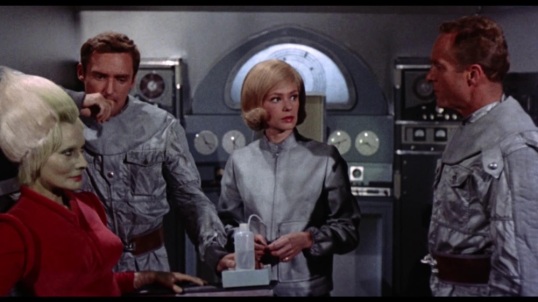
The film opens with Dr. Faraday (Basil Rathbone) discovering that aliens have been transmitting a message to Earth. They’re sending an ambassador to meet with the Earthlings but the aliens’ spaceship ends up crash landing on Mars! Faraday arranges for an Earth spaceship, the Oceano, to go to Mars and rescue the ambassador.

Aboard the Oceano is a cast made up of a few familiar faces. John Saxon plays Allan, who is the de facto leader of the expedition and also engaged to marry Dr. Faraday’s assistant, Laura (Judi Meredith). A young-looking Dennis Hopper is Paul Grant, an astronaut. Don’t get too excited about Hopper being in the cast. Queen of Blood was made when Hopper was still trying to pursue mainstream film stardom so he gives a rather bland performance here. There’s a few scenes where you can tells that Hopper is on the verge of smirking at some of his dialogue but, for the most part, he plays the role extremely straight. Rounding out the crew is Anders (Robert Boon) and Tony (Don Eitner), neither one of whom would go on to star in Easy Rider, Blue Velvet, or Nightmare on Elm Street.

It’s a difficult journey. The Oceano keeps running into Russian-filmed turbulence on the way to Mars. When they do land, they discover that the ambassador (Florence Marly) is waiting for them to rescue her. She doesn’t talk much nor does she have any interest in eating Earth food. She does seem to like every member of the crew except for Laura. Of course, the ambassador’s defining trait is that she likes to drink blood….

All things considered, Queen of Blood works pretty well. While none of the performances are particularly memorable (though Basil Rathbone does bring some old school class to what is essentially a cameo role), Curtis Harrington does a great job creating and maintaining a properly ominous atmosphere. It takes a while for the crew to finally find the Queen of Blood but, when they do, Harrington gets every bit of creepiness that he can out of the character. The film even ends on an appropriately dark note, suggesting that the human race may be just too stupid to survive.

Queen of Blood is an entertaining B-movie. Watch it the next time you’re in the mood for some intergalactic blood-sucking fun!

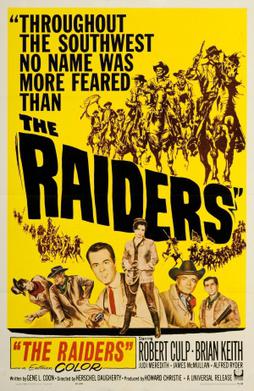
The Raiders (1963, directed by Herschel Daughtery)


In the years immediately following the Civil War, seven Texas cattleman, led by Col. John McElroy (Brian Keith), try to drive their cattle into Missouri.  The terrains proves treacherous and the local Pawnees refuse to allow the cattlemen to pass through their land without paying a hefty fee for the right.  McElroy and his followers go to Fort Hays and demands that the local railroad magnate, Huntingon Lawford (Addison Richards), extend his line into Texas.  When both Lawford and martinet Calvary officer Capt. Benton (Alfred Ryder) refuse to help, McElroy and his man start sabotaging the railroad’s western expansion.

This brings them into conflict with Wild Bill Hickok (Robert Culp), Buffalo Bill Cody (Jim McMullan), and Calamity Jane (Judi Meredith), all of whom are working for the railroad!  Hickok is an old friend of McElroy’s and Cody is sympathetic to McElroy’s cause but will they be able to broker a peace between the two sides?  When Captain Benton plans to lure McElroy into a trap where he and his friends will fired on with a Gatling gun, it’s up to Cody and Hickok to try to prevent a massacre.

The Raiders starts out as a downbeat look at a cattle drive in the years when America was still trying to rebuild from the devastation of the Civil War.  Brian Keith was one of those actors who was always ideally cast in westerns and war movies and he’s convincing as the tough but fair-minded McElroy.  If the film had just been about McElroy, it would have been a good B-western.  Instead, it brings heavily fictionalized versions of Wild Bill Hickock, Buffalo Bill Cody, and Calamity Jane into the story.  Robert Culp, Jim McMullan, and especially Judi Meredith all overact in their roles and a lot of time is wasted on subplots like Calamity Janes being in love with Wild Bill and Buffalo Bill trying to prove himself to the older man.

The Raiders started out as a made-for-TV movie and it appears that it was a pilot for a proposed TV show about Calamity Jane and the Bills.  (Brian Keith is even listed in the credits as being a “special guest star.”)  When the pilot wasn’t picked up, the film was given a theatrical release but The Raiders still has the flat look and unimaginative editing of a television show.  No matter how authentic Brian Keith’s performance might be, he can’t make up for the fact that the majority of the film was clearly shot on a studio backlot.