Love on the Shattered Lens: Brief Encounter (dir by David Lean)


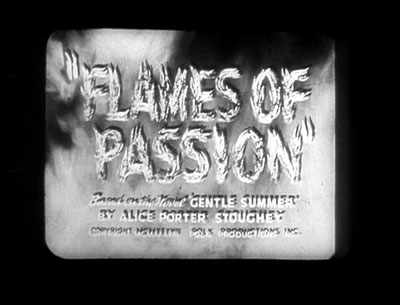
Flames of Passion is a British film from 1938.  I’ve seen the trailer but I’ve never actually seen the film and that’s kind of a shame because it’s a really good trailer.  Not only does it feature romance and adventure but it’s apparently based on a novel called Gentle Summer.  As someone who is fascinated by the power of a good title, I have to give credit to whoever changed that one.  Flames of Passion is far more intriguing than Gentle Summer.

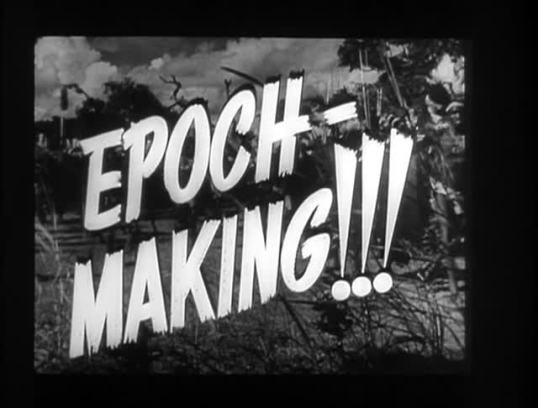
Another reason that I want to see Flames of Passion is because it was apparently “Epoch-Making!!!”  In fact, they say so right in the trailer:
Unfortunately, I’ll never get a chance to actually see Flames of Passion.  As you probably already guessed, it’s a fictional film.  (I’m going to guess that “Epoch-Making” gave it away.)  It’s a fake film that plays a very important role in real film, the 1945 classic Brief Encounter.

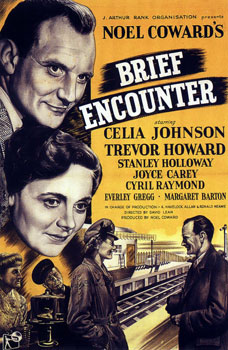
Taking place in Britain shortly before the start of World War II, Brief Encounter tells the story of two people.  Laura Jesson (Celia Johnson) is respectable, middle class, and middle aged.  Every Thursday, she takes the train into a nearby town where she does the shopping and catches a matinee.  Alec Harvey (Trevor Howard) is a doctor who rides the train every Thursday so that he can help out at a local hospital.  Dr. Harvey volunteers at the hospital because that’s the type of person that he is.  He also volunteers, one Thursday, to help Laura get a piece of dirt out of her eye.

The next Thursday, Laura and Alec run into each other again.  They have coffee.  A week later, they have lunch.  A week after that, they go to the movies and they see the trailer for Flames of Passion.  Laura and Alec enjoy each other’s company and they quickly find themselves growing very close to one another.  The only problem is that, occasionally, Laura’s friends see the two of them together.  Laura knows how quickly gossip can be spread.

Actually, that’s not the only problem.  There’s actually an even bigger problem that neither Laura nor Alec know how to deal with.  Both of them are married and both of them have children.  In fact, Laura would appear to have the type of life that a lot of people would envy.  She has a nice home.  She has wonderful children.  She has a husband named Fred (Cyril Raymond) and there’s no doubt that Fred loves her.  Fred’s a good man but he’s boring, safe, and set-in-his-ways.  He’s the type who, when Laura mentions that she’s made a male friend and that she goes to the movies with him, barely looks up from the newspaper.

What is Laura to do?  She soon finds that her life is now centered around those Thursday meetings with Alec but are they worth the risk of losing her family?  And when Alec tells her that he’s been offered a job in South Africa, Laura realizes that she will soon no longer even have Thursday to which to look forward.

Brief Encounter is an interesting film.  From the minute that Alec and Laura meet, you know that they’re destined to fall for each other but nothing else about the film plays out in the way that you would expect it to.  As much as being a love story, it’s also a story about two people who have reached a point in their lives where they’ve reached the halfway mark of their lives and now they’re asking, “Is this it?”  It’s not just that Laura is attracted to Alec, though she certainly is.  It’s also that she knows that Alec represents what is probably her last chance to do something grand and romantic with her life.  Once Alec leaves, it’ll mean accepting her life as it is, with the good and the bad things that go along with it.

The film’s dialogue is as erudite and witty as you would expect from a cinematic adaptation of a Noel Coward play and David Lean keep the action moving along at a brisk pace.  Celia Johnson and Trevor Howard are absolutely perfect as the two would-be lovers, with Johnson especially giving a powerful and sympathetic performance.  (If you don’t tear up during Laura’s final scene with Alec, you may want to check to see if you have a heart.)  It helps that neither one of them was a traditionally glamorous movie star.  (Trevor Howard may have been handsome but he was no Cary Grant.)  They come across as being very real people and it’s easy to imagine them being very happy together.  They’re such decent people that they even feel guilty for walking out on Flames of Passion, which Laura apparently did not feel was a particularly good movie.  Watching Brief Encounter, you wish that Alec and Laura could have met earlier but you are happy that they at least had their Thursdays.
Lisa Reviews An Oscar Nominee: In Which We Serve (dir by Noel Coward and David Lean)


“This is the story of a ship….”

The 1942 British war film, In Which We Serve, opens with footage of the HMS Torrin, a destroyer, being constructed in a British shipyard.  When the Torrin is finally finished, the men who worked on it cheer as it leaves on its maiden voyage.  The film then abruptly jumps forward to the year 1941.  The Torrin is sinking, the victim of German bombers.  The surviving members of her crew float in the ocean, holding onto debris and watching as their home for the past few years capsizes and slowly goes underneath the surface of the water.  Even as the Torrin sinks, German planes continue to fly overhead, firing on the stranded men and killing several of them.

As the men fight to survive both the ocean and the Germans, they remember their time on the Torrin.  Captain Kinross (Noel Coward, who also wrote the script and co-directed the film) thinks back to 1939, when he was first given command of the Torrin.  He remembers the early days of the war and the time that he spent with his wife (Celia Johnson) before leaving to do his duty.  As the captain of the ship, Kinross was a tough but compassionate leader.  He expected a lot out of the men but he also came to view them as his second family.  Meanwhile, Shorty Blake (John Mills) thinks about his wife and his newborn son back in London.  Everyone on the Torrin has left their families behind.  Some of them even lose their loved ones during the war, victims of the relentless German Blitz.  But, even as they float in the ocean, everyone continues to fight on, knowing that there will be bigger ships to replace the Torrin and that Britain will never surrender.

In 1942, British film producer Anthony Havelock-Allan approached Noel Coward and asked him if he would be interested in writing the screenplay for a morale-boosting propaganda film.  Coward agreed, on the condition that he be given complete control of the project and that the film deal with the Royal Navy.  Though one might not immediately think that the author of drawing room comedies like Easy Virtue and Private Lives would be the obvious choice to write a war film, Coward’s family actually had a long tradition of serving in the Navy and Coward based a good deal of the film’s action on the wartime exploits of his friend, Lord Mountbatten.  Though there was initially some concern about Coward’s insistence that he should play the lead role on top of everything else, the Ministry of Information fully supported the production of In Which We Serve.

However, Corward knew that he would need help directing the film.  He asked his friend, John Mills, for advice and Mills suggested that Coward should bring in, as co-director, “the best editor in Britain,” David Lean.  Though Lean was initially only meant to handle the action scenes, Coward quickly discovered that he didn’t particularly enjoy all of the detail that went into directing a film.  As a result, David Lean ended up directing the majority of the film.  This would be Lean’s first film as a director and he would, of course, go one to become one the top British directors of all time.

(Also of note, frequent Lean collaborator Ronald Neame served as the film’s cinematographer.  Neame later went on to have his own career as a director.  In 1972, Neame directed another film about a capsized ship, The Poseidon Adventure.)

As for the film itself, In Which We Serve is an unapologetic propaganda film, carefully crafted to inspire the British people to support the war effort and also to win over the sympathy of American viewers.  (During the film’s production, America had finally entered the war but there were still skeptics, at home and abroad.)  Along with being a war film, In Which We Serve is also a rather touching and heartfelt tribute to the strength and determination of the British people.  Though it’s a rather grim film at times and it doesn’t shy away from the fact that lives are going to be lost in the battle to defeat Hitler, it’s also a rather inspiring film.  The sacrifice will be great, In Which We Serve tells us, but it will also be worth it.  The entire ensemble — including future director Richard Attenborough, making his film debut as a frightened sailor — does an excellent job of creating memorable characters, some of whom only appear for a few fleeting moments before meeting their fate.

In Which We Serve was a box office hit in both the UK and the US.  It was Oscar-nominated for Best Picture of the year, though it ultimately lost to another film about World War II, Casablanca.