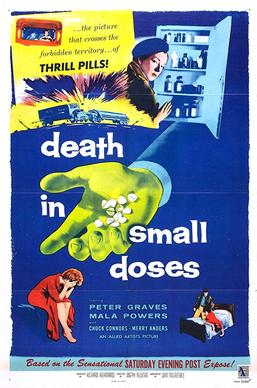
30 More Days of Noir #10: Death in Small Doses (dir by Joseph M. Newman)


Ah, speed.

I have to admit that I always find films about amphetamines to be fascinating because I take them for my ADD.  I’ve been taking Dexedrine since I was in middle school and it has always amused me how people who don’t have ADD seem to think that the meds will give you super powers.  For instance, every season of Big Brother, there’s people online who get outraged over certain houseguests taking Adderall.  “She had an unfair advantage!” someone will say, “Because she’s taking Adderall!”  What can I say?  People who don’t have ADD just don’t get it.  Yes, if you have ADD, the meds can help you focus but it’s not like they’re going to give you any sort of special power that’s not available to any other person.

(I will admit that there is a slight difference between me on my meds and me off my meds.  Actually, my family says that there’s a huge difference but I think they’re exaggerating.  It is true that I’m a lot more focused when I take my Dexedrine.  My mind wanders a bit less than usual and I’m also usually in better control of my frustrations.  When I take my meds, I can finish any project.  When I don’t take them, I can talk about finishing any project.)

Dexedrine focuses me but apparently, it does the opposite for those who don’t have ADD.  The 1957 film, Death in Small Doses, features a truck driver named Mink Reynolds who, despite not having ADD, pops too many capsules and ends up playing really loud music and trying to force a waitress to dance with him.  He also hallucinates seeing a car and then grabs a knife and tries to kill another truck driver.  To be honest, that seems a bit extreme to me.  In fact, I’d almost argue that Mink’s behavior would indicate that the filmmakers really didn’t know much about amphetamines.  Making things even stranger is that Mink is played by Chuck Connors, who was a remarkably inexpressive actor.  Watching Connors, with his stone face, trying to dance and jump around is an interesting experience.  Mink is supposed to be a jazz-crazed, speed-abusing hepcat but instead, he comes across like an animatronic mannequin.  You can almost hear the gears shifting whenever he has to move across the screen.

Mink’s fellow truck driver is Tom Kaylor (Peter Graves), a seemingly upright man who is usually seen wearing a tie and who looks like he would be more comfortable working behind a desk than driving a truck.  Of course, that’s because Tom is actually an FBI agent!  He’s working undercover, pretending to be a truck driver so that he can smash a ring of drug dealers!  Of course, the problem here is that everything about Peter Graves’s screen presence shouts out, “Narc!”  With his square jaw and his perfect haircut and his stiff but authoritative delivery of his dialogue, he seems like he was created in a lab that specifically set out to develop the most stereotypical FBI agent imaginable.  There’s not a single rough edge to him and it’s hard to buy that the other truck drivers wouldn’t see straight through him.

While Tom tries to bust the ring, he also finds time to possibly fall in love with two different women, both of whom seem as if they might know more than they’re letting on.  Amy (Merry Anders) is the waitress who has developed a drug habit of her own.  Val (Mala Powers) owns the boarding house when Tom and Mink live.  Can Tom trust either one of them?  And will Tom not only undercover the identity of the head of the drug ring but also survive long enough to bring the dealers to justice?

So, here’s the thing.  During its worst moments — i.e., whenever Chuck Connors is jumping all over the place and talking about how much he loves his friend “benny” — this is a campy and rather silly film that makes Reefer Madness look subtle by comparison.  However, during its best moments, this is a tough and entertaining noir that features good performances from Merry Anders and Mala Powers.  Both Anders and Powers manage to transcend the film’s sillier moments and they actually bring a charge of reality to the story.  And while director Joseph M. Newman may not have known much about drugs, he did know how to shoot a fight scene.  Making good use of its desolate locations (the truck drivers spend a lot of time driving through the desert) and setting many of the film’s best moments at night, Newman overcomes some of the script’s weaker moments.  In the end, it makes for a rather uneven but entertaining viewing experience.  Despite the film’s cluelessness about drugs and the miscasting of both Graves and Connors, this lesser-known noir is worth tracking down.

An Offer You Can’t Refuse #6: King of the Roaring 20s: The Story of Arnold Rothstein (dir by Joseph M. Newman)


The 1961 gangster biopic, King of the Roaring ’20s: The Story of Arnold Rothstein, tells the story of two men.

David Janssen is Arnold Rothstein, the gambler-turned-millionaire crime lord who, in the early years of the 20th Century, was one of the dominant figures in American organized crime.  Though he may be best-remembered for his alleged role in fixing the 1918 World Series, Rothstein also served as a mentor to men like Lucky Luciano, Meyer Lansky, and Bugsy Siegel.  Rothstein was perhaps the first gangster to to treat crime like a business.

Mickey Rooney is Johnny Burke, Arnold’s best friend from childhood who grows up to be a low-level hood and notoriously unsuccessful gambler.  Whereas Arnold is intelligent, cunning, and always calm, Johnny always seems to be a desperate.  Whereas Arnold’s success is due to his ability to keep a secret, Johnny simply can’t stop talking.

Together …. THEY SOLVE CRIMES!

No, actually, they don’t.  They both commit crimes, sometimes together and sometimes apart.  Perhaps not surprisingly, Arnold turns out to be a better criminal than Johnny.  In fact, Johnny is always in over his head.  He often has to go to his friend Arnold and beg him for his help.  Johnny does this even though Arnold continually tells him, “I only care about myself and money.”

The friendship between Arnold and Johnny is at the heart of King of the Roaring 20s, though it’s not much of a heart since every conversation they have begins with Johnny begging Arnold for help and ends with Arnold declaring that he only cares about money.  At a certain point, it’s hard not to feel that Johnny is bringing a lot of this trouble on himself by consistently seeking help from someone who brags about not helping anyone.  From the minute that the film begins, Arnold Rothstein’s mantra is that he only cares about money, gambling, and winning a poker game with a royal flush.  Everything else — from his friendship to Johnny to his marriage to former showgirl Carolyn Green (Dianne Foster) to even his violent rivalry with crooked cop Phil Butler (Dan O’Herlihy) — comes second to his own greed.  The film’s portrayal of Rothstein as being a single-minded and heartless sociopath may be a convincing portrait of the type of mindset necessary to be a successful crime lord but it hardly makes for a compelling protagonist.

Oddly enough, the film leaves out a lot of the things that the real-life Arnold Rothstein was best known for.  There’s no real mention of Rothstein fixing the World Series. His mentorship to Luciano, Lansky, and Seigel is not depicted.  The fact that Rothstein was reportedly the first gangster to realize how much money could be made off of bootlegging goes unacknowledged.  By most reports, Arnold Rothstein was a flamboyant figure.  (Meyer Wolfsheim, the uncouth gangster from The Great Gatsby, was reportedly based on him.)   There’s nothing flamboyant about David Janssen’s performance in this film.  He plays Rothstein as being a tightly-wound and rather unemotional businessman.  It’s not a bad performance as much as it just doesn’t feel right for a character who, according to the film’s title, was the King of the Roaring 20s.

That said, there are still enough pleasures to be found in this film to make it worth watching.  As if to make up for Janssen’s subdued performance, everyone else in the cast attacks the scenery with gusto.  Mickey Rooney does a good job acting desperate and Dan O’Herlihy is effectively villainous as the crooked cop.  Jack Carson has a few good scenes as a corrupt political fixer and Dianne Foster does the best that she can with the somewhat thankless role of Rothstein’s wife.  The film moves quickly and, even if it’s not as violent as the typical gangster film, it does make a relevant point about how organized crime became a big business.

It’s not a great gangster film by any stretch of the imagination and the lead role is miscast but there’s still enough about this film that works to make it worth a watch for gangster movie fans.

Previous Offers You Can’t (or Can) Refuse:

  1. The Public Enemy
  2. Scarface
  3. The Purple Gang
  4. The Gang That Could’t Shoot Straight
  5. The Happening

Film Review: This Island Earth (dir by Joseph M. Newman and Jack Arnold)


Oh, those poor aliens!

Ever since the 1950s, intergalactic diplomats, soldiers, and explorers have come to Earth looking for help.  Some of them have come from planets that orbit dying stars.  Some represent civilizations that have been destroyed by war or pollution.  Some of them have come here looking to inspire us to be more peaceful and less destructive.  Others were just looking for something to eat.

What they all have in common is that they all came to Earth and things really didn’t work out that well.  Occasionally, they ran into humans who, due to cynicism and skepticism, simply weren’t willing to help.  Often, the aliens arrived just to discover that the humans had no interest in being conquered.  Remember what Eros yelled at the Plan 9 From Outer Space?  “Your stupid, stupid minds!”  Oh yeah?  Well, our menfolk kicked your ass and blew up your flying saucer.  So there.

Consider the sad case of Exeter (Jeff Morrow), the alien at the center of 1955’s This Island Earth.  Exeter has come to Earth with his associates and disguised himself as a human.  Despite the fact that they all have remarkably high foreheads and a total inability to relate to actual humans, no one seems to suspect that Exeter and his friends are from outer space.  Even when he starts recruiting leading scientists to come hang out at his isolated headquarters, it doesn’t seem to occur to anyone that they should be too concerned.  Exeter’s just a little bit weird.  Why worry?

Well, Dr. Carl Meacham (Rex Reason) is worried!  He’s a pilot and a scientist and he’s got a square jaw and one of those deep, 1950s American male voices.  Everything that Dr. Meacham says sounds authoritative.  When you hear that confident, take-no-prisoners voice, you have no doubt that Eisenhower’s in the White House and everything’s going to be alright.  Carl doesn’t trust Exeter and he suspicions are proven correct when he and Dr. Ruth Adams (Faith Domergue) are taken to Exeter’s war-ravaged planet.  Not only is the planet on the verge of blowing up but the whole place is crawling with mutants!

Unfortunately, it takes a while for Carl, Ruth, and Exeter to reach the planet.  This Island Earth is an oddly structured film.  The first third of the film deals with Carl and his squirmy associate, Joe (Robert Nichols), building something called an interocitor.  Once Carl has shown that he can follow the alien instruction booklet, Carl is allowed to meet Exeter.  (For some reason Joe is left behind.)  Once Carl arrives at Exeter HQ, it’s another lengthy wait before he, Ruth, and Exeter are launched into space.

Still, on the plus side, one of the scientists gets to drive this really cool car:

(Unfortunately, the car doesn’t make it to the end of the movie.)

The movie gets a lot better once the action moves to Exeter’s home planet.  The planet was a gloriously realized world, a pop art masterpiece:

And then there were the mutants!  Look at this thing:

Anyway, despite the slow start, This Island Earth is a classic of 1950s science fiction, one that manages to maintain a perfect balance between the sublime and the ludicrous.  Rex Reason and Faith Domergue are inoffensively bland as Carl and Ruth but Jeff Morrow brings a weary and even tragic dignity to the role of Exeter.  If nothing else, it lives up to its title by suggesting that Earth actually is just one insignificant island in the vast ocean of the universe and that both humans and aliens are mere slaves to fate.  For all of his deep-voiced authority, Carl really doesn’t accomplish much over the course of the film.  By that same token, for all of his efforts and his integrity, there’s little that Exeter can do to alter the destiny of his planet.  At times, This Island Earth is almost existential in its portrayal of both human and extraterrestrial inability to alter the whims of fate.  Of course, it’s also a frequently silly film that will be a lot of fun for anyone who appreciates a good B-movie.

On Saturday night, I watched This Island Earth with my friends in the Late Night Movie Gang.  After last week’s experience with Disco Beaver From Outer Space, I decided to play it safe this week.  We had a lot of fun with This Island Earth.  In case you want to learn how to make an interocitor of your very own, the film is available on YouTube.

Horror On TV: The Twilight Zone 5.5 “The Last Night of a Jockey”


TheTwilightZoneLogo


For tonight’s episode of The Twilight Zone, we present to you The Last Night of A Jockey. In this episode, Mickey Rooney plays a jockey who has just been banned, for life, from horse racing. The self-pitying jockey is offered the chance to change his life with “one wish.” He wishes that he could be a “big man” and, unfortunately, he gets his wish.


This episode is basically a one-man show for Mickey Rooney and he makes the most of it. I almost feel like I have to share this episode, just in case my earlier review of The Manipulator inspired anyone to see that misbegotten film. Needless to say, Rooney is a lot more impressive in Last Night Of A Jockey than he was in The Manipulator.


This episode originally aired on October 25th, 1963.