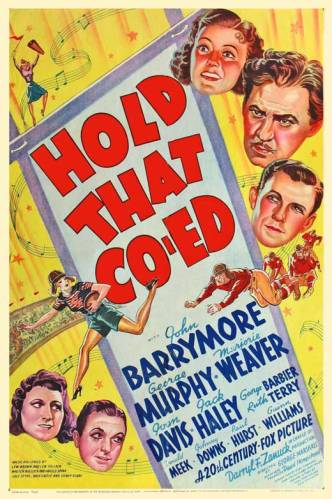
“Americans will put up with bad government but they won’t stand for bad sportsmanship!” — A political consultant in Hold That Co-Ed (1938)
Rusty Stevens (George Murphy) is the new head football coach at State University. (Which state? We never learn for sure, though the implication is that it’s somewhere near Louisiana.) From the minute that he arrives, Rusty discovers why State’s football program is so unheralded. Not only are the majority of the students lazy and unmotivated but the college can’t even afford to buy the players uniforms. The perpetually nervous Dean Thatcher (Donald Meek) is of no help when it comes to getting the university what it needs. Even worse, the state’s Governor, Gabby Harrigan (John Barrymore), is running for the senate and he has sworn that he’s going to solve the state’s budget crisis by cutting the football program!
(Cue dramatic music. Actually, not really. There’s not a single dramatic moment to be found in Hold that Co-Ed.)
Well, what can Rusty be expected to do, other than lead all the students on a march down to the capitol building where they demand to see Gov. Harrigan. However, Harrigan is busy giving an interview and he refuses to meet with the students. Instead, he tells a fawning reporter how he is going to introduce a bill in the U.S. Senate that will guarantee all retired people, “Not one, not two, not three, but a sum of 400 dollars every month!”
After the reporter leaves, his cynical (Is there any other type?) secretary Marjorie (Marjorie Weaver) asks Harrigan how the government will ever be able to afford his plan. Harrigan says that the government can’t but “isn’t it nice for” retired people “to have something to look forward to?”
(Gov. Harrigan sounds like he could be elected President in 2016.)
Meanwhile, the college students get rowdy in the front office and end up picking up the Governor’s aide, Wilbur (Jack Haley, who a year later would play The Tin Man in The Wizard Of Oz), and passing him around over their heads. Naturally, this gets the attention of the press and suddenly, the fate of State’s football program is a campaign issue.
Upon discovering that most voters like football, Harrigan declares himself to be State’s biggest supporter and soon starts to play a very prominent role in the football program. Not only does he arrange for Lizzie Olsen (Joan Davis) to become the only female to play on a college football team (When informed that Lizzie playing is against the rules, Harrigan replies, “I’ll change them!”) but he also pays players to come to State. (When informed that paying players is against the law, Harrigan replies, “I’ll change the law!”)
It all eventually leads to Rusty romancing Marjorie and a bet between Harrigan and his opponent in the Senate race in which the outcome of the big game will determine who withdraws from the race.
Because of course it does.
First released in 1938, Hold That Co-Ed is one of those strange films that seems like it could only have come out in the 1930s. Obviously, it’s primarily a college comedy. Yet, at the same time, it’s also a musical which features Rusty randomly breaking out into song and dancing. And then, on top of that, it’s a political satire. (Reportedly, Harrigan was based on Huey Long, who also served as the basis for a far more sinister character in All The King’s Men.)
And, in its way, Hold That Co-Ed is a fun, little time capsule. If anything, the film’s political satire feels just as relevant today as it probably did when it was first released. As playing in grand theatrical fashion by John Barrymore, Gabby Harrigan could be any number of pompous, say-whatever-you-have-to-say demagogues.
What makes this film particularly interesting is just how much it’s on Harrigan’s side. Whereas most political films always feel the need to at least pretend to be on the side of “good” government, Hold that Co-Ed cheerfully celebrates Harrigan’s casual corruption. In this shrill day and age, there’s something refreshing about seeing a film that passes no judgment.
And speaking of politics, John Barrymore was never elected to political office. However, the film’s other star, George Murphy, was. He served in the U.S. Senate from 1965 to 1971.
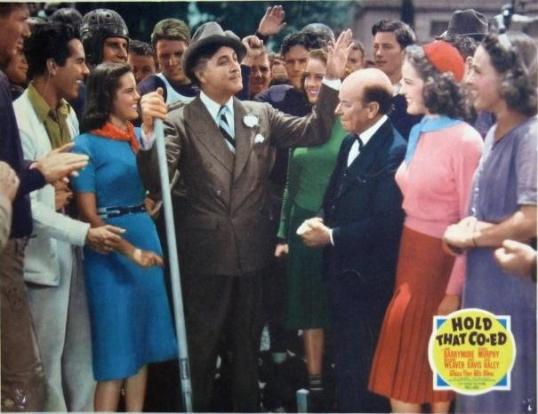
Governor Gabby Harrigan (John Barrymore) in Hold That Co-Ed
 Through the Shattered Lens