Film Review: Old Boyfriends (dir by Joan Tewkesbury)


In 1979’s Old Boyfriends, Talia Shire plays Dianne Cruise.

A sociology professor (or so she claims at one point), Dianne is struggling with an unhappy marriage and trying to recover from a recent breakdown.  After deliberately crashing her car, she leaves her husband and goes on a trip across the country.  She sets out to track down three ex-boyfriends.

Jeff Turrin (Richard Jordan) was her college boyfriend, the one who asked her to marry him three times.  Jeff is now working as a director.  When we first see him, he’s shooting a commercial for a political campaign in which Sam the Fisherman (Gerrit Graham) complains that the current governor of Colorado is a “long-hair” who gets in the way of small businessmen like himself.  Dianne shows up on the set.  Sam hits on her.  Interestingly, it takes Jeff a while before he recognizes her.  (Jeff comments that Dianne used to have longer hair but still, it seems like Jeff should be able to recognize someone to whom he proposed marriage three times.)

After having an affair with Jeff, who is in the process of getting a divorce, Dianne tracks down Eric Katz (John Belushi), the aspiring musician who humiliated her in middle school by telling everyone that she was “easy.”  Eric owns a formal wear store and he still performs with his band. (Belushi sings the Hell out of Jailhouse Rock at one point.)  He mostly performs at proms.  As he explains it to Dianne, most of his customers are teenagers looking for prom outfits so it only makes sense that he should perform for them as well as dress them.

Dianne’s third old boyfriend is Louis Van Til but, when Dianne arrives at his home, she is told that Louis died in Vietnam.  Under the watchful eye of his mother (Bethel Leslie) and his psychiatrist (John Houseman), she starts an obviously doomed relationship with Louis’s sensitive younger brother, Wayne (Keith Carradine).

While Dianne travels around the country, Jeff continues to look for her.  He even hires a private detective named Art Kopple (Buck Henry).

Old Boyfriends is a film that I had been meaning to watch for a while.  (I first read about it in a biography of John Belushi.)  A lot of talent went into making the film.  The script is by Paul and Leonard Schrader.  Director Joan Tewkesbury wrote the script for Robert Altman’s Nashville and indeed, there is an Altmanesque feel to the loose way that the film’s story unfolds.  The cast is full of talented people.  This was John Belushi’s first film after Animal House and Talia Shire’s first after Rocky.  With all that talent, you would think that the end result would be more interesting than it actually is.  The story is intriguing.  The cast is impressive.  But Old Boyfriends falls flat.

Why doesn’t the film work?  A lot of it is due to Tewkesbury’s direction.  She struggles with the film’s frequent shifts in tone and she always seems to be keeping a certain distance from the characters.  Talia Shire is in nearly every scene but the film seems to be determined to just observe her as opposed to actually allowing the viewer to get into her head.  Shire herself never seem to be particularly comfortable with the role and, as a result, none of her visits with her old boyfriends carry much of an emotional impact.  (Unfortunately, they don’t carry much of an intellectual impact either.)  Jordan, Belushi, and Carradine all give good performances but the film itself doesn’t seem to be sure what it wants to say about any of them.

It’s a disappointing film.  It’s not awful but, while watching it, it’s hard not to think about how much better it could have been.  One gets the feeling that Robert Altman, with his eye for quirky detail and his skill with improvisation, could have gotten something worthwhile out of the material.  As it is, Old Boyfriends is an intriguing idea that doesn’t quite work.
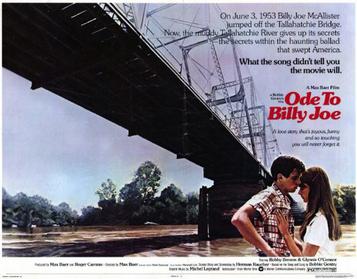
Film Review: Ode to Billy Joe (dir by Max Baer, Jr.)


Why, on June 3rd, did Billie Joe McAllister jump off of the Tallahatchie Bridge in Mississippi?

That was the question that was asked in Ode to Billie Joe, a 1967 country song by Bobbie Gentry.  In the song, the details were deliberately left inconclusive.  Why did Billie Joe commit suicide?  No one knows.  All they know is that he was a good worker at the sawmill and, the weekend before jumping, he was seen standing on the bridge with a teenage girl and apparently, they dropped something down into the river below.  The song suggests that the girl and the narrator are one in the same but even that is left somewhat vague.

Ode to Billie Joe was a hit when it was first released, largely because it’s story could be interpreted in so many different ways.  Why did Billie Joe kill himself?  Maybe it was because he didn’t want to be drafted.  Maybe it was because he and his girlfriend had killed their baby and tossed it off the bridge.  Maybe it was because he was hooked on Dexedrine and his doctor wasn’t available to renew his prescription.  It could be any reason that you wanted it to be.

However, in 1976, when Ode to Billie Joe was turned into a movie, ambiguity would not do.  As opposed to the song, Ode To Billy Joe had to answer the question as to why Billy Joe jumped into that river.  In the movie, 18 year-old Billy Joe (Robby Benson) works at the sawmill and spends his time courting 15 year-old Bobbie Lee Hartley (Glynnis O’Connor).  Bobbie Lee’s father (Sandy McPeak) says that she’s too young to have a “gentleman caller,” even though Bobbie Lee insists that she’s “15 going on 34 … B cup!”  Bobbie Lee warns Billy Joe that her father is liable to shoot his ears off but Billy Joe insists that he doesn’t need ears because he’s in love with her.  That’s kind of a sweet sentiment, even though I don’t think Billy Joe would look that good without ears.

(Whenever I complain about how Southerners in the movies always seem to have two first names, my sister Erin replies, “Yeah, that’s really annoying, Lisa Marie.”  So, I won’t make a big deal about it this time…)

One night, Billy Joe and his friends go out and Billy Joe ends up getting drunk.  He disappears for several days and when he shows up again, something has definitely changed.  After unsuccessfully trying to make love to Bobbie Lee, Billy Joe tells her what happened that night he got drunk.  Billy Joe had sex with a man, something that he has been raised to view as being the ultimate sin.  When Billy Joe is later pulled out of the river, the entire town wonders why he jumped off the bridge and how Bobbie Lee was involved…

Ode to Billy Joe, which aired last Tuesday on TCM, is a better-than-average film, one that I was surprised to have never come across in the past.  That doesn’t mean that it’s a perfect movie. Robby Benson, in the role of Billy Joe, gives an absolutely terrible performance.  You can tell that Benson was trying really hard to do a good job but, often, he goes totally overboard, making scenes that should be poignant feel melodramatic.  Though it probably has more to do with when the film was made than anything else, the film is also vague about Billy Joe’s sexuality.  Is Billy Joe in denial about his identity?  Is he deeply closeted or was he in such a drunken stupor that he was taken advantage of?  Ode to Billy Joe does not seem to be sure.  By committing suicide, Billy Joe joins the ranks of gay movie characters who would rather die than accept their sexuality.  Obviously, he had to jump off that bridge because that’s what the song said he did but there’s a part of me that wishes the movie had featured someone commenting that they never actually found Billy Joe’s body and then the final scene could have taken place 16 years later, with Bobbie Lee living as a hippie in San Francisco and just happening to spot Billy Joe walking down the street, hand-in-hand with his boyfriend.

Here’s what does work about the movie.  Glynnis O’Connor gives a great and empathetic performance as Bobbie Lee.  The scenes with her father and her mother (played by Joan Hotchkis) have a very poignant and wonderful realness to them.  Though I’ll always be a city girl at heart (well, okay — a suburb girl), I spent some time in the country when I was growing up.  And while I was never quite as isolated as Bobbie Lee (who lives in a house with no electricity or plumbing) and the film took place in the past, I could still relate to many of Bobbie Lee’s experiences.  The film may have been made in 1976 and set in 1952 but life in the country hasn’t changed that much.

For instance, there’s this great scene where Bobbie Lee’s father is trying to drive across the bridge.  The only problem is that there’s a bunch of drunk shitkickers on the bridge, sitting in their pickup truck and blocking his way.  It’s a very tense scene, one that I found difficult to watch because, when I was growing up in Arkansas, Oklahoma, Louisiana, and South Texas, I saw the exact same thing happen more times than I care to admit.  In the country, no one backs down.  Scenes like that elevated Ode To Billy Joe to being something more than just another movie based on a song.

Finally, there’s a beautiful scene towards the end of the film, between Bobbie Lee and a character played by an actor named James Best.  I won’t spoil the scene but it’s a master class in great acting.  (Best also played one of the sadistic villains in Rolling Thunder, another good 70s film about life and death in the country.)

Though I wasn’t expecting much from it, Ode to Billy Joe was a pleasant surprise.  It’s not perfect but it’s still worth watching.