The Sundance Film Festival is currently underway in Utah. For the next few days, I’ll be taking a look at some of the films that have previously won awards at Sundance.
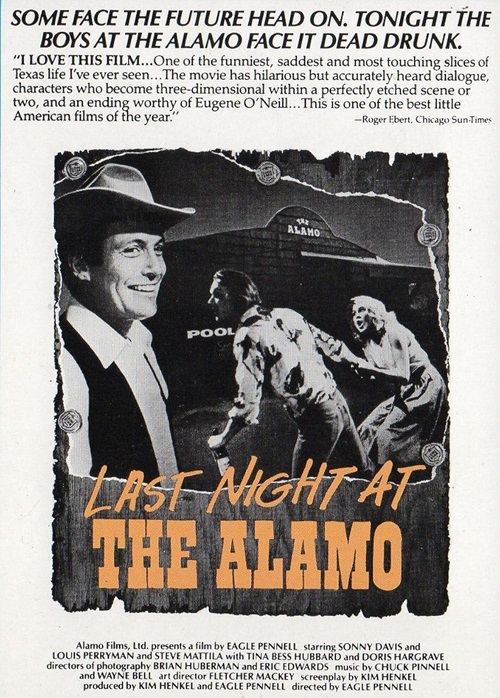
1983’s Last Night At The Alamo is the epitome of an indie film. Filmed in black-and-white and populated with performers who possess a raw authenticity, Last Night of the Alamo takes place over the course of one long day and night.
A seedy Houston bar known as The Alamo is set to close down and the regulars come by for their final drinks. It’s definitely a blue collar bar, a place where the conversations are loud and it seems like there’s always a possibility that a fight could break out at any minute. Claude (Lou Perryman) shows up after getting kicked out by his wife and spends a good deal of the movie yelling and cursing into a telephone. Ichabod (Steve Mattila), a young exterminator, spends almost the entire movie arguing with his girlfriend, Mary (Tina-Bess Hubbard). Steve (J. Michael Hammond) is an adult who still has the personality of a high school bully. For all the arguing and the taunting and the cursing that one hears over the course of the film, it’s also obvious that the regulars at the Alamo have formed a community of sorts. No one is surprised when Claude starts yelling into the telephone. That’s just Claude being Claude and he’s allowed to have his breakdown in peace. As long as he doesn’t interrupt anyone else’s drinking, he’ll be tolerated. It’s a very Texas attitude but then again, Last Night At The Alamo is a very Texas film.
It was written by Kim Henkel, who is probably best-known for writing the screenplay for the original Texas Chainsaw Massacre. (Henkel also appears in the film.) Director Eagle Pennell was one of the pioneers of the Texas film scene, making independent films about life in his home state. (Robert Redford has said that one of the main reasons he started the Sundance Film Festival was because he was impressed with Pennell’s films and wanted to create something that would bring attention to indie filmmakers like Pennell.) Much like many of the characters in Last Night At The Alamo, Pennell struggled with alcoholism and his promising career fizzled out as a result. He died at the age of 49. Legend has it that, shortly before his death, he was seen standing on a Houston streetcorner with a sign asking for either “a rich woman or a warm beer.” Again, it’s a very Texas story.
The majority of the characters in Last Night At The Alamo look up to the bar’s best-known regular, Cowboy Regan (Sonny Carl Davis). Cowboy is handsome and friendly, with a quick smile and a confident manner that makes him stand-out amongst the regulars at the Alamo. He presents himself as being successful and connected and he claims that he has a friend in Austin who is going to save The Alamo from demolition. Deep down, Cowboy is just as desperate as everyone else at the bar but he does a far better job of hiding it. The others look up to him not so much because they believe his stories but because they want to believe them.
It’s an almost plotless film but it does a great job of capturing my home state, with its blue collar culture and its frequent embrace of hucksters like Cowboy. Watching the film, one can see why it’s a favorite of Richard Linklater’s. It’s a melancholy film in many regards. Most of the characters don’t have much going for themselves. But they do have their bar and they have the community that they bult for themselves. The Alamo may be closing but life will continue just as surely as Ichabod and Mary will start and end every day yelling at each other.
Last Night At The Alamo was a prize winner at the 1984 Sundance Film Festival, winning the Dramatic Jury Prize. It can be found, in all of its grainy black-and-white glory, on YouTube.
 Through the Shattered Lens