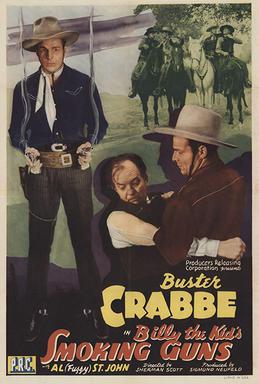
 It’s a tale as old as time. During the days when the west was wild, the U.S. Army is planning on setting up a new outpost near a town so the bad guys want to run all the ranchers off of their land so that they can be the ones to sell it. Sheriff Carson (Ted Adams) is corrupt and working for the bad guys so the ranchers have to turn to Billy the Kid (Buster Crabbe) and his sidekicks, Jeff (Dave O’Brien) and Fuzzy (Al St. John) for help. When Jeff is wounded in a fight, Fuzzy takes him to Doc Hagen (Milton Kibbee), little suspecting the doctor is actually the leader of the bad guys and using his medical practice to kill anyone who won’t give up their land!
Coming to us straight from Poverty Row, this B-western is interesting in that it seems to take a very cynical view of law enforcement. Sheriff Carson is corrupt and Billy and his friends are running from the law themselves. Buster Crabbe’s Billy the Kid films always kept it unclear why Billy was in trouble with the authorities. Crabbe’s Billy the Kid always seemed to be the nicest guy in the west. (Of course, Crabbe was also 33 and no longer seemed like he should have been known as “the Kid.”) Eventually, the series was retconned and Buster Crabbe was no longer playing Billy the Kid but instead he was playing an upstanding citizen named Billy Carson.
Crabbe may not be a convincing outlaw but he is a convincing hero, which is all these films really required. Billy the Kid’s Smoking Guns is a little bit interesting because of the character of Doc Hagen, whose occupation makes him a little more memorable than typical B-western bad guy. The film is also interesting in that, for once, there’s no love interest. Instead, it’s just men in hats shooting at each other. That probably made the film’s youthful target audience happy.
The real-life Billy The Kid was killed when he was only 21 and after he had been an outlaw for only three years. Buster Crabbe would g0 on to play Billy (or o some variation of Billy) until he was closing in on 40.

 Through the Shattered Lens