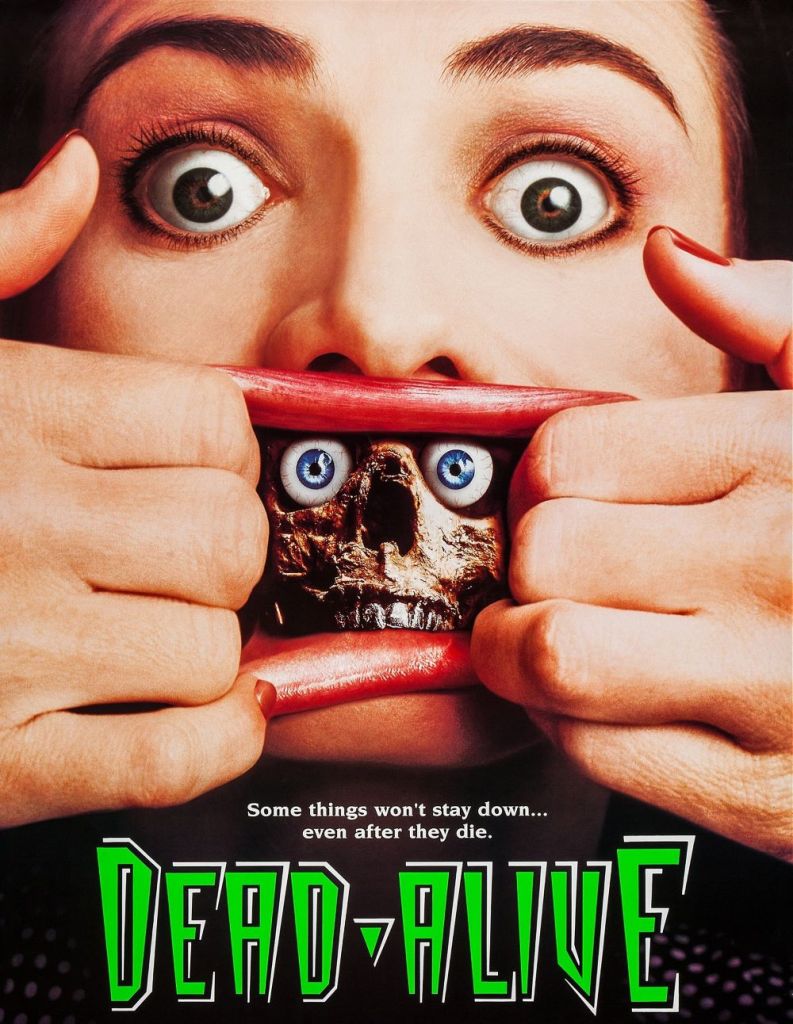
“I kick ass for the Lord!” — Father McGruder
Peter Jackson’s Dead Alive (or Braindead, if you’re fancy about it) is what happens when deranged genius meets a barrel of fake blood and zero self-restraint. It’s equal parts grand guignol and Saturday morning cartoon—one of the bloodiest and funniest films ever made. Long before Jackson became the cinematic architect of The Lord of the Rings, he was a scrappy splatter artist, weaponizing gore and absurdity with childlike glee. And while his first two features, Bad Taste and Meet the Feebles, showcased raw chaos and puppet debauchery, Dead Alive marks his evolution—still insane, but sharpened, confident, and shockingly heartfelt in its bizarre way.
The film opens on Skull Island, that mythic symbol of cinematic imperialism, where bumbling white explorers snatch a grotesque hybrid creature—the infamous Sumatran Rat-Monkey. When one of them is bitten, the native tribesmen panic, shrieking “Singaya! Singaya!” while pointing at the wound. It’s grotesquely hilarious—dark humor rooted in colonial parody. For a few fleeting moments, Jackson seems to flirt with serious themes: the toxicity of imperial arrogance, cultural desecration, and the viral consequences of exploitation. You could easily write a twenty-page graduate thesis connecting this opening to the cannibal panic of 20th-century western adventure cinema. But then the movie rolls into prosthetic carnage and butt jokes, and you realize—thankfully—that Dead Alive is no place for academic solemnity.
The story moves to Wellington, New Zealand, where Lionel Cosgrove (Timothy Balme) lives under the suffocating grip of his passive-aggressive mother, Vera. She’s the kind of matriarch who vacuum-seals her son’s adulthood. When Lionel starts falling for Paquita (Diana Peñalver), a kind-hearted shop girl whose grandmother insists destiny has chosen them, Vera’s jealousy leads her to sabotage the romance—and right into a bite from the cursed Rat-Monkey. That’s when everything turns gleefully revolting.
Vera’s infection transforms her into a dripping monument of decay, devouring neighbors and spewing black sludge at tea parties. Lionel, too timid to kill her, instead tries to sedate and hide the growing zombie horde in his basement. Naturally, this plan collapses with the speed of a B-movie funeral, leading to an escalating chain reaction of undead madness. By the one-hour mark, Jackson isn’t directing a film anymore—he’s conducting a symphony of splatter.
Part of what makes Dead Alive endure is just how expertly it moves between the grotesque and the hilarious. Every melted face and gory evisceration is framed like a punchline. Jackson’s camera zooms, tilts, and spins through crimson chaos with joyous purpose. The gore isn’t meant to horrify; it’s kinetic comedy, pure visual rhythm. By the time Lionel revs up his lawnmower for the film’s final massacre—quite possibly the most ambitious use of landscaping equipment in film history—Dead Alive has transcended genre. It’s no longer horror or comedy. It’s delirium art.
Of course, the cast of oddballs steals plenty of the show. Father McGruder, the kung-fu priest, delivers the film’s single most quoted line—“I kick ass for the Lord!”—before dropkicking zombies with ecclesiastical authority. The zombie baby, born from two reanimated corpses who just couldn’t keep their limbs off each other, is another masterstroke of twisted creativity. Lionel’s attempt to civilize the infant, leading to a playground brawl between man and monster-stroller, might be the most deranged slapstick sequence ever shot.
It’s the tactile nature of Dead Alive that makes it timeless. The production team drenched every set in homemade latex, goo, and fake blood—over 300 liters for the finale alone. No digital shortcuts, just pure craft and chaos. You can see Jackson’s imagination fermenting into the precision that would one day fuel his massive fantasy epics. Every scene here, beneath its slime and slapstick, demonstrates an intuitive cinematic intelligence.
If someone wanted to, they could absolutely load an academic essay with postcolonial readings, Freudian analyses, or references to Julia Kristeva’s theory of abjection—arguing that Vera embodies the grotesque maternal figure polluting the symbolic order. You could apply Deleuze and Guattari, Lacan, or even Foucault if you were persistent (and a little delusional). But Dead Alive doesn’t invite theory—it belly-laughs in the face of it. This isn’t a film to decode; it’s a film to experience, preferably with popcorn and zero pretension. Jackson knows exactly what he’s making and relishes every revolting frame of it.
More than thirty years later, Dead Alive remains the filthiest funhouse in horror history—an outrageous blend of low-budget energy, visual wit, and pure imagination. It might gesture briefly toward colonial rot and unchecked power, but ultimately, this movie isn’t about guilt or grandeur. It’s about having the best possible time making the worst possible mess.
For scholars, it’s a nightmare to analyze. For horror lovers, it’s cinematic nirvana. And somewhere in between all the entrails and laughter, you realize Peter Jackson’s greatest early lesson: sometimes, the most profound statement a film can make is “Relax—it’s just blood.”
 Through the Shattered Lens