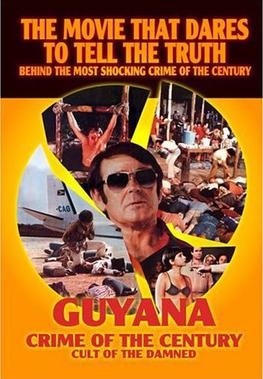
In the late 1970s, the Rev. Jim Jones was a very powerful man.
The leader of the California-based People’s Temple, Rev. Jones had made a name for himself as a civil right activist. As a minister, he made it a point to reach out to the poor and to communities of color. (It was said, largely by Jones, that he had been forced to leave his home state of Indiana by the Ku Klux Klan.) Local politicians eagerly sought not only Jones’s endorsement but also the donations that he could easily raise from the members of the People’s Temple. Though there were rumors that he was more of a cult leader than a traditional preacher, Jones was appointed chairman of the San Francisco Housing Authority. Everyone from Governor Jerry Brown to San Francisco Mayor George Moscone appeared with Jim Jones at campaign events. Among the national figures who regularly corresponded with Jim Jones were First Lady Rosalyn Carter and Vice President Walter Mondale.
Of course, what actually went on behind the closed doors of the People’s Temple was a bit of secret. Jones was a self-proclaimed communist who claimed to have had visions of an upcoming nuclear war between the U.S. and Russia. In his sermons, he often claimed that it would be necessary for both him and the rest of the People’s Temple to eventually leave the United States. Jones spoke of enemies that were trying to destroy him, like the reporters who investigated Jones’s claim of being a faith healer and who followed up on reports that Jones was sexually exploiting both the women and the men who followed him. Jones secretly started to make plans to leave the United States in 1973 but it would be another four years before he and a thousand of his followers arrived in Guyana. The People’s Temple Agricultural Project sat in the jungle, isolated from oversight. It was informally known as Jonestown.
Over the next year, Jonestown did not exactly thrive. Rev. Jones demanded that his people work hard and he also demanded that they spend several hours a day studying socialism and listening to him preach. Jones ran his commune like a dictator, refusing to allow anyone to leave (for their own safety, of course). Anyone who questioned him was accused of being an agent of the CIA. In the U.S, the families of Jonestown’s citizens became concerned and started to petition the government to do something about what was happening in Guyana. A few people who did manage to escape from Jonestown told stories of forced labor, suicide drills, rape, and torture. The People’s Temple claimed that those people were all lying and, because Jones still had his government connections, he was largely left alone.
Finally, in 1978, Congressman Leo Ryan, a Democrat who had a history of opposing the political establishment, flew down to Guyana so that he could see Jonestown for himself and also bring back anyone who wanted to leave. Despite the efforts of Jones to disguise the truth about life in Jonestown, several people did ask to leave the colony with Rep. Ryan. Jones sent his most loyal men to meet and open fire on Rep. Ryan’s entourage at a nearby airstrip. Rep. Ryan and four others were shot and killed, making Ryan the first Congressman to be assassinated since 1868. Nine others, including future Rep. Jackie Speier, were wounded in the attack.
Back at Jonestown, Jim Jones announced that his prophecy was coming true and that the imperialists would soon descend on Jonestown. Though 85 of Jones’s followers managed to escape into the jungle, the other 909 residents of Jonestown subsequently died. Though some showed signs of having been murdered by Jones’s followers, the majority committed suicide by drinking poisoned Flavor-Aid. Jim Jones shot himself in the head.
The world was horrified and the term “drinking the Kool-Aid” entered the discourse. And, of course, many filmmakers were inspired by the horrific events that happened in Jonestown. Ivan Rassimov, for instance, played a Jim Jones-style cult leader in Umberto Lenzi’s Eaten Alive. Meanwhile, Powers Boothe would win an Emmy for playing Jim Jones in a 1980 television miniseries called Guyana Tragedy.
Guyana Tragedy is often described as being the definitive film about Jim Jones. However, a full year before Guyana Tragedy aired, the Mexican director, Rene Cardona Jr., was in theaters with his own version of the Jim Jones story. To anyone who is familiar with Cardona’s style of filmmaking, it’s perhaps not surprising that 1979’s Guyana: Crime of the Century did not win any awards.
Cardona’s film opens with a rather odd title card, explaining that, though the film is based on Jonestown, the names of certain characters “have been changed to protect the innocent.” But if you’re going to start the film by announcing that it’s about the biggest news story of the past year, what’s the point of changing anyone’s name? And for that matter, why is Jim Jones renamed James Johnson and his colony rechristened Johnsontown? Jones was hardly one of the innocents, not to mention that he was dead and in no position to sue when the film came was released. Why is Leo Ryan renamed Lee O’Brien, especially when the film portrays Ryan as being the type of hard-working and honest congressman that anyone would be happy to vote for?
The film opens with Rev. James “Johnson” (played by Stuart Whitman) giving a lengthy sermon about how it’s time for the congregation to move to Guyana, which he describes as being a Socialist paradise. Oddly, in the film, the People’s Temple is portrayed being largely white and upper middle class whereas, in reality, the opposite was true. Indeed, Jones specialized in exploiting communities that were largely marginalized by American society. One reason why Jones’s claim of government persecution was accepted by the members of his church is because the People’s Temple was made up of people who had very legitimate reasons for distrusting the American government.
A few scenes later, Johnson is ruling over “Johnsonville.” Since this is a Cardona film, the viewers are shown several scenes of people being tortured for displeasing Johnson. A child is covered in snakes. Another is shocked with electricity. A teenage boy and girl are forced to kneel naked in front of Johnson as he announce that their punishment for trying to run away is that they will be forced to have sex with someone of Johnson’s choosing. Once the torture and the nudity is out of the way, the film gets around to Congressman O’Brien (Gene Barry) traveling to the Johnsontown. Since the audience already knows what’s going to happen, the film becomes a rather icky game of waiting for O’Brien to announce that he’s ready to go back to the landing strip.
Because the film has been released under several different titles and with several different running times, Guyana: Crime of the Century has gotten a reputation for being one of those films that was supposedly cut up by the censors. I’ve seen the original, uncut 108-minute version of Guyana and I can tell you that there’s nothing particularly shocking about it. Instead, it’s a painfully slow film that doesn’t really offer much insight into how Jim Jones led over 900 people to their deaths. While Gene Barry make for a convincing congressman, Stuart Whitman gives a stiff performance as the Reverend Johnson. There’s very little of the charisma that one would expect from a successful cult leader. One gets the feeling that Whitman largely made the film for the paycheck.
Of course, Whitman was hardly alone in that regard The film features a host of otherwise respectable actors, including Yvonne DeCarlo, Joseph Cotten, John Ireland, Robert DoQui, and Bradford Dillman. As well, Cardona regular Hugo Stiglitz appears as a photographer. (Stiglitz is perhaps best known for starring in Nightmare City and for lending his name to a character in Tarantino’s Inglourious Basterds.) Of the large cast, I appreciated the performances of Cotten and Ireland, who play Johnson’s amoral but well-connected attorneys. (The characters are based on the Temple’s real-life attornes, Charles Garry and Mark Lane. Lane also wrote the first JFK conspiracy book, Rush to Judgment.) I also liked Yvonne DeCarlo’s performance as the most devoted of Johnson’s followers. Even Bradford Dillman’s natural blandness was used to good effect as his character comes to represent the banality of evil when it comes time for him to start administering the Flavor-Aid. But those good performances still can not overcome the film’s slow pace and the fact that the film didn’t bring any new insight to the tragedy.
The film sticks fairly close to what is believed to have actually happened at Jonestown but, in the end, it barely even works as an example of shameless grindhouse filmmaking. It’s not even offensive enough to be enjoyable on a subversive level. Instead, it was just a quick attempt to make some money off of the crime of the century.

 Through the Shattered Lens