October Positivity: The 3 (dir by Chip Rossetti)


You don’t have to be a gun control fanatic to be horrified by the school shootings that seem to be a regular occurrence nowadays.

I mean, the thing with school is that, at a certain age, you’re pretty much forced to be there.  If you skip school, you could potentially get into a lot of trouble and, depending on where you live, your parents could get in a lot of trouble as well.  You’re not really given a choice about going to school so it’s not unreasonable to feel that you should at least be able to go to school without feeling like you’re going to die as a result.  Instead, children are now regularly subjected to active shooter drills and encouraged to snitch on any classmates who seem to be troubled.  Many are expected to start each day stepping through metal detectors while being eyeballed by security guards.  While I support the second amendment, I’m not particularly a huge fan of the idea of teachers being told to come to school armed so they can gun down any potential threats.  (Then again, when we have cops like the cowards in Uvalde, what choice do people have than to arm themselves?)  School shootings are a terrifying thing but what is even more terrifying is that people are starting to get used to type this violence.  It’s no longer an automatic shock to hear that there’s been a shooting at a school.  Often times, the incidents are in and out of the news within days.

2019’s The 3 is a film that deals with the aftermath of a school shooting.  One day, divorced dad Jimmy Collins (Jeff Armstrong) sends his daughter, Brittany (Kate Kilcoyne), out of the house and to school.  He barely even says goodbye to her.  A few hours later, Jimmy gets a call from ex-wife, Susan (Jessica Bell).  Jimmy thinks that Susan is calling to yell at him about a late alimony check but instead, she tells him to turn on the news.  There’s been a shooting at the school and, as we soon learn, Brittany is dead.

After the funeral, Jimmy wants to lock himself away from the world and basically drink himself into unconsciousness.  (He refuses the comfort of the local pastor, despite the fact that the pastor’s wife is played by Tina Wesson, the winner of the second season of Survivor.)  Instead, Jimmy is visited by three spirits.  The first spirit is Jimmy’s Dad (Darryl Worley), who talks about the events that led to him committing suicide and who essentially dares Jimmy to follow the same path.  The third spirit is …. well, he doesn’t give his name but the fact that he’s played by Jefferson Moore, the star of the Perfect Stranger series, should give the audience a clue as to who he is.  And, appearing in between these two, is Brittany.  Brittany talks about her short life and shares memories, both good and bad, with her father.  She also tells her father that he has to let go of her but, of course, neither Jimmy nor Susan can bring themselves to do that.

It’s a well-acted and effective film.  It’s certainly far more sensitive than you might expect from a film directed by the same guy who did Right to Believe.  It’s a film that explores the horror of everyday violence and which makes its theological case without coming across as being overly preachy.  That said, the film cheats a bit at the end, giving Jimmy an opportunity that doesn’t quite seem to go along with the film’s theme.  It allows the film to have a happy ending but it still feels a bit like a cop out.  That said, though, The 3 turned out to be far better than I was expecting.

October Positivity: Nikki and the Perfect Stranger (dir by Jefferson Moore)


The third part of The Perfect Stranger trilogy finds Nikki Comiskey at a crossroads …. again.

The film begins with Nikki (now played by Julianna Allen) recapping how, many years ago, she was a high-profile attorney who, after having dinner with Jesus (Jefferson Moore), decided to ditch her legal career and devote herself to her family.  (Nikki explains that she was a “closet agnostic” before she met Jesus.)  Ten years after having dinner with Nikki, Jesus appeared to Nikki’s teenage daughter, Sarah, and encouraged her to not abandon the faith of her parents.  However, while Sarah is off thriving at college, Nikki feels like her life is in a rut.  Though she still believes, she no longer gets much out of going to church and, once again, her marriage is starting to feel strained.

A visit with her mom doesn’t go well.  Mom wants to know why Nikki had to abandon her legal career.  Nikki gets annoyed and storms out of the house.  She gets in her car and starts to make the long drive home.  She calls her husband and explains what happened.  Her husband informs her that he’s going to busy working on the roof for a bit.  (Hmmm …. I wonder if this seemingly random bit of dialogue is going to come up again towards the end of the film?)  While Nikki is driving home, she sees a familiar figure standing on the side of the road.

Yes, it’s Jesus (though he’s currently going by Josh).

Nikki gives Jesus a ride and they discuss why Nikki is feeling so unsatisfied with her life.  Along the way, they meet a trucker with a porn addiction and they take him to dinner so that Jesus can encourage him to go to rehab.  (At the diner, Nikki tries to order a late night salad.  Needless to say, that doesn’t go well.)  Finally, Nikki gets a chance to help out a minister named Tony (Matt Wallace), who is a character in another film that Jefferson Moore made in which he played Jesus.

(In fact, I discovered that Moore also starred in a TV series called The Stranger, which was a spin-off of The Perfect Stranger films.  So really, there’s an entire Perfect Stranger cinematic universe out there.)

My main impression of Nikki and the Perfect Stranger is that it was surprisingly short.  With a running time of 63 minutes, it definitely felt more like an extra long episode of an anthology show than an actual movie.  That said, Nikki and the Perfect Stranger doesn’t feel as preachy as the previous Perfect Stranger films.  I imagine that’s because the previous two films featured Jesus “educating” an agnostic while this third one features Jesus checking up on an old friend and giving advice.  Since he’s a bit less condescending and argumentative in this film, Jefferson Moore is far more likable here than he was in the previous films.  As opposed to some of the films that I’ve watched this month, the emphasis is more on helping than on judging.  (I can only imagine the tortures to which the Christianos would have subjected that trucker.)  By the time the end credits roll, Nikki’s story has been efficiently wrapped up.

October Positivity: Another Perfect Stranger (dir by Jefferson Moore and Shane Sooter)


Ten years after Nikki Cominskey had the world’s most awkward dinner date with Jesus (played by Jefferson Moore), Nikki’s daughter is flying to Portland.

Having just graduated from high school, Sarah (Ruby Lewis) wants to attend an exclusive art school but she fears that she may not get the scholarship that she would need.  If that wasn’t stressful enough, she’s also not getting along with her parents.  She never thought that her mom and dad were actually seriously about all that church stuff but it turns out that they were and now they are scandalized to discover that Sarah doesn’t even consider herself to be a believer!  The night before Sarah’s trip, Nikki sat her daughter down and told her about the night that she had dinner with Jesus.  Now, Sarah is worried that her mother has lost her mind.

Because Sarah is flying the least efficient airline in existence, there’s a layover in Dallas on the way to Portland.  That leaves Sarah a lot of time to get to know the man who is sitting next to her on the airplane.  His name is Yesh and he says that he comes from a small town in the east.  He also says that he’s a counselor and that he works with his father.  When Sarah asks what Yesh’s father does, Yesh says that it’s not easy to explain but that his father has a lot of responsibility.  He’s in charge of many things.  Sarah thinks that Yesh is a friendly stranger but, since he’s played by Jefferson Moore, the audience knows who he actually is.

Yesh and Sarah discuss religion.  Sarah says she hates religion.  Yesh says that he agrees, because people have twisted religion to satisfy their own base desires.  Sarah says that she can’t understand her parents.  Yesh says that her parents love her just as his father loves everyone.  Sarah says that she wants to be an artist.  Yesh tells her to be sure not to fall asleep during art history class.  (Hold on, Yesh!  I majored in art history!  Art history rocks!)  Sarah assumes that Yesh is an atheist and gets a little annoyed when Yesh reveals that he’s actually not.  Yesh reads her a poem and explains that it was written by his father and that it’s in the Bible.  Sarah is amazed because she thought the Bible was just full of rules.  She doesn’t seem to notice that Yesh said that his father wrote the Bible but that’s because Sarah doesn’t really come across as being that smart.

You can pretty much guess where all of this leading.  With the exception of one surprisingly well-handled scene in which Sarah discusses the trauma that turned her away from religion, Another Perfect Stranger follows the same storyline as The Perfect Stranger.  The main difference is that Sarah is a teenager and the conversation takes place on a plane instead of at a restaurant.  Once again, Yesh wins every argument because the screenwriter is on his side and Sarah is incapable of coming up with any counterpoints that aren’t easily dismissed.  Unfortunately, this film is also 20 minutes longer than The Perfect Stranger and pace is much slower.  The majority of Sarah’s dialogue sounds like it was written by a computer program designed to basically approximate the speaking habits of someone under the age of 30.  On the plus side, Sarah is not quite as humiliated by Jesus as her mother was.

This was followed by one more Perfect Stranger film, which was only 61 minutes long and which I’ll take a look at tomorrow.

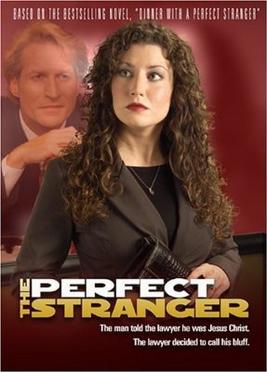
October Positivity: The Perfect Stranger (dir by Jefferson Moore and Shane Sooter)


The 2005 film, The Perfect Stranger, opens with Nikki Cominsky (Pamela Brumley) feeling very stressed and underappreciated.

She’s an attorney and she really should be heading off for work but first, she has to make her daughter’s school lunch.  (Her daughter is not extremely appreciative.)  Meanwhile, her husband has just informed her that he’s canceling their date night because he has to go to a baseball game with a client!  Nikki was so looking forward to going to a nice restaurant.  Finally, to top all off, the neighbors are religious and they keep inviting Nikki to church.  Argggh!  The frustration!

Nikki gets to work and the aggravation continues.  Her administrative assistant calls her “Mrs. Cominskey,” making Nikki feel old.  (“Mrs. Cominskey is my mother-in-law!” Nikki snaps.)  Plus, there’s a weird note on Nikki’s desk.  The note is inviting her to dinner and it is signed Jesus.  At first, Nikki is convinced that her neighbors somehow broke into the office and left the note on her desk.  But then she realizes how weird that sounds.  Instead, she decides that the note is from her husband.  Obviously, he canceled his plans and they’re going to go out to dinner.  Yay!  But why would her husband sign the letter as Jesus?  “He must be joking,” Nikki says, with a laugh.  Okay, then.  Everyone has their own sense of humor.

Nikki heads to the restaurant straight after work and discovers …. that her husband is not there.  Her husband went to the baseball game.  Her husband was not playing a joke on her.  He really is the type of insensitive idiot who would break a date with his wife and go to a baseball game with client.  (You deserve better, Nikki!)  However, her neighbors aren’t there either.  Instead, there’s a blonde man (Jefferson Moore) wearing a suit who says that his name is Jesus and he wants to have a conversation with her.  Nikki’s first instinct is to leave but Jesus offers to pay for dinner.  That changes Nikki’s mind and I guess that’s understandable.  A free dinner is a free dinner!

Nikki and Jesus go on to have the most awkward dinner date ever.  Nikki wants to talk about how annoyed she is with her life.  Jesus wants to talk about Heaven.  Nikki complains about religion.  Jesus tells her that her problem is not with religion but with religious people.  Nikki says that she feels like she could get just as much out of being a Hindu or Muslim as she could out of being a Christian.  Jesus laughs at her.  There’s one long stretch of time when we just see Jesus and Nikki talking but we don’t actually hear what they’re saying.  Maybe they’re discussing the food, which does look pretty good.

The Perfect Stranger is an example of a popular sort of faith-based film, one in which Jesus has dinner or coffeewith an unbeliever and basically spends an hour telling them that they’re stupid.  Jesus always has the advantage in these films, largely because the screenwriter is on his side and the non-believers are usually limited to repeating a bunch of clichés about all the bad things in the world.  That’s certainly the case with The Perfect Stranger, in which Nikki is not only an agnostic but also a bit of a flake.  One gets the feeling that many of these films was made less to reach nonbelievers and more to give believers a chance to laugh at the other side.  Then again, consider how negatively most people of faith are portrayed in mainstream films, one could argue that the faith-based film industry is basically looking at Hollywood and yelling, “I learned it from watching you!”

Anyway, the important thing is that Nikki felt better about her life and she got a free dinner.  Good for Nikki.