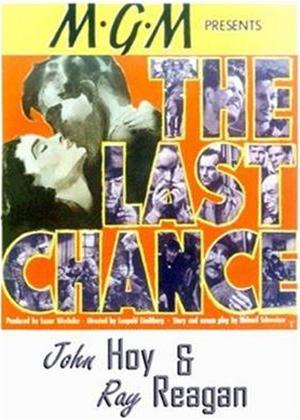
The Fabulous Forties #31: The Last Chance (dir by Leopold Lindtberg)


12022809425545_l

The 31st film in Mill Creek’s Fabulous Forties box set was a 1945 film called The Last Chance.

I have to admit that one reason why I’ve been struggling to finish up the relatively simple task of watching all 50 of the films included in this box set is that a lot of the films just aren’t very good.  Along with suffering from the typically poor Mill Creek transfer, quite a few of the movies are forgettable filler.  You can only watch so many movies like Freckles Comes Home before you start to lose your enthusiasm.

Fortunately, even if most of the films are forgettable, there are still a handful of outstanding productions to be found in the Fabulous Forties.  You just have to have a lot of patience and you have to be willing to look for them.  For instance, if I had given up on the Fabulous Forties after sitting through Drums of Africa, I would never have discovered The Last Chance.

And that would have been a shame because The Last Chance is an excellent film!  It’s certainly the best of the 31 Fabulous Forties films that I’ve watched so far.

Directed by Leopold Lindtberg, an Austrian who fled to Switzerland shortly after the Nazis came to power, The Last Chance tells a deceptively simple story.  Two POWs — an American named Braddock (Ray Reagan) and a British soldier name Halliday (John Hoy) — are being transported across Italy via train.  When the train crashes, Braddock and Halliday escape.  They spend the rest of the film trying to reach Switzerland.  Along the way, they struggle to avoid Nazis, deal with civilians who mostly just want the war to be over, and eventually meet and hook up with the Italian resistance.  (The resistance here is represented by a self-sacrificing priest, who was well-played by real-life refugee named Romano Calo.)  Eventually, the two soldiers meet up with another escaped POW (Ewart G. Morrison) and the three of them lead a group of refugees to the Swiss border.

What distinguishes The Last Chance is its authenticity.  Reagan, Hoy, and Morrison were not professional actors.  Instead, they were real-life soldiers, all of whom had once been POWs and all of whom managed to escape to Switzerland.  What these three actors lacked in polish, they made up for in reality.  When they talked about the risks of trying to reach the Swiss border and the ruthless barbarity of the Axis regime, they knew what they were talking about.  As well, the film was actually shot in Europe during the war.  When we see the three soldiers leading the band of refugees through bombed out villages, we’re not just seeing a bunch of actors on a safe Hollywood sound stage.  Instead, we are watching real-life refugees walking through the ruins of their former home.  Though the story may be fictionalized, Leopold Lindtberg directed the film as if it were a documentary and the result is both a passionate condemnation of fascism and an emotional anti-war piece that remains powerful to this day.

I don’t care how many bad films that I had to sit through (and have left to sit through) as a result of my decision to review all of the movies inside the Fabulous Forties box set.  Discovering a film like The Last Chance makes it all worth it.
http://www.youtube.com/watch?v=S2umn94XT0s

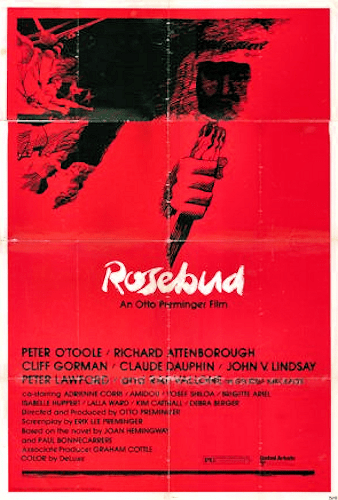
Shattered Politics #37: Rosebud (dir by Otto Preminger)


Rosebud_-_1975_-_Film_Poster

Before I review the 1975 film Rosebud, allow me to tell you about how I first discovered the existence of this particular film.

The greatest used bookstore in the world is located in Denton, Texas.  It’s called Recycled Books and it is three stories of pure literary goodness!  (Plus, there are apartments on the top floor where I attended some pretty interesting parties but that’s another story….)  When I was attending the University of North Texas, I used to stop by Recycled Books nearly every day.  One day, I happened to be searching the Film and TV section when I came across a beat-up paperback called Soon To Be A Major Motion Picture.

This book, which was written by Theodore Gershuny, told the story of how the previously acclaimed director Otto Preminger attempted to make a film about terrorism.  Starting with the attempts of Preminger’s son, Erik Lee Preminger, to come up with a workable script and then going on to detail how Peter O’Toole came to replace Robert Mitchum as the star of the film and ending with the film’s disastrous release, Soon To Be A Major Motion Picture proved to be a fascinating read.

After finishing the book, I simply had to see Rosebud for myself.  Unfortunately, at that time, Rosebud had not yet been released on Blu-ray or DVD.  So, I actually ended up ordering an old VHS copy of it.  The tape that I got was not in the best condition but it played well enough and I can now say that, unlike the majority of people in the world, I’ve actually seen Rosebud!

Which is not to say that Rosebud is any good.  It’s not the disaster that I had been led to expect.  In fact, it probably would have been more fun if it had been a disaster, as opposed to being just a forgettable film from a director who was probably capable of better.  Preminger started his career in the 30s and was considered, at one point, to be quite innovative.  He directed Laura and Anatomy of a Murder, two great films.  Unfortunately, there’s really nothing innovative about his direction of Rosebud.  In Gershuny’s book, Preminger comes across like an intelligent and thoughtful man who was too set in his ways to realize that what was shocking in 1959 was no longer that big of a deal in 1975.  (And, needless to say, it’s even less of a big deal in 2015.)

As for what Rosebud‘s about, it’s about a man named Sloat (Richard Attenborough), a former journalist who now lives in a cave in Israel and dreams of establishing a worldwide terrorist network.  Under Sloat’s direction, terrorists storm a yacht named the Rosebud and take the girls on board hostage.  The girls are wealthy and privileged.  Their fathers are judges, senators, and businessmen.  CIA agent Larry Martin (Peter O’Toole) is tasked with tracking down and rescuing the girls.  If it sounds like an action film — well, it’s not.  This is not a prequel to Taken.  Instead, it’s a very talky film that has a few isolated good moments and performances but otherwise, is fairly forgettable.

That said, the film does have an interesting cast.  Peter O’Toole seems bored by his role (and who can blame him?) but Attenborough briefly livens things up in the role of Sloat.  As for the girls being held hostage, they’re not given much to do.  One of them is played by a young Isabelle Huppert.  Long before she would play Samantha on Sex and the City, Kim Cattrall plays a hostage here.  The English hostage is played by Lalla Ward, who is now married to Richard Dawkins.

And then there’s the girl’s parents, who are played by an odd assortment of character actors.  Raf Vallone, an Italian, plays a Greek.  (His daughter, meanwhile, is played by the French Isabelle Huppert.)  Peter Lawford, looking somewhat dazed, shows up as Lalla Ward’s father.  (One of the sadder scenes in Gershuny’s book deals with Lawford’s attempts to remember his lines.)  And than, in the role of Cattrall’s father, we have a very distinguished looking man named John Lindsay.

John Lindsay was the former mayor of New York City, a man who ran for President in 1972 and, three years later, attempted to launch a new career as an actor.  Rosebud was his both his first and final film.  (Rumor has it that Martin Scorsese attempted to convince Lindsay to play Senator Palatine in Taxi Driver but Lindsay turned the role down.)  Lindsay is not particularly memorable in Rosebud.  It’s not so much that Lindsay gives a bad performance as much as it’s just the fact that he has a very bland screen presence.  That blandness probably served him well as a politician but, as an actor — well, let’s just say that John Lindsay was apparently no Fred Thompson.

And so that’s Rosebud.  It’s a film that, much like Maidstone, you can only appreciate if you know what went on behind the scenes.  I can’t really recommend Rosebud but, if you ever come across a battered old copy of Soon To Be A Major Motion Picture in a used bookstore, be sure to buy it!

Seriously, you will not be sorry.