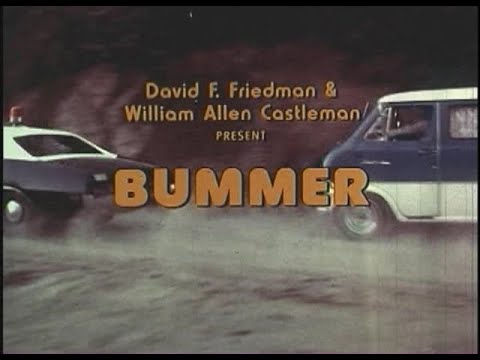
The TSL Grindhouse: Bummer (dir by William Alan Castleman)


The 1973 film Bummer tells the story of a California rock band known as The Group.

The Group plays groovy music with a mellow feel.  The music they play doesn’t sound so much like actual 70s California rock as much as it sounds like what someone from the big band era would have assumed mellow 70s California rock sounded like.  The Group is led by the charismatic Duke (Kipp Whitman).  The lead guitarist and the drummer look like groovy dudes as well.  But then there’s Butts (played by the great character actor, Dennis Burkley), the bass player.  Butts is a big fat slop with a beard, unwashed hair, and a genuine aura of grime.  Duke’s girlfriend tells Duke that he really should kick Butts out of the band.  The problem is that Duke owns the van that the Group travels around in.  It’s the type of 70s van that was probably nicknamed “The Second Base Mobile.”

Well, Duke really should have considered kicking Butts out of the band because it turns out that Butts is crazy.  He’s a sociopath with a mother fixation and, when he realizes that he’s the only member of the band who isn’t getting laid on a regular basis, he goes crazy and starts assaulting and murdering groupies.

It’s a bummer!

This film was produced by David Friedman, the genial sexploitation producer who is best-known for his collaborations with Herschell Gordon Lewis.  Lewis did not direct Bummer and I have to say that I was a little bit surprised to discover that because there’s a scene at a strip club that goes on for so long and which features so many pointless close-ups of pervy men staring up at the dancers that I immediately assumed that Lewis must have, at the very least, snuck onto the set and supervised it.  Instead, the film was directed by William Allen Castleman, who also did directed Johnny Firecloud and The Erotic Adventures of Zorro.  So be it.  I’m still convinced that Lewis has something to do with this movie.

Bummer is one of those films about how wasteful the younger generation is, with their mellow rock music and their bongs and their groupies.  The film’s main message seems to be that anyone under the age of 30 is intellectually vapid and spiritually empty but at least they look good without their clothes on.  It’s a mix of exploitation and nostalgia.  “You know who didn’t murder groupies?” the film seems to be saying, “Glenn Miller, that’s who.”

The film is pretty dull.  Scenes drag.  It takes forever for any sort of plot to develop.  Most of the cast is forgettable but Dennis Burkley makes an impression as the unhinged bass player and watching him in this, it’s easy to understand why be became such a busy character actor.  There’s an authentic edge to Burkley, one that comes through even in this film.  One of the groupies is played by Carol Speed, who would later appear in Disco Godfather and warn people about the dangers of “whack attack.”  Oddly enough, the film looks surprisingly good.  Cinematographer Gary Graver worked on films like this in between working on Orson Welles’s The Other Side Of The Wind.

In the end, Bummer lives up to its title.
Horror on TV: Twilight Zone 3.12 “The Jungle”


TheTwilightZoneLogo

Along with starting each day of October with a horror film here at the Shattered Lens, we’re going to end each day with a horror-themed television show.

While I had previously caught a few episodes of the Twilight Zone during one of the annual holiday marathons on SyFy, I didn’t truly appreciate the show until I first exchanged e-mails with my friend in Australia, Mark. Among other things, Mark expressed a very eloquent appreciation for The Twilight Zone and that inspired me to watch quite a few episodes that have been uploaded to YouTube and Hulu. Along with being an essential piece of television history, the best episodes of the Twilight Zone remain watchable and entertaining 50 years after they were first broadcast.

Considering the esteemed place that the Twilight Zone continues to occupy in American culture, it seems appropriate to feature it during Horror Month here at the Shattered Lens.

The Jungle, which first aired on December 1st, 1961, is a personal favorite of mine. A businessman returns to New York from Africa. While in Africa, he upset a local witch doctor. Though the businessman, at first, laughs off the possibility that he may be cursed, it soon turns out that he’s wrong. There’s a lesson to this episode and here it is: Don’t piss off a witch doctor.

When I first saw this episode, the final scene caused me to have nightmares!

(By the way, I’m embedding this episode from Hulu. Sadly, you will have to deal with commercials. However, it’s really a great episode!)

(It has also come to my attention that some browsers do not work with embedded Hulu vidoes.  Seriously, the internet is so frustrating!  If the embedded video is not appearing on your browser, you should be able to watch this episode on Hulu.  Here’s the link — http://www.hulu.com/watch/440777.  I apologize for the inconvenience but still, it is a really good episode!)

Netflix Noir #3: Crime of Passion (dir by Gerd Oswald)


CrimepassionPosterThe third Netflix Noir that I watched was 1957’s Crime of Passion.

In Crime of Passion, Barbara Stanwyck plays Kathy Ferguson, a San Francisco-based advice columnist.  She is approached by two homicide detectives who request her help tracking down a fugitive who they think might read her column.  Charlie (Royal Dano) is aggressive and outspoken.  When he first meets Kathy, he tells her, “You’re work should be raising a family and having dinner ready when your husband comes home from work.”  His far more passive partner is Detective Bill Doyle (Sterling Hayden).

Kathy writes a column that convinces the fugitive to turn herself in.  (The power of Kathy’s column is shown in an amusing montage where woman after woman is seen reading the column aloud.  Significantly, no men are seen to ever read anything that Kathy has written.)  The resulting fame leads to Kathy getting a job offer in New York.

However, before Kathy can leave, she gets a phone call from Bill.  He asks her out on a date and, one scene later, they’re getting married in the shabby office of a justice of the peace.  Kathy sacrifices her career to be a suburban housewife.

From the minute that Kathy first looks at the small and anonymous house and the boring neighborhood that she’ll be sharing with Bill, it’s obvious that things are not going to work out well.  Even though Kathy even tells Bill, “I hope all your socks have holes in them and I can sit for hours darning them,” the life of domestic servitude is not for her.

Every day, she stays home while Bill goes to work.  At night, she reluctantly plays hostess to the constant gatherings of Bill’s colleagues and their wives.  The women stay in one room while the man gather in another.  Kathy is quickly bored with the inane chattering of the other wives but whenever she tries to go into the other room, she finds herself treated like an unwanted intruder.

And worst of all is the fact that Bill has absolutely no ambition of his own.  He’s got his house.  He’s got his wife.  He’s got his friends.  And he doesn’t feel that he needs anything else.

Kathy takes it into her own hands to advance Bill’s career, first by having an affair with Bill’s boss (Raymond Burr) and finally by trying to find a spectacular crime that Bill can solve.  And, as the suburbs continue to drive her mad, Kathy is not above creating a few crimes on her own…

In many ways, Crime of Passion reminds of another 50s film, Nicholas Ray’s Bigger Than Life.  Both films use the conventions of melodrama to present a surprisingly subversive look at the horrors of suburban conformity.  Unfortunately, Crime of Passion never quite reaches the heights of Bigger Than Life, largely because Sterling Hayden gives such a dull performance as Bill that you never believe that Kathy would have married him in the first place.  (The film would have been far more impressive if Bill had started out as an apparently dynamic character whose dullness was then revealed after Kathy married him.)  However, Barbara Stanwyck is well-cast as Kathy and Raymond Burr plays up his character’s ambiguous morality.  If nothing else, Crime of Passion is one of those film to show anyone who is convinced that nothing subversive was produced in the 1950s.

Horror on TV: Twilight Zone 4.4 “He’s Alive”


TheTwilightZoneLogo

Tonight’s episode of the Twilight Zone was originally broadcast on January 24th, 1963 and it’s one of the rare hour-long episodes of the original Twilight Zone. In He’s Alive, a very young Dennis Hopper plays Peter Vollmer, an aspiring Neo-Nazi who isn’t having much luck bringing fascism to America until he meets a mysterious benefactor who teaches him the tricks of the trade.

It’s a pretty good (if heavy-handed) episode, distinguished by both Dennis Hopper’s lead performance and a message that is probably even more relevant today than when the show was first broadcast.

This episode was written by Rod Serling and directed by Stuart Rosenberg.

Horror on The Lens: Grave of the Vampire


In this 1972 film (which was reportedly made for $50,000), exploitation vet William Smith plays James Eastman, a young man who just happens to be half-vampire and who has dedicated his life to tracking down and destroying his father.  And who is his father?  None other than serial killer-turned-bloodsucker Caleb Croft (Michael Pataki) who is now teaching a course down at the local college!  What choice does James have but to enroll in his father’s class and then make plans to destroy him?

While it’s pretty obvious that Grave of the Vampire was made for next to no money, it’s still got a few atmospheric scenes.  While the film really doesn’t do as much as one might hope with the whole idea of James between half-vampire and half-human, it’s still worth seeing for Michael Pataki’s performance.  He is one intimidating vampire!

http://www.youtube.com/watch?v=TX4Aa0Ajs8M