Unlike just about everyone else that I know, I am about as apolitical as you can get.
Oh, don’t get me wrong. I always vote. I believe in …. stuff. Occasionally, I get angry about the state of the world. Why I’ll have you know that when I first registered to vote, I was really, really excited and I even sat down and researched every single person who was running for President. (And, of course, I decided I would support John Edwards because he had good hair. But then I changed my mind and ended up voting for Charles Jay, the candidate of the Personal Choice Party.) But, for whatever reason, current events have never become the obsession for me that they are for some people. You’ll never catch me posting a political meme or sagely agreeing with an activist on Facebook. It’s just not for me.
(On the plus side, this has allowed me to have friends with many diverse viewpoints and generally lead a happy life.)
At the same time, I’m also fascinated by history and history is often the story of politics and politicians. As a result, I’m far more interested in past affairs than I am in current affairs. I can spend hours talking about the election of 1876 but I could hardly care less who is elected in 2016. I know my political history well enough not to worry about the political present.
Perhaps that explains why, despite my indifference to politics, I tend to enjoy political movies. And that leads us to my latest review series here at the Shattered Lens. Over the next two weeks, I will be reviewing, in chronological order, 94 films about politics and politicians. It’s a little something I call Shattered Politics.
(For some previous examples of what I mean by review series, check out Lisa’s Homestate Reviews, Lisa Goes Back To College, Netflix Noir, 44 Days of Paranoia, Embracing the Melodrama, Back To School, and, of course, Lisa’s Marie’s Favorite Grindhouse and Exploitation Film Trailers!)
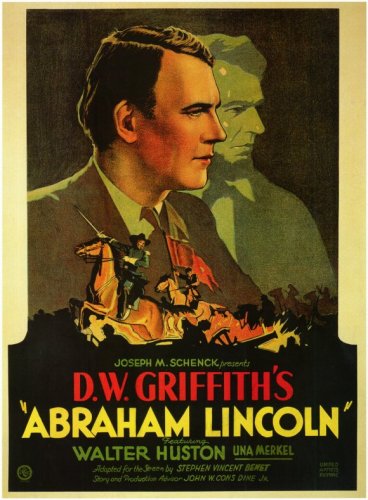
We start things off with a film from 1930. One of only two sounds films to be directed by cinematic pioneer D.W. Griffith, Abraham Lincoln is — as you might guess from the title — a 90 minute biopic about the 16th President of the United States. It tells the same basic story as Lincoln, just in a lot less time and with Walter Huston playing the title role. The film opens in 1809 with his birth then speeds forward to detail his tragic love affair with Ann Rutledge (played by Una Merkel) and his subsequent marriage to Mary Todd (Kay Hammond). We get a snippet of the Lincoln-Douglas debates and then, just as quickly, Abe is President, the country plunges into civil war, and an alcoholic actor named John Wilkes Booth (Ian Keith) is meeting with disreputable looking men in a shadowy bar and making shadowy plans.
Any honest review of this version of Lincoln’s life needs to deal with the obvious. Abraham Lincoln was released 84 years ago, at a time when the film industry was still struggling to make the transition from silent to sound film. In other words, the film is stiff, stagey, and full of actors who alternate between shouting their dialogue and delivering their lines through nervously clinched teeth. This is essentially a silent film — complete with overdramatic title cards and heavy-handed symbolism — that just happens to feature some very awkwardly delivered dialogue. Walter Huston is occasionally effective as Lincoln but, just as often, he’s not.
However, Abraham Lincoln is fascinating to watch from a historical point of view. It helps if you know a little something about director D.W. Griffith. Almost all of the narrative techniques that we now take for granted were originally introduced to cinema by D.W. Griffith and many of them were introduced in his controversial 1915 epic, The Birth of a Nation.
Of course, Griffith’s legacy is problematic precisely because of The Birth of a Nation. An epic look at the Civil War, Birth not only featured white actors in black face menacing Lillian Gish but also ended with the Ku Klux Klan heroically riding to the rescue. That even viewers in 1915 were critical of the film’s racism and overly pro-Confederate sentiments should tell you something about just how extreme the film truly was.
(That said, one huge fan of the film was U.S. President and aspiring dictator Woodrow Wilson.)
By most accounts, Griffith was stunned by the negative reaction to The Birth of a Nation and several of his subsequent films (most famously, Intolerance) were meant to answer his critics.
That’s what makes the opening scenes of Abraham Lincoln all the more interesting. The film opens in 1809 with a shot of a ship on the ocean. We catch a glimpse of the Africans chained in the lower decks. Two white slave traders are seen carrying a dead body to the side of the ship and tossing it overboard.
We cut to Virginia, where we see a group of slave owners complaining about how the North is harming them financially by trying to end the slave trade. One of the men says that the only man who could have kept the north and south united is dead. The camera pans up to a picture of George Washington.
Then, the scene cuts to Boston. A group of northerners sit around a table and talk about how slavery is harming the north economically and therefore, it has to end. One of the northerners says that the only man who could have kept north and south united is dead. Again, the camera pans up to a picture of George Washington.
And, it’s a wonderfully effective sequence, one that not only reveals the economic reasons behind most wars but one which also reveals the cruelty, inhumanity, and pure evil of slavery. (That said, when the film later shows us a glimpse of life in the Confederacy, Griffith does include a couple of slaves cheerfully dancing in the background.)
And, as awkward as the scenes involving dialogue are (the less said about the scenes between Walter Huston and Una Merkel, the better), Griffith does occasionally show the visual flair that was his trademark. One excellent sequence involves soldier after soldier lining up, one after the other and each of them staring straight into the camera as they prepare to go to war. When the film concentrates on scenes of men marching across the countryside, it actually works.
Then again, you may just want to see the film for the chance to hear one extra, when asked the identity of a man giving a fiery speech, awkwardly explain, “That’s the actor, John Wilkes Booth. Not much of an actor but he’s got a way with the ladies!”
It’s really up to you.
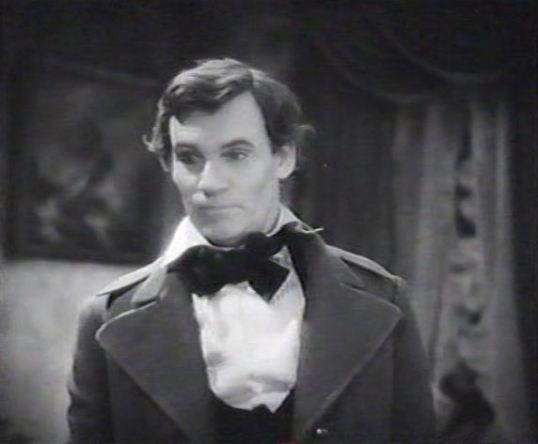
Walter Huston as Abraham Lincoln
 I watched this movie by accident.
 Through the Shattered Lens